



 Chat with AI
Exam 15: Income Inequality and Poverty

Exam 1: The Economic Approach210 Questions
Exam 2: A: Some Tools of the Economist224 Questions
Exam 2: B: Some Tools of the Economist33 Questions
Exam 3: A: Supply, Demand, and the Market Process225 Questions
Exam 3: B: Supply, Demand, and the Market Process180 Questions
Exam 4: A: Supply and Demand: Applications and Extensions233 Questions
Exam 4: B: Supply and Demand: Applications and Extensions98 Questions
Exam 5: Difficult Cases for the Market and the Role of Government168 Questions
Exam 6: The Economics of Collective Decision-Making180 Questions
Exam 7: Consumer Choice and Elasticity223 Questions
Exam 8: A: Costs and the Supply of Goods223 Questions
Exam 8: B: Costs and the Supply of Goods8 Questions
Exam 9: A: Price Takers and the Competitive Process237 Questions
Exam 9: B: Price Takers and the Competitive Process23 Questions
Exam 10: Price-Searcher Markets With Low Entry Barriers216 Questions
Exam 11: A: Price-Searcher Markets With High Entry Barriers229 Questions
Exam 11: B: Price-Searcher Markets With High Entry Barriers25 Questions
Exam 12: The Supply of and Demand for Productive Resources200 Questions
Exam 13: Earnings, Productivity, and the Job Market109 Questions
Exam 14: Investment, the Capital Market, and the Wealth of Nations129 Questions
Exam 15: Income Inequality and Poverty136 Questions
Exam 16: Appendix: Government Spending and Taxation79 Questions
Exam 17: Appendix: the Economics of Social Security54 Questions
Exam 18: Appendix: the Stock Market: Its Function, Performance, and Potential As an Investment Opportunity70 Questions
Exam 19: Appendix: Great Debates in Economics: Keynes Versus Hayek8 Questions
Exam 20: Appendix: the Crisis of 2008: Causes and Lessons for the Future64 Questions
Exam 21: Appendix: Lessons From the Great Depression60 Questions
Exam 22: Appendix: the Economics of Healthcare68 Questions
Exam 23: Appendix:education: Problems and Performance60 Questions
Exam 24: Appendix: Earnings Differences Between Men and Women47 Questions
Exam 26: Appendix: the Question of Resource Exhaustion61 Questions
Exam 25: Appendix: Do Labor Unions Increase the Wages of Workers74 Questions
Exam 27: Appendix: Difficult Environmental Cases and the Role of Government63 Questions
Select questions type


According to the official measure of poverty, in 2009 the poverty rate of families in the United States was
(Multiple Choice)
4.9/5  (86)
(86) Figure 15-3
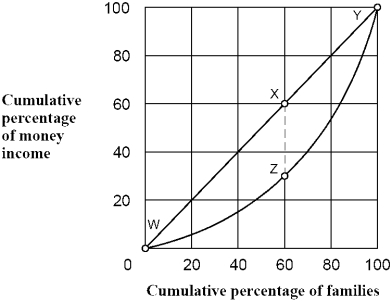 -As shown in Figure 15-3, 40 percent of families earned a cumulative share of about ____ percent of income.
 (Multiple Choice)
4.8/5 (75)
(75) Programs that limit the eligibility of transfer recipients to those with low income are called
(Multiple Choice)
4.9/5 (83)
(83) Assume that Peter is a single parent who is in poverty. He receives food stamps and Medicaid. For every $100 that he earns, Peter loses $35 in food stamps and $20 in Medicaid benefits. Also, Peter's income is taxed at a rate of 10%. Then, Peter's total tax rate is
(Multiple Choice)
4.8/5 (85)
(85) Data on income inequality in the United States indicate that
(Multiple Choice)
4.9/5 (82)
(82) What percent of the families classified as poor in 2009 were headed by an elderly (age 65 and over) person?
(Multiple Choice)
4.9/5 (69)
(69) Analysis of the economic status of poor people reveals that
(Multiple Choice)
4.9/5 (79)
(79) Poor people, who receive income assistance from the government, often do not work because
(Multiple Choice)
4.9/5 (83)
(83) Redistribution through the public sector tends to lower economic prosperity because
(Multiple Choice)
4.9/5 (80)
(80) Data on the distribution of income among individuals and families in the United States indicate that
(Multiple Choice)
4.9/5 (79)
(79) Which of the following would cause the poverty threshold income level for a given family to increase by 20 percent from one year to another?
(Multiple Choice)
4.8/5 (79)
(79) Which one of the following groups has a below-average incidence of poverty?
(Multiple Choice)
4.9/5 (81)
(81) 
Filters
- Essay(0)
- Multiple Choice(0)
- Short Answer(0)
- True False(0)
- Matching(0)