



 Chat with AI
Exam 15: Income Inequality and Poverty

Exam 1: The Economic Approach210 Questions
Exam 2: A: Some Tools of the Economist224 Questions
Exam 2: B: Some Tools of the Economist33 Questions
Exam 3: A: Supply, Demand, and the Market Process225 Questions
Exam 3: B: Supply, Demand, and the Market Process180 Questions
Exam 4: A: Supply and Demand: Applications and Extensions233 Questions
Exam 4: B: Supply and Demand: Applications and Extensions98 Questions
Exam 5: Difficult Cases for the Market and the Role of Government168 Questions
Exam 6: The Economics of Collective Decision-Making180 Questions
Exam 7: Consumer Choice and Elasticity223 Questions
Exam 8: A: Costs and the Supply of Goods223 Questions
Exam 8: B: Costs and the Supply of Goods8 Questions
Exam 9: A: Price Takers and the Competitive Process237 Questions
Exam 9: B: Price Takers and the Competitive Process23 Questions
Exam 10: Price-Searcher Markets With Low Entry Barriers216 Questions
Exam 11: A: Price-Searcher Markets With High Entry Barriers229 Questions
Exam 11: B: Price-Searcher Markets With High Entry Barriers25 Questions
Exam 12: The Supply of and Demand for Productive Resources200 Questions
Exam 13: Earnings, Productivity, and the Job Market109 Questions
Exam 14: Investment, the Capital Market, and the Wealth of Nations129 Questions
Exam 15: Income Inequality and Poverty136 Questions
Exam 16: Appendix: Government Spending and Taxation79 Questions
Exam 17: Appendix: the Economics of Social Security54 Questions
Exam 18: Appendix: the Stock Market: Its Function, Performance, and Potential As an Investment Opportunity70 Questions
Exam 19: Appendix: Great Debates in Economics: Keynes Versus Hayek8 Questions
Exam 20: Appendix: the Crisis of 2008: Causes and Lessons for the Future64 Questions
Exam 21: Appendix: Lessons From the Great Depression60 Questions
Exam 22: Appendix: the Economics of Healthcare68 Questions
Exam 23: Appendix:education: Problems and Performance60 Questions
Exam 24: Appendix: Earnings Differences Between Men and Women47 Questions
Exam 26: Appendix: the Question of Resource Exhaustion61 Questions
Exam 25: Appendix: Do Labor Unions Increase the Wages of Workers74 Questions
Exam 27: Appendix: Difficult Environmental Cases and the Role of Government63 Questions
Select questions type


Which of the following groups are overrepresented among those with low incomes?
(Multiple Choice)
4.7/5  (85)
(85) Figure 15-1
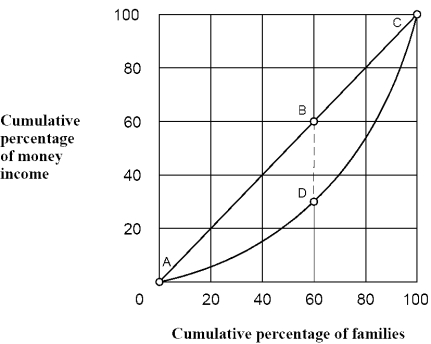 -As shown in Figure 15-1, 80 percent of families earned a cumulative share of about ____ of income.
 (Multiple Choice)
4.8/5 (71)
(71) In 2009, the percentage of all U.S. families officially considered to be in poverty was approximately
(Multiple Choice)
4.9/5 (87)
(87) Figure 15-1
-As shown in Figure 15-1, the perfect equality line is drawn between points
-As shown in Figure 15-1, the perfect equality line is drawn between points (Multiple Choice)
4.9/5 (76)
(76) If complete equality of income were legislated, which of the following would economics predict?
(Multiple Choice)
4.9/5 (84)
(84) Compared to high-income families, low-income families tend to have
(Multiple Choice)
4.7/5 (96)
(96) Most studies indicate that the degree of income inequality in the United States has
(Multiple Choice)
4.8/5 (74)
(74) Figure 15-1
-As shown in Figure 15-1, 60 percent of families earned a cumulative share of about ____ of income.
-As shown in Figure 15-1, 60 percent of families earned a cumulative share of about ____ of income. (Multiple Choice)
4.8/5 (84)
(84) Data suggest that the large increase in government spending on income transfers over the past three decades has been accompanied by
(Multiple Choice)
5.0/5 (78)
(78) Which of the following contributed most to the large increases in poverty since 1960?
(Multiple Choice)
4.9/5 (73)
(73) Which of the following is accurate regarding income statistics?
(Multiple Choice)
4.8/5 (93)
(93) Andy observes that the income distribution between the richest and poorest people in the population has remained fixed for decades. He concludes that the rich stay rich and the poor stay poor. Is this a valid conclusion, or has Andy missed something?
(Essay)
4.8/5 (101)
(101) Which of the following benefits is counted as income when the official poverty rate is calculated?
(Multiple Choice)
4.9/5 (65)
(65) Evaluate this sentence, "The best way to get rid of poverty is to increase government expenditures on welfare programs."
(Multiple Choice)
4.9/5 (89)
(89) Compared to low-income families, upper-income families are likely to
(Multiple Choice)
4.8/5 (89)
(89) This year, Tammy earned $15,000 and she paid 15 percent in income and payroll taxes. She qualified for Medicaid and food stamps. For every $100 that she earns, Tammy loses $35 in Medicaid benefits and $15 in food stamps. Tammy faces an effective marginal tax rate of
(Multiple Choice)
4.8/5 (80)
(80) 
Filters
- Essay(0)
- Multiple Choice(0)
- Short Answer(0)
- True False(0)
- Matching(0)