



 Chat with AI
Exam 15: Income Inequality and Poverty

Exam 1: The Economic Approach210 Questions
Exam 2: A: Some Tools of the Economist224 Questions
Exam 2: B: Some Tools of the Economist33 Questions
Exam 3: A: Supply, Demand, and the Market Process225 Questions
Exam 3: B: Supply, Demand, and the Market Process180 Questions
Exam 4: A: Supply and Demand: Applications and Extensions233 Questions
Exam 4: B: Supply and Demand: Applications and Extensions98 Questions
Exam 5: Difficult Cases for the Market and the Role of Government168 Questions
Exam 6: The Economics of Collective Decision-Making180 Questions
Exam 7: Consumer Choice and Elasticity223 Questions
Exam 8: A: Costs and the Supply of Goods223 Questions
Exam 8: B: Costs and the Supply of Goods8 Questions
Exam 9: A: Price Takers and the Competitive Process237 Questions
Exam 9: B: Price Takers and the Competitive Process23 Questions
Exam 10: Price-Searcher Markets With Low Entry Barriers216 Questions
Exam 11: A: Price-Searcher Markets With High Entry Barriers229 Questions
Exam 11: B: Price-Searcher Markets With High Entry Barriers25 Questions
Exam 12: The Supply of and Demand for Productive Resources200 Questions
Exam 13: Earnings, Productivity, and the Job Market109 Questions
Exam 14: Investment, the Capital Market, and the Wealth of Nations129 Questions
Exam 15: Income Inequality and Poverty136 Questions
Exam 16: Appendix: Government Spending and Taxation79 Questions
Exam 17: Appendix: the Economics of Social Security54 Questions
Exam 18: Appendix: the Stock Market: Its Function, Performance, and Potential As an Investment Opportunity70 Questions
Exam 19: Appendix: Great Debates in Economics: Keynes Versus Hayek8 Questions
Exam 20: Appendix: the Crisis of 2008: Causes and Lessons for the Future64 Questions
Exam 21: Appendix: Lessons From the Great Depression60 Questions
Exam 22: Appendix: the Economics of Healthcare68 Questions
Exam 23: Appendix:education: Problems and Performance60 Questions
Exam 24: Appendix: Earnings Differences Between Men and Women47 Questions
Exam 26: Appendix: the Question of Resource Exhaustion61 Questions
Exam 25: Appendix: Do Labor Unions Increase the Wages of Workers74 Questions
Exam 27: Appendix: Difficult Environmental Cases and the Role of Government63 Questions
Select questions type


Suppose you had the choice of attending two universities. University A pays all of its professors the same wage and awards the same raises. University B pays each professor according to market wages and productivity. Which university would you rather attend and why?
(Essay)
4.8/5  (78)
(78) Which of the following contributed to the increase in income inequality among families in the United States during the 1980s and 1990s?
(Multiple Choice)
4.9/5 (96)
(96) In 2007, the poorest 20 percent of families in the United States population earned approximately ____ percent of the before-tax total income. (Fill in the blank.)
(Multiple Choice)
4.9/5 (85)
(85) During 1959 through 2009, the percent of poor families headed by an elderly person
(Multiple Choice)
5.0/5 (71)
(71) Which one of the following groups has a below-average incidence of poverty?
(Multiple Choice)
4.7/5 (83)
(83) Which of the following is accurate regarding income statistics?
(Multiple Choice)
4.9/5 (69)
(69) Even if lifetime incomes were equal, there still might be substantial inequality in annual income data because
(Multiple Choice)
4.7/5 (89)
(89) Income supplements large enough to significantly increase the economic status of poor people will
(Multiple Choice)
4.8/5 (93)
(93) Some people inherit money and wealth that they did nothing to earn. Why don't we tax inheritance at 100 percent?
(Essay)
4.9/5 (75)
(75) Compared to low-income families, high-income families tend to
(Multiple Choice)
4.8/5 (89)
(89) Assume that Jill is a single parent who is in poverty. She receives food stamps and Medicaid. For every $100 that she earns, Jill loses $20 of her food stamp benefits and $15 in her Medicaid benefits. Jill's implicit marginal tax rate from these two programs is
(Multiple Choice)
4.9/5 (67)
(67) Why don't we divide the economic pie evenly so that each person receives the same income?
(Essay)
4.8/5 (72)
(72) Which of the following statements regarding poverty in the United States is correct?
(Multiple Choice)
4.9/5 (85)
(85) "There is considerable movement up and down the economic ladder. Relative income positions often change over time." This statement is
(Multiple Choice)
4.8/5 (75)
(75) Figure 15-3
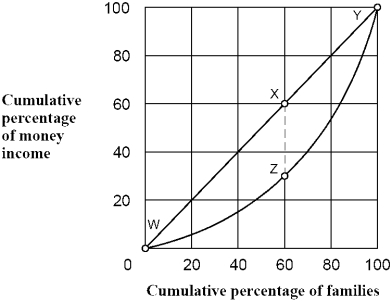 -As shown in Figure 15-3, 20 percent of families earned a cumulative share of about ____ percent of income.
 (Multiple Choice)
4.8/5 (81)
(81) If the marginal productivity of labor was the sole determinant of household income in the U.S., then
(Multiple Choice)
4.8/5 (86)
(86) The Samaritan's dilemma describes the problem that exists when transfer programs, designed to help the poor, encourage choices that can promote or perpetuate
(Multiple Choice)
4.8/5 (68)
(68) If a family earned an additional $6,000 and, as a consequence, sustained a reduction of $3,600 in government benefits, the implicit marginal tax rate for this family would be
(Multiple Choice)
4.9/5 (71)
(71) Over the past two decades, the earnings gap between college graduates and those with only a high school education has
(Multiple Choice)
4.8/5 (64)
(64) 
Filters
- Essay(0)
- Multiple Choice(0)
- Short Answer(0)
- True False(0)
- Matching(0)