



 Chat with AI
Exam 15: Income Inequality and Poverty

Exam 1: The Economic Approach210 Questions
Exam 2: A: Some Tools of the Economist224 Questions
Exam 2: B: Some Tools of the Economist33 Questions
Exam 3: A: Supply, Demand, and the Market Process225 Questions
Exam 3: B: Supply, Demand, and the Market Process180 Questions
Exam 4: A: Supply and Demand: Applications and Extensions233 Questions
Exam 4: B: Supply and Demand: Applications and Extensions98 Questions
Exam 5: Difficult Cases for the Market and the Role of Government168 Questions
Exam 6: The Economics of Collective Decision-Making180 Questions
Exam 7: Consumer Choice and Elasticity223 Questions
Exam 8: A: Costs and the Supply of Goods223 Questions
Exam 8: B: Costs and the Supply of Goods8 Questions
Exam 9: A: Price Takers and the Competitive Process237 Questions
Exam 9: B: Price Takers and the Competitive Process23 Questions
Exam 10: Price-Searcher Markets With Low Entry Barriers216 Questions
Exam 11: A: Price-Searcher Markets With High Entry Barriers229 Questions
Exam 11: B: Price-Searcher Markets With High Entry Barriers25 Questions
Exam 12: The Supply of and Demand for Productive Resources200 Questions
Exam 13: Earnings, Productivity, and the Job Market109 Questions
Exam 14: Investment, the Capital Market, and the Wealth of Nations129 Questions
Exam 15: Income Inequality and Poverty136 Questions
Exam 16: Appendix: Government Spending and Taxation79 Questions
Exam 17: Appendix: the Economics of Social Security54 Questions
Exam 18: Appendix: the Stock Market: Its Function, Performance, and Potential As an Investment Opportunity70 Questions
Exam 19: Appendix: Great Debates in Economics: Keynes Versus Hayek8 Questions
Exam 20: Appendix: the Crisis of 2008: Causes and Lessons for the Future64 Questions
Exam 21: Appendix: Lessons From the Great Depression60 Questions
Exam 22: Appendix: the Economics of Healthcare68 Questions
Exam 23: Appendix:education: Problems and Performance60 Questions
Exam 24: Appendix: Earnings Differences Between Men and Women47 Questions
Exam 26: Appendix: the Question of Resource Exhaustion61 Questions
Exam 25: Appendix: Do Labor Unions Increase the Wages of Workers74 Questions
Exam 27: Appendix: Difficult Environmental Cases and the Role of Government63 Questions
Select questions type


(I) Positive economics cannot determine how much income inequality should be present in a country. (II) Critics of government action to reduce income inequality argue that modifying the market process of income determination may create perverse incentives and hurt wealth creation.
(Multiple Choice)
4.8/5  (84)
(84) The level of money income below which a family is considered poor is called the
(Multiple Choice)
4.9/5 (78)
(78) (I) Opponents to government action to reduce income inequality argue that the pattern of economic outcomes is more important than the process that generates the outcomes. (II) Opponents of government action to reduce income inequality argue that the proposed solutions will retard economic growth.
(Multiple Choice)
4.9/5 (84)
(84) Which of the following is not counted as income when the official poverty rate is calculated?
(Multiple Choice)
5.0/5 (83)
(83) Measuring poverty using an absolute income scale like the poverty line can be misleading because
(Multiple Choice)
4.8/5 (86)
(86) Since 1980, income inequality (as measured by the income share of the highest 20 percent of income earners relative to the lowest 20 percent) has
(Multiple Choice)
4.9/5 (74)
(74) As the War on Poverty programs were instituted and transfer payments expanded in the last half of the 1960s, what happened to the poverty rate?
(Multiple Choice)
4.7/5 (72)
(72) The mythical country of Quitar has just established a policy to give very generous in-kind benefits to the nation's poor, currently defined as those earning less than $10,000 a year. Several years later, the poverty rate has not fallen. Why not?
(Essay)
4.8/5 (75)
(75) Income inequality exists in the United States. Is this necessarily a bad thing? Explain how our assessment of income inequality depends crucially on the source of that inequality.
(Essay)
4.7/5 (88)
(88) "Annual income during the prime working years may overstate the economic well-being of most households over their lifetime." This statement is
(Multiple Choice)
4.9/5 (79)
(79) Compared to low-income families, a larger proportion of high-income families
(Multiple Choice)
4.9/5 (76)
(76) (I) High implicit marginal tax rates reduce the incentive of the poor to earn. (II) The Samaritan's dilemma is that transfer programs lower the opportunity cost of activities that lead to poverty.
(Multiple Choice)
4.7/5 (69)
(69) How do the high implicit marginal tax rates that often occur when transfer payments are inversely linked to earnings affect the incentive of poor people to work and earn?
(Multiple Choice)
4.8/5 (90)
(90) Figure 15-4
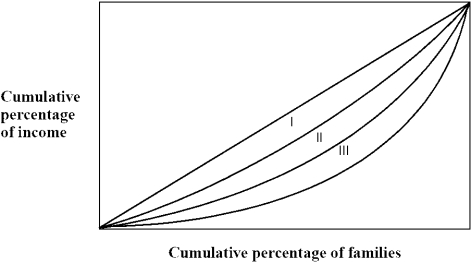 -Figure 15-4 shows the Lorenz Curve for three countries, I, II, and III. Which of the following statements is true?
 (Multiple Choice)
4.8/5 (88)
(88) Figure 15-2
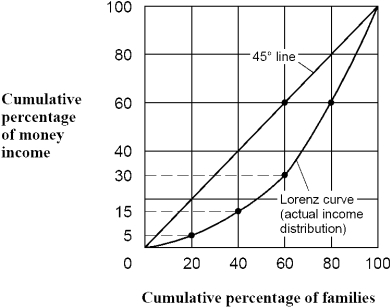 -If this economy's distribution of income becomes more equal, then the Lorenz curve shown in Figure 15-2 will
 (Multiple Choice)
4.9/5 (80)
(80) Use the following two statements to answer this question. (I) In a market system, resource prices both provide incentives for the efficient allocation of resources and determine income distribution.
(II) Income and wealth are neither created nor destroyed, they are just fixed-sized pies to be allocated among individuals.
(Multiple Choice)
4.9/5 (77)
(77) 
Filters
- Essay(0)
- Multiple Choice(0)
- Short Answer(0)
- True False(0)
- Matching(0)