



 Chat with AI
Exam 10: Monopoly and Antitrust Policy

Exam 1: Economics: Foundations and Models444 Questions
Exam 2: Trade-Offs, comparative Advantage, and the Market System498 Questions
Exam 3: Where Prices Come From: the Interaction of Demand and Supply475 Questions
Exam 4: Market Efficiency and Market Failure465 Questions
Exam 5: The Economics of Health Care334 Questions
Exam 6: Firms, the Stock Market, and Corporate Governance250 Questions
Exam 7: Consumer Choice and Elasticity380 Questions
Exam 8: Technology, production, and Costs276 Questions
Exam 9: Firms in Perfectly Competitive Markets297 Questions
Exam 10: Monopoly and Antitrust Policy271 Questions
Exam 11: Monopolistic Competition and Oligopoly414 Questions
Exam 12: Gdp: Measuring Total Production and Income266 Questions
Exam 13: Unemployment and Inflation292 Questions
Exam 14: Economic Growth, the Financial System, and Business Cycles257 Questions
Exam 15: Aggregate Demand and Aggregate Supply Analysis284 Questions
Exam 16: Money, banks, and the Federal Reserve System279 Questions
Exam 17: Monetary Policy277 Questions
Exam 18: Fiscal Policy282 Questions
Exam 19: Comparative Advantage, international Trade, and Exchange Rates446 Questions
Select questions type


Assume a hypothetical case where an industry begins as perfectly competitive and then becomes a monopoly.Which of the following statements comparing the conditions in the industry under both market structures is true?
(Multiple Choice)
4.9/5  (81)
(81) Which of the following statements is consistent with the views of Joseph Schumpeter?
(Multiple Choice)
4.9/5 (76)
(76) Unlike a perfect competitor,a monopolist faces the market demand curve.
(True/False)
4.8/5 (86)
(86) Network externalities refer to the situation where the usefulness of a product increases with the number of consumers who use it.
(True/False)
4.8/5 (81)
(81) Figure 10-3
 Figure 10-3 above shows the demand and cost curves facing a monopolist.
-Refer to Figure 10-3.Suppose the monopolist represented in the diagram above produces positive output.What is the profit-maximizing/loss-minimizing output level?
Figure 10-3 above shows the demand and cost curves facing a monopolist.
-Refer to Figure 10-3.Suppose the monopolist represented in the diagram above produces positive output.What is the profit-maximizing/loss-minimizing output level? (Multiple Choice)
5.0/5 (80)
(80) Many biologic drug manufacturers are pushing for patent protection to be extended to 12 years before generics are allowed to be introduced to the market.This reflects which of the following barriers to entry?
(Multiple Choice)
4.8/5 (63)
(63) Figure 10-15
 Figure 10-15 shows the cost and demand curves for the Erickson Power Company.
-Refer to Figure 10-15.If the government regulates Erickson Power Company so that the firm can earn a normal profit,the price would be set at ________ and the output level is ________.
Figure 10-15 shows the cost and demand curves for the Erickson Power Company.
-Refer to Figure 10-15.If the government regulates Erickson Power Company so that the firm can earn a normal profit,the price would be set at ________ and the output level is ________. (Multiple Choice)
4.7/5 (69)
(69) Figure 10-4
 Figure 10-4 shows the demand and cost curves for a monopolist.
-Refer to Figure 10-4.What is the amount of the monopoly's profit?
Figure 10-4 shows the demand and cost curves for a monopolist.
-Refer to Figure 10-4.What is the amount of the monopoly's profit? (Multiple Choice)
5.0/5 (71)
(71) Arnold Harberger was the first economist to estimate the loss of economic efficiency due to market power.Since Harberger's findings were published,other researchers have studied this same issue.How do the results of these researchers compare to Harberger's results?
(Multiple Choice)
4.8/5 (78)
(78) According to the Department of Justice merger guidelines,a proposed merger between two firms may be challenged if the post-merger Herfindahl-Hirschman Index
(Multiple Choice)
4.9/5 (79)
(79) Figure 10-9
 Figure 10-9 shows the demand and cost curves for a monopolist.
-Refer to Figure 10-9.What is the economically efficient output level?
Figure 10-9 shows the demand and cost curves for a monopolist.
-Refer to Figure 10-9.What is the economically efficient output level? (Multiple Choice)
4.7/5 (89)
(89) Table 10-4
Price per Dose Quantity Demanded (dose) Total Cost of Production (dollars) \ 80 0 \ 80 72 1 82 64 2 88 56 3 100 48 4 124 40 5 164 32 6 208 24 7 268 16 8 340
Shakti Inc.has been granted a patent for its Arnica toothache balm. Table 10-4 shows the demand and the total cost schedule for the firm.
-Refer to Table 10-4.What is the amount of the deadweight loss generated by Shakti when it produces the monopoly output?
(Multiple Choice)
4.7/5 (98)
(98) Figure 10-18
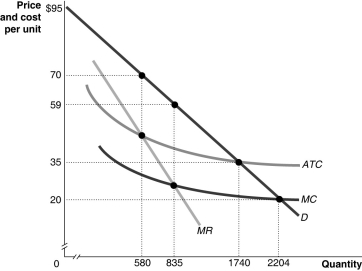 -Refer to Figure 10-18 to answer the following questions.
a.What quantity will this monopoly produce and what price will it charge?
b.Suppose the monopoly is regulated.If the regulatory agency wants to achieve economic efficiency,what price should it require the monopoly to charge?
c.To achieve economic efficiency,what quantity will the regulated monopoly produce?
d.Will the regulated monopoly make a profit if it charges the price that will achieve economic efficiency?
e.Suppose the government decides to regulate the monopoly by imposing a price ceiling of $35.What quantity will the monopoly produce and what price will the monopoly charge?
f.With the price ceiling of $35,what profit will the monopoly earn?
-Refer to Figure 10-18 to answer the following questions.
a.What quantity will this monopoly produce and what price will it charge?
b.Suppose the monopoly is regulated.If the regulatory agency wants to achieve economic efficiency,what price should it require the monopoly to charge?
c.To achieve economic efficiency,what quantity will the regulated monopoly produce?
d.Will the regulated monopoly make a profit if it charges the price that will achieve economic efficiency?
e.Suppose the government decides to regulate the monopoly by imposing a price ceiling of $35.What quantity will the monopoly produce and what price will the monopoly charge?
f.With the price ceiling of $35,what profit will the monopoly earn? (Essay)
4.9/5 (71)
(71) Figure 10-7
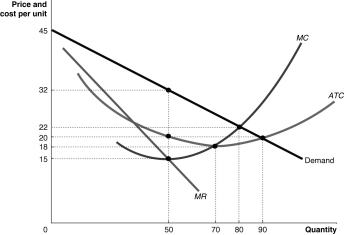 -Refer to Figure 10-7.Use the figure above to answer the following questions.
a.What is the profit-maximizing quantity and what price will the monopolist charge?
b.What is the total revenue at the profit-maximizing output level?
c.What is the total cost at the profit-maximizing output level?
d.What is the profit?
e.What is the profit per unit (average profit)at the profit-maximizing output level?
f.If this industry was organized as a perfectly competitive industry,what would be the profit-maximizing price and quantity?
-Refer to Figure 10-7.Use the figure above to answer the following questions.
a.What is the profit-maximizing quantity and what price will the monopolist charge?
b.What is the total revenue at the profit-maximizing output level?
c.What is the total cost at the profit-maximizing output level?
d.What is the profit?
e.What is the profit per unit (average profit)at the profit-maximizing output level?
f.If this industry was organized as a perfectly competitive industry,what would be the profit-maximizing price and quantity? (Essay)
4.8/5 (84)
(84) Table 10-4
Price per Dose Quantity Demanded (dose) Total Cost of Production (dollars) \ 80 0 \ 80 72 1 82 64 2 88 56 3 100 48 4 124 40 5 164 32 6 208 24 7 268 16 8 340
Shakti Inc.has been granted a patent for its Arnica toothache balm. Table 10-4 shows the demand and the total cost schedule for the firm.
-Refer to Table 10-4.What is Shakti's profit-maximizing output?
(Multiple Choice)
4.8/5 (86)
(86) In discussions of barriers to entry,what is meant by the term "virtuous cycle"?
(Multiple Choice)
4.8/5 (81)
(81) Natural monopolies in the United States are generally regulated by
(Multiple Choice)
4.9/5 (92)
(92) Figure 10-17
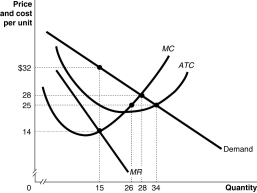 -Refer to Figure 10-17 to answer the following questions.
a.What quantity will this monopoly produce and what price will it charge?
b.Suppose the government decides to regulate this monopoly and imposes a price ceiling of $25.Now what quantity will the monopoly produce and what price will it charge?
c.Will every consumer who is willing to pay the ceiling price of $25 be able to buy the product? Briefly explain.
-Refer to Figure 10-17 to answer the following questions.
a.What quantity will this monopoly produce and what price will it charge?
b.Suppose the government decides to regulate this monopoly and imposes a price ceiling of $25.Now what quantity will the monopoly produce and what price will it charge?
c.Will every consumer who is willing to pay the ceiling price of $25 be able to buy the product? Briefly explain. (Essay)
4.9/5 (76)
(76) 
Filters
- Essay(0)
- Multiple Choice(0)
- Short Answer(0)
- True False(0)
- Matching(0)