



 Chat with AI
Exam 10: Monopoly and Antitrust Policy

Exam 1: Economics: Foundations and Models444 Questions
Exam 2: Trade-Offs, comparative Advantage, and the Market System498 Questions
Exam 3: Where Prices Come From: the Interaction of Demand and Supply475 Questions
Exam 4: Market Efficiency and Market Failure465 Questions
Exam 5: The Economics of Health Care334 Questions
Exam 6: Firms, the Stock Market, and Corporate Governance250 Questions
Exam 7: Consumer Choice and Elasticity380 Questions
Exam 8: Technology, production, and Costs276 Questions
Exam 9: Firms in Perfectly Competitive Markets297 Questions
Exam 10: Monopoly and Antitrust Policy271 Questions
Exam 11: Monopolistic Competition and Oligopoly414 Questions
Exam 12: Gdp: Measuring Total Production and Income266 Questions
Exam 13: Unemployment and Inflation292 Questions
Exam 14: Economic Growth, the Financial System, and Business Cycles257 Questions
Exam 15: Aggregate Demand and Aggregate Supply Analysis284 Questions
Exam 16: Money, banks, and the Federal Reserve System279 Questions
Exam 17: Monetary Policy277 Questions
Exam 18: Fiscal Policy282 Questions
Exam 19: Comparative Advantage, international Trade, and Exchange Rates446 Questions
Select questions type


"Being the only seller in the market,the monopolist can choose any price and quantity it desires." Evaluate this statement: is it true or false? Explain your answer.
(Essay)
4.8/5  (80)
(80) Market power in the United States causes a huge loss of economic efficiency.
(True/False)
4.9/5 (80)
(80) The 10-year protection period from generic competition for drug manufacturers is a form of
(Multiple Choice)
4.9/5 (67)
(67) If a monopolist's marginal revenue is $15 per unit and its marginal cost is $25,then to maximize profit the firm should decrease output.
(True/False)
5.0/5 (80)
(80) Figure 10-12
 Figure 10-12 shows the cost and demand curves for a monopolist.
-Refer to Figure 10-12.If the firm maximizes its profits,the deadweight loss to society due to this monopoly is equal to the area
Figure 10-12 shows the cost and demand curves for a monopolist.
-Refer to Figure 10-12.If the firm maximizes its profits,the deadweight loss to society due to this monopoly is equal to the area (Multiple Choice)
4.9/5 (85)
(85) Producers in perfect competition receive a smaller producer surplus than a monopoly producer.
(True/False)
4.9/5 (85)
(85) In the short-run,even if a monopoly's total revenue does not cover its variable costs,it should continue to produce because ultimately in the long run,the monopoly will start earning profits.
(True/False)
4.9/5 (79)
(79) Figure 10-2
 Figure 10-2 above shows the demand and cost curves facing a monopolist.
-Refer to Figure 10-2.If the firm's average total cost curve is ATC₂,the firm will
Figure 10-2 above shows the demand and cost curves facing a monopolist.
-Refer to Figure 10-2.If the firm's average total cost curve is ATC₂,the firm will (Multiple Choice)
4.8/5 (70)
(70) Economic efficiency requires that a natural monopoly's price be
(Multiple Choice)
4.9/5 (78)
(78) Table 10-4
Price per Dose Quantity Demanded (dose) Total Cost of Production (dollars) \ 80 0 \ 80 72 1 82 64 2 88 56 3 100 48 4 124 40 5 164 32 6 208 24 7 268 16 8 340
Shakti Inc.has been granted a patent for its Arnica toothache balm. Table 10-4 shows the demand and the total cost schedule for the firm.
-Refer to Table 10-4.What is the economically efficient output level?
(Multiple Choice)
4.7/5 (87)
(87) Figure 10-4
 Figure 10-4 shows the demand and cost curves for a monopolist.
-Refer to Figure 10-4.What is the amount of the monopoly's total revenue?
Figure 10-4 shows the demand and cost curves for a monopolist.
-Refer to Figure 10-4.What is the amount of the monopoly's total revenue? (Multiple Choice)
4.9/5 (72)
(72) If you own the only bookstore in a small town,do you have a monopoly?
(Essay)
4.8/5 (75)
(75) The Aluminum Company of America (Alcoa)had a monopoly until the 1940s because
(Multiple Choice)
4.8/5 (81)
(81) When the government makes a firm the exclusive legal provider of a good or service,it grants the firm
(Multiple Choice)
4.8/5 (83)
(83) Figure 10-14
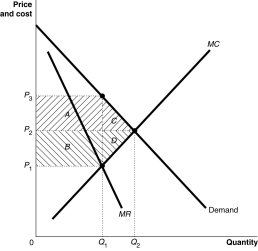 -Refer to Figure 10-14.From the monopoly graph above,identify the following:
a.The profit maximizing price
b.The profit maximizing quantity
c.The area representing deadweight loss
d.The area representing the transfer of consumer surplus to the monopoly
-Refer to Figure 10-14.From the monopoly graph above,identify the following:
a.The profit maximizing price
b.The profit maximizing quantity
c.The area representing deadweight loss
d.The area representing the transfer of consumer surplus to the monopoly (Essay)
4.8/5 (88)
(88) 
Filters
- Essay(0)
- Multiple Choice(0)
- Short Answer(0)
- True False(0)
- Matching(0)