



 Chat with AI
Exam 10: Monopoly and Antitrust Policy

Exam 1: Economics: Foundations and Models444 Questions
Exam 2: Trade-Offs, comparative Advantage, and the Market System498 Questions
Exam 3: Where Prices Come From: the Interaction of Demand and Supply475 Questions
Exam 4: Market Efficiency and Market Failure465 Questions
Exam 5: The Economics of Health Care334 Questions
Exam 6: Firms, the Stock Market, and Corporate Governance250 Questions
Exam 7: Consumer Choice and Elasticity380 Questions
Exam 8: Technology, production, and Costs276 Questions
Exam 9: Firms in Perfectly Competitive Markets297 Questions
Exam 10: Monopoly and Antitrust Policy271 Questions
Exam 11: Monopolistic Competition and Oligopoly414 Questions
Exam 12: Gdp: Measuring Total Production and Income266 Questions
Exam 13: Unemployment and Inflation292 Questions
Exam 14: Economic Growth, the Financial System, and Business Cycles257 Questions
Exam 15: Aggregate Demand and Aggregate Supply Analysis284 Questions
Exam 16: Money, banks, and the Federal Reserve System279 Questions
Exam 17: Monetary Policy277 Questions
Exam 18: Fiscal Policy282 Questions
Exam 19: Comparative Advantage, international Trade, and Exchange Rates446 Questions
Select questions type


Figure 10-2
 Figure 10-2 above shows the demand and cost curves facing a monopolist.
-Refer to Figure 10-2.If the firm's average total cost curve is ATC₃,the firm will
Figure 10-2 above shows the demand and cost curves facing a monopolist.
-Refer to Figure 10-2.If the firm's average total cost curve is ATC₃,the firm will (Multiple Choice)
4.8/5  (100)
(100) For a natural monopoly,the marginal cost of producing an additional unit of its product is relatively small.
(True/False)
5.0/5 (66)
(66) Which of the following is a characteristic shared by a perfectly competitive firm and a monopoly?
(Multiple Choice)
4.8/5 (80)
(80) How does a network externality serve as a barrier to entry? Is this barrier surmountable? Explain.
(Essay)
4.9/5 (89)
(89) Assume a hypothetical case where an industry begins as perfectly competitive and then becomes a monopoly.Which of the following statements regarding economic surplus in each market structure is true?
(Multiple Choice)
4.8/5 (84)
(84) Figure 10-8
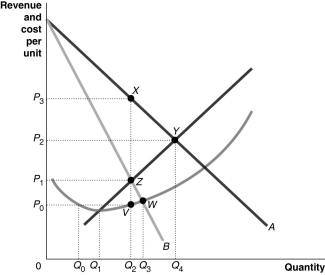 Figure 10-8 reflects the cost and revenue structure for a monopoly that has been in business for a very long time.
-Refer to Figure 10-8.Use the figure above to answer the following questions.
a.Identify the curves labeled A and B.Identify the curve which contains both point Y and point Z.Identify the curve which contains both point V and point W.
b.What is the profit-maximizing quantity and what price will the monopolist charge?
c.What area represents total revenue at the profit-maximizing output level?
d.What area represents total cost at the profit-maximizing output level?
e.What area represents profit?
f.What is the profit per unit (average profit)at the profit-maximizing output level?
g.If this industry was organized as a perfectly competitive industry,what would be the profit-maximizing price and quantity?
h.What area represents the deadweight loss as a result of a monopoly?
Figure 10-8 reflects the cost and revenue structure for a monopoly that has been in business for a very long time.
-Refer to Figure 10-8.Use the figure above to answer the following questions.
a.Identify the curves labeled A and B.Identify the curve which contains both point Y and point Z.Identify the curve which contains both point V and point W.
b.What is the profit-maximizing quantity and what price will the monopolist charge?
c.What area represents total revenue at the profit-maximizing output level?
d.What area represents total cost at the profit-maximizing output level?
e.What area represents profit?
f.What is the profit per unit (average profit)at the profit-maximizing output level?
g.If this industry was organized as a perfectly competitive industry,what would be the profit-maximizing price and quantity?
h.What area represents the deadweight loss as a result of a monopoly? (Essay)
4.8/5 (89)
(89) A natural monopoly is characterized by large fixed costs relative to variable costs.
(True/False)
4.9/5 (65)
(65) Figure 10-4
 Figure 10-4 shows the demand and cost curves for a monopolist.
-Refer to Figure 10-4.What is the profit-maximizing/loss-minimizing output level?
Figure 10-4 shows the demand and cost curves for a monopolist.
-Refer to Figure 10-4.What is the profit-maximizing/loss-minimizing output level? (Multiple Choice)
4.7/5 (95)
(95) The U.S.Congress has given two government entities the authority to police mergers.These two entities are
(Multiple Choice)
5.0/5 (94)
(94) A snack shop inside a hotel in a busy city has a monopoly on food sales if it is the only food vendor in the hotel that is open 24 hours a day.
(True/False)
4.8/5 (66)
(66) Figure 10-15
 Figure 10-15 shows the cost and demand curves for the Erickson Power Company.
-Refer to Figure 10-15.The firm would maximize profit by producing
Figure 10-15 shows the cost and demand curves for the Erickson Power Company.
-Refer to Figure 10-15.The firm would maximize profit by producing (Multiple Choice)
4.8/5 (90)
(90) Figure 10-10
 -Refer to Figure 10-10.Compared to a perfectly competitive market,consumer surplus is lower in a monopoly by an amount equal to the
 (Multiple Choice)
4.8/5 (75)
(75) Table 10-3
Price Quantity Total Revenue Marginal Revenue Total Cost Marginal Cost \ 17 3 \ 51 \@cdots- \ 56 \ldots 16 4 64 \ 13 63 \ 7 15 5 75 11 71 8 14 6 84 9 80 9 13 7 91 7 90 10 12 8 96 5 101 11
Assume Table 10-3 gives the monthly demand and costs for subscriptions to basic cable for Comcast, a cable television monopoly in Philadelphia.
-Refer to Table 10-3.If Comcast maximizes its profits how much profit will it earn?
(Multiple Choice)
4.9/5 (70)
(70) If a natural monopoly regulatory commission sets a price where marginal cost is equal to demand
(Multiple Choice)
4.9/5 (85)
(85) Figure 10-16
 Figure 10-16 shows the market demand and cost curves facing a natural monopoly.
-Refer to figure 10-16.In the absence of any government regulation,the profit-maximizing owners of this firm will produce ________ units and charge a price of ________.
Figure 10-16 shows the market demand and cost curves facing a natural monopoly.
-Refer to figure 10-16.In the absence of any government regulation,the profit-maximizing owners of this firm will produce ________ units and charge a price of ________. (Multiple Choice)
4.8/5 (63)
(63) Whenever a firm can charge a price greater than marginal cost,
(Multiple Choice)
4.8/5 (86)
(86) A product's price approaches its marginal cost as market concentration increases.
(True/False)
5.0/5 (73)
(73) Explain whether a monopoly that maximizes profit will also be maximizing revenue and production.
(Essay)
4.9/5 (71)
(71) Figure 10-1
 -Refer to Figure 10-1.Which of the following statements about the firm depicted in the diagram is true?
 (Multiple Choice)
4.9/5 (84)
(84) 
Filters
- Essay(0)
- Multiple Choice(0)
- Short Answer(0)
- True False(0)
- Matching(0)