



 Chat with AI
Exam 12: Enzymes Kinetics and Specificity

Exam 1: The Facts of Life: Chemistry Is the Logic of Biological Phenomena33 Questions
Exam 2: Water: the Medium of Life35 Questions
Exam 3: Thermodynamics of Biological Systems35 Questions
Exam 4: Amino Acids23 Questions
Exam 5: Proteins: Their Primary Structure and Biological Functions43 Questions
Exam 6: Proteins: Secondary, tertiary, and Quaternary Structure49 Questions
Exam 7: Carbohydrates and the Glycoconjugates of Cell Surfaces48 Questions
Exam 8: Lipids28 Questions
Exam 9: Lipid Biosynthesis59 Questions
Exam 10: Membranes and Membrane Transport43 Questions
Exam 11: The Reception and Transmission of Extracellular Information47 Questions
Exam 12: Enzymes Kinetics and Specificity43 Questions
Exam 13: Mechanisms of Enzyme Action27 Questions
Exam 14: Enzyme Regulation33 Questions
Exam 15: Molecular Motors28 Questions
Exam 16: Nutrition and the Organization of Metabolism59 Questions
Exam 17: Glycolysis56 Questions
Exam 18: The Tricarboxylic Acid Cycle46 Questions
Exam 19: Electron Transport and Oxidative Phosphorylation56 Questions
Exam 20: Photosynthesis52 Questions
Exam 21: Gluconeogenesis, glycogen Metabolism, and the Pentose Phosphate Pathway51 Questions
Exam 22: Fatty Acid Catabolism32 Questions
Exam 23: Nitrogen Acquisition and Amino Acid Metabolism47 Questions
Exam 24: Nucleotides and Nucleic Acids32 Questions
Exam 25: Structure of Nucleic Acids29 Questions
Exam 26: Synthesis and Degradation of Nucleotides32 Questions
Exam 27: Recombinant Dna: Cloning and Creation of Chimeric Genes30 Questions
Exam 28: DNA Metabolism: Replication, recombination, and Repair58 Questions
Exam 29: Transcription and the Regulation of Gene Expression58 Questions
Exam 30: Protein Synthesis49 Questions
Exam 31: Post-Transcriptional Regulation of Gene Expression38 Questions
Exam 32: Completing the Protein Life Cycle: Folding, processing, and Degradation28 Questions
Exam 33: Metabolic Integration and Organ Specialization35 Questions
Select questions type


Which of the following is NOT correct regarding non-competitive inhibition?

Free
(Multiple Choice)
4.8/5  (83)
(83) Correct Answer: Verified
B
Against which type of antigen is a catalytic antibody (abzyme)generated?
Free
(Multiple Choice)
4.8/5 (81)
(81) Correct Answer:Verified
VerifiedA
What is the definition of the free energy of activation,∆G‡?
Free
(Multiple Choice)
4.8/5 (81)
(81) Correct Answer:Verified
VerifiedC
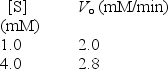
For an enzyme-catalyzed reaction,the initial velocity was determined at 2 different concentrations of the substrate.Which of the following would be closest to the value of Vmₐₓ?
(Multiple Choice)
4.9/5 (99)
(99) Which of the following is a feature of uncompetitive inhibition?
(Multiple Choice)
4.9/5 (92)
(92) Which of the following is NOT correct regarding enzyme pathways?
(Multiple Choice)
5.0/5 (84)
(84) A plot of 1/V versus 1/[S] for an enzyme-catalyzed reaction gave a line with an equation of y = 0.5x + 0.2.The same enzyme with an inhibitor present gave a line with an equation of y = 1.1x + 0.2.Which of these statements is correct regarding the inhibition?
(Multiple Choice)
4.9/5 (74)
(74) Which term defines the catalytically active complex of an apoenzyme and its prosthetic group?
(Multiple Choice)
4.8/5 (66)
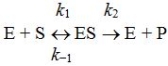
(66) Which of the following is correct regarding the Michaelis-Menten constant,Km,for this kinetic mechanism?
(Multiple Choice)
4.8/5 (81)
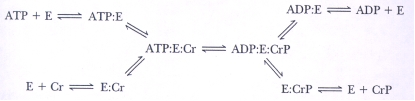
(81) In the enzyme catalyzed reaction sequence below,can the E-PO₄- intermediate be predicted and why?
(Multiple Choice)
4.9/5 (73)
(73) Which of the following is NOT a distinctive feature of enzymes?
(Multiple Choice)
4.9/5 (77)
(77) What is the basis for the International Units of an enzyme?
(Multiple Choice)
4.8/5 (80)
(80) If an enzyme has a Vmₐₓ of 15 mM/min,what is the velocity if the substrate is present at ¼ of the Km?
(Multiple Choice)
4.9/5 (85)
(85) What term describes an enzyme that is an ATP-dependent phosphotransferase?
(Multiple Choice)
4.8/5 (85)
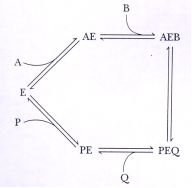
(85) In the reaction mechanism below,which components are competitive for binding to free enzyme E?
(Multiple Choice)
4.8/5 (78)
(78) Which of these antibiotics acts by forming a covalent derivative of the enzyme glycoprotein peptidase?
(Multiple Choice)
4.9/5 (84)
(84) Which of the following is NOT a characteristic of ribozymes?
(Multiple Choice)
4.8/5 (69)
(69) Which reaction would NOT proceed via bimolecular elementary steps?
(Multiple Choice)
4.8/5 (84)
(84) Which of the following is NOT correct regarding the transition state of a reaction?
(Multiple Choice)
4.8/5 (67)
(67) 
Filters
- Essay(0)
- Multiple Choice(0)
- Short Answer(0)
- True False(0)
- Matching(0)