



 Chat with AI
Exam 1: The Ancient Near East: the First Civilizations

Exam 1: The Ancient Near East: the First Civilizations82 Questions
Exam 2: The Hebrews: a New View of God and the Individual74 Questions
Exam 3: The Greeks: From Myth to Reason95 Questions
Exam 4: Rome: From City-State to World Empire93 Questions
Exam 5: Early Christianity: a World Religion79 Questions
Exam 6: The Rise of Europe: Fusion of Classical, Christian, and Germanic Traditions89 Questions
Exam 7: The Flowering and Dissolution of Medieval Civilization84 Questions
Exam 8: Transition to the Modern Age: Renaissance and Reformation92 Questions
Exam 9: Political and Economic Transformation: National States, Overseas Expansion, Commercial Revolution84 Questions
Exam 10: Intellectual Transformation: the Scientific Revolution and the Age of Enlightenment86 Questions
Exam 11: The Era of the French Revolution: Affirmation of Liberty and Equality92 Questions
Exam 12: The Industrial Revolution: the Transformation of Society79 Questions
Exam 13: Thought and Culture in the Early Nineteenth Century82 Questions
Exam 14: Surge of Liberalism and Nationalism: Revolution, Counterrevolution, and Unification78 Questions
Exam 15: Thought and Culture in the Mid-Nineteenth Century: Realism, Positivism, Darwinism, and Social Criticism86 Questions
Exam 16: Europe in the Late Nineteenth Century: Modernization, Nationalism, Imperialism93 Questions
Exam 17: Modern Consciousness: New Views of Nature, Human Nature, and the Arts78 Questions
Exam 18: World War I: the West in Despair83 Questions
Exam 19: An Era of Totalitarianism87 Questions
Exam 20: World War 2: Western Civilization in the Balance55 Questions
Exam 21: Europe After World War 2: Recovery and Realignment, 1945-198963 Questions
Exam 22: The Troubled Present55 Questions
Select questions type


Please use this outline map of the Near East to answer the question(s).
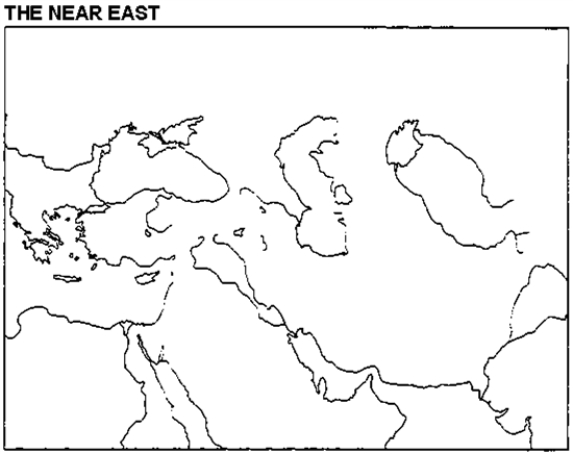 -On the map of the Near East, locate the approximate sites of the following ancient cities: Memphis, Tyre, Sidon, Babylon, and Nineveh.
 (Short Answer)
4.9/5  (76)
(76) The authors define all of the following as characteristics of early civilization except
(Multiple Choice)
4.7/5 (78)
(78) In the Mesopotamian civilization the temple administration functioned in each of the following ways except
(Multiple Choice)
4.9/5 (80)
(80) Please define the following key terms. Show Who? What? Where? When? Why Important?
-Atonism
(Essay)
4.9/5 (83)
(83) Provisions related to business transactions in the Code of Hammurabi indicate that in ancient Mesopotamia
(Multiple Choice)
4.8/5 (82)
(82) Please define the following key terms. Show Who? What? Where? When? Why Important?
-Phoenicians
(Essay)
4.8/5 (85)
(85) Please use this outline map of the world to answer the question(s).
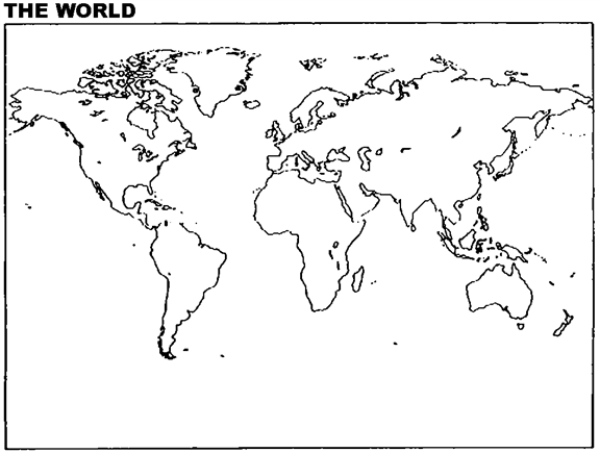 -What were some of the negative consequences first of the agricultural revolution and later of the development of civilization?
 (Essay)
4.9/5 (81)
(81) Please define the following key terms. Show Who? What? Where? When? Why Important?
-Sumerians
(Essay)
4.9/5 (93)
(93) Please define the following key terms. Show Who? What? Where? When? Why Important?
-Indo-Europeans
(Essay)
4.8/5 (62)
(62) Which of the following provided a basis for the Mesopotamian civilization?
(Multiple Choice)
4.9/5 (84)
(84) Which of the following best explains the Mesopotamian religious worldview about disease?
(Multiple Choice)
4.8/5 (79)
(79) Please use this outline map of the Near East to answer the question(s).
-On the map of the Near East, trace the location of the Tigris and Euphrates Rivers. Mark and identify the sea into which the rivers flow.
-On the map of the Near East, trace the location of the Tigris and Euphrates Rivers. Mark and identify the sea into which the rivers flow. (Short Answer)
4.8/5 (78)
(78) From studying the Hammurabi Code, historians have learned that
(Multiple Choice)
4.7/5 (82)
(82) Please use this outline map of the world to answer the question(s).
-Refer to some ways that people during the Paleolithic era showed evidence of an ability to form abstractions.
-Refer to some ways that people during the Paleolithic era showed evidence of an ability to form abstractions. (Essay)
4.9/5 (76)
(76) All of the following happened during the Neolithic age except
(Multiple Choice)
4.8/5 (85)
(85) 
Filters
- Essay(0)
- Multiple Choice(0)
- Short Answer(0)
- True False(0)
- Matching(0)