



 Chat with AI
Exam 7: Counters and Registers

Exam 1: Introductory Concepts69 Questions
Exam 2: Number Systems and Codes81 Questions
Exam 3: Describing Logic Circuits92 Questions
Exam 4: Combinational Logic Circuits81 Questions
Exam 5: Flip-Flops and Related Devices80 Questions
Exam 6: Digital Arithmetic: Operations and Circuits74 Questions
Exam 7: Counters and Registers75 Questions
Exam 8: Integrated-Circuit Logic Families104 Questions
Exam 9: MSI Logic Circuits78 Questions
Exam 10: Digital System Projects Using HDL77 Questions
Exam 11: Interfacing With the Analog World91 Questions
Exam 12: Memory Devices116 Questions
Exam 13: Programmable Logic Device Architectures41 Questions
Select questions type


A 30 kHz clock pulse is applied to a MOD- 15 ripple counter. What is the output frequency?
(Multiple Choice)
4.8/5  (69)
(69) A MOD 12 and a MOD 10 counter are cascaded. The input clock frequency is 60 MHz. Determine the counter output frequency.
(Multiple Choice)
4.7/5 (88)
(88) 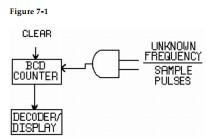 -Select the sequence for the counter in Figure 7- 1 that best describes its operation.
 (Multiple Choice)
4.9/5 (72)
(72) When two counters are cascaded, the overall MOD number is equal to the____of their individual MOD numbers
(Short Answer)
4.7/5 (82)
(82)
-What will the display reading in Figure 7- 1 be if the sampling interval is 100 ms and the unknown frequency is 200 kHz? (Assume the counter was cleared prior to the sampling interval.)
-What will the display reading in Figure 7- 1 be if the sampling interval is 100 ms and the unknown frequency is 200 kHz? (Assume the counter was cleared prior to the sampling interval.) (Multiple Choice)
4.8/5 (76)
(76) The + sign on a counter symbol by the input labeled CP indicates a count- up operation.
(True/False)
4.9/5 (79)
(79) Table 7- 1 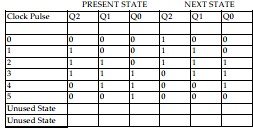 Table 7- 1 shows a state sequence used to program a GAL16V as a counter. The indicated sequence represents a:
 (Multiple Choice)
4.9/5 (77)
(77) Shift registers that are identified as parallel in/parallel out, serial in/parallel out, etc. are defined in this manner because:
(Multiple Choice)
4.8/5 (89)
(89) How many stages would be required for a cascaded BCD counter to provide a decimal count of 9,999?
(Multiple Choice)
4.7/5 (88)
(88) A MOD- 4 counter with an input clock frequency of 1500 Hz has an output frequency of 375 Hz.
(True/False)
4.9/5 (75)
(75) A major advantage of the synchronous counter over the nonsynchronous counter is its ability to:
(Multiple Choice)
4.8/5 (77)
(77) 
Filters
- Essay(0)
- Multiple Choice(0)
- Short Answer(0)
- True False(0)
- Matching(0)