



 Chat with AI
Exam 17: Monopolistic Competition

Exam 1: Ten Principles of Economics237 Questions
Exam 2: Thinking Like an Economist267 Questions
Exam 3: Interdependence and the Gains From Trade217 Questions
Exam 4: The Market Forces of Supply and Demand303 Questions
Exam 5: Elasticity and Its Applications282 Questions
Exam 6: Supply, demand, and Government Policies252 Questions
Exam 7: Consumers, producers, and the Efficiency of Markets248 Questions
Exam 8: Application: the Costs of Taxation245 Questions
Exam 9: Application: International Trade245 Questions
Exam 10: Externalities288 Questions
Exam 11: Public Goods and Common Resources258 Questions
Exam 12: The Design of the Tax System328 Questions
Exam 13: The Costs of Production303 Questions
Exam 14: Firms in Competitive Markets271 Questions
Exam 15: Monopoly306 Questions
Exam 16: Oligopoly291 Questions
Exam 17: Monopolistic Competition257 Questions
Exam 18: The Markets for the Factors of Production284 Questions
Exam 19: Earnings and Discrimination286 Questions
Exam 20: Income Inequality and Poverty247 Questions
Exam 21: The Theory of Consumer Choice238 Questions
Exam 22: Frontiers of Microeconomics199 Questions
Exam 23: Measuring a Nations Income215 Questions
Exam 24: Measuring the Cost of Living208 Questions
Exam 25: Production and Growth240 Questions
Exam 26: Saving, investment, and the Financial System282 Questions
Exam 27: The Basic Tools of Finance249 Questions
Exam 28: Unemployment242 Questions
Exam 29: The Monetary System277 Questions
Exam 30: Money Growth and Inflation224 Questions
Exam 31: Open-Economy Macroeconomics: Basic Concepts256 Questions
Exam 32: A Macroeconomic Theory of the Open Economy217 Questions
Exam 33: Aggregate Demand and Aggregate Supply302 Questions
Exam 34: The Influence of Monetary and Fiscal Policy on Aggregate Demand249 Questions
Exam 35: The Short Run Trade Off Between Inflation and Unemployment246 Questions
Exam 36: Five Debates Over Macroeconomic Policy140 Questions
Select questions type


A study of the market for optometrists' services in the 1960s showed that
(Multiple Choice)
4.8/5  (79)
(79) Advertisements that appear to convey no information at all
(Multiple Choice)
4.7/5 (77)
(77) Table 17-2
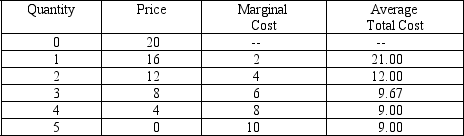 -Refer to Table 17-2.Which of the following statements regarding this monopolistically competitive firm is true?
 (Multiple Choice)
4.8/5 (81)
(81) When poor-quality products are advertised using cheap advertising,consumers learn to ignore such cheap advertising.
(True/False)
4.8/5 (84)
(84) Figure 17-5
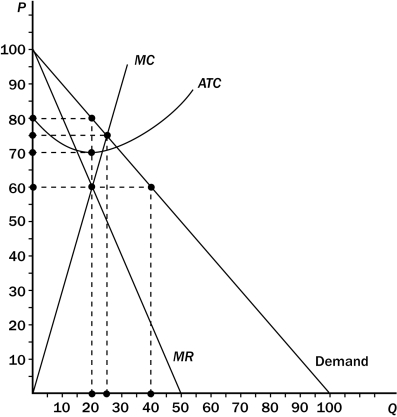 -Refer to Figure 17-5.This figure depicts a situation in a monopolistically competitive market.How much output will the monopolistically competitive firm produce in this situation?
 (Multiple Choice)
4.9/5 (92)
(92) In which of the following market structures can firms earn economic profits in the long run?
(Multiple Choice)
4.9/5 (72)
(72) The product-variety externality associated with monopolistic competition arises because in monopolistically competitive markets,
(Multiple Choice)
4.9/5 (75)
(75) Use a graph to demonstrate why a profit-maximizing monopolistically competitive firm must operate at excess capacity.Explain why a perfectly competitive firm is not subject to the same constraint.
(Essay)
4.9/5 (83)
(83) Figure 17-6
 -Refer to Figure 17-6.The maximum total short-run economic profit for the monopolistically competitive firm in this figure is
 (Multiple Choice)
4.9/5 (87)
(87) Table 17-2
-Refer to Table 17-2.This table shows the demand schedule,marginal cost,and average cost for a monopolistically competitive firm.What price should this firm charge to maximize profit?
-Refer to Table 17-2.This table shows the demand schedule,marginal cost,and average cost for a monopolistically competitive firm.What price should this firm charge to maximize profit? (Multiple Choice)
4.8/5 (74)
(74) Defenders of advertising argue that it is not rational for profit-maximizing firms to spend money on advertising for products that have
(Multiple Choice)
4.8/5 (84)
(84) A monopolistically competitive firm faces the following demand schedule for its product:  The firm has total fixed costs of $20 and a constant marginal cost of $2 per unit.The firm will maximize profit with
 (Multiple Choice)
4.8/5 (82)
(82) Suppose the point of tangency that characterizes long-run equilibrium for a monopolistically competitive firm occurs at Q₁ units of output.This level of output,Q₁,
(Multiple Choice)
4.8/5 (77)
(77) Table 17-3
Traci's Hairstyling is one salon among many in the market for hairstyling. The following table presents cost and revenue data for Traci's Hairstyling.
 -Refer to Table 17-3.If the government forced Traci's to produce at the efficient scale of output,what is the maximum profit Traci's could earn?
 (Multiple Choice)
4.7/5 (71)
(71) Figure 17-1
 -Refer to Figure 17-1.The firm depicted in panel b faces a horizontal demand curve.If panel b depicts a profit-maximizing firm,
 (Multiple Choice)
4.7/5 (77)
(77) Figure 17-1
-Refer to Figure 17-1.Which of the graphs depicts the situation for a profit-maximizing firm in a monopolistically competitive market?
-Refer to Figure 17-1.Which of the graphs depicts the situation for a profit-maximizing firm in a monopolistically competitive market? (Multiple Choice)
4.8/5 (70)
(70) Empirical evidence suggests that advertising usually leads to an increase in the price for advertised products.
(True/False)
5.0/5 (88)
(88) One way in which monopolistic competition differs from oligopoly is that
(Multiple Choice)
4.8/5 (76)
(76) In the long run,a monopolistically competitive firm produces a quantity that is
(Multiple Choice)
4.7/5 (74)
(74) 
Filters
- Essay(0)
- Multiple Choice(0)
- Short Answer(0)
- True False(0)
- Matching(0)