



 Chat with AI
Exam 17: Monopolistic Competition

Exam 1: Ten Principles of Economics237 Questions
Exam 2: Thinking Like an Economist267 Questions
Exam 3: Interdependence and the Gains From Trade217 Questions
Exam 4: The Market Forces of Supply and Demand303 Questions
Exam 5: Elasticity and Its Applications282 Questions
Exam 6: Supply, demand, and Government Policies252 Questions
Exam 7: Consumers, producers, and the Efficiency of Markets248 Questions
Exam 8: Application: the Costs of Taxation245 Questions
Exam 9: Application: International Trade245 Questions
Exam 10: Externalities288 Questions
Exam 11: Public Goods and Common Resources258 Questions
Exam 12: The Design of the Tax System328 Questions
Exam 13: The Costs of Production303 Questions
Exam 14: Firms in Competitive Markets271 Questions
Exam 15: Monopoly306 Questions
Exam 16: Oligopoly291 Questions
Exam 17: Monopolistic Competition257 Questions
Exam 18: The Markets for the Factors of Production284 Questions
Exam 19: Earnings and Discrimination286 Questions
Exam 20: Income Inequality and Poverty247 Questions
Exam 21: The Theory of Consumer Choice238 Questions
Exam 22: Frontiers of Microeconomics199 Questions
Exam 23: Measuring a Nations Income215 Questions
Exam 24: Measuring the Cost of Living208 Questions
Exam 25: Production and Growth240 Questions
Exam 26: Saving, investment, and the Financial System282 Questions
Exam 27: The Basic Tools of Finance249 Questions
Exam 28: Unemployment242 Questions
Exam 29: The Monetary System277 Questions
Exam 30: Money Growth and Inflation224 Questions
Exam 31: Open-Economy Macroeconomics: Basic Concepts256 Questions
Exam 32: A Macroeconomic Theory of the Open Economy217 Questions
Exam 33: Aggregate Demand and Aggregate Supply302 Questions
Exam 34: The Influence of Monetary and Fiscal Policy on Aggregate Demand249 Questions
Exam 35: The Short Run Trade Off Between Inflation and Unemployment246 Questions
Exam 36: Five Debates Over Macroeconomic Policy140 Questions
Select questions type


When a new firm enters a monopolistically competitive market,the individual demand curves faced by all existing firms in that market will
(Multiple Choice)
4.8/5  (84)
(84) Which of the following statements regarding monopolistic competition is false?
(Multiple Choice)
4.8/5 (79)
(79) Monopolistic competition differs from perfect competition because in monopolistically competitive markets
(Multiple Choice)
5.0/5 (67)
(67) Assume the role of a defender of advertising.Describe the characteristics of advertising that enhance the effectiveness of markets and increase the social welfare of society.
(Essay)
4.8/5 (94)
(94) Advertising that uses celebrity endorsements is most likely intended to
(Multiple Choice)
4.9/5 (84)
(84) Table 17-1
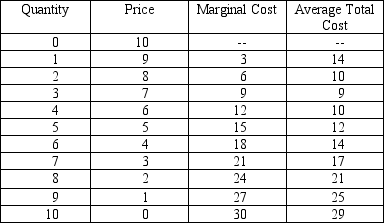 -Refer to Table 17-1.This table shows the demand schedule,marginal cost,and average total cost for a monopolistically competitive firm.What price will this firm charge to maximize profit?
 (Multiple Choice)
4.7/5 (80)
(80) The debate over the efficiency of markets in which products with brand names are sold
(Multiple Choice)
4.8/5 (82)
(82) What is meant by the term "excess capacity" as it relates to monopolistically competitive firms?
(Essay)
4.9/5 (85)
(85) Two soft drinks sit side-by-side in a grocery store: A six-pack of Coca-Cola (a brand name)sells for $3.00,while a six-pack of Uncle Don's cola (not a brand name)sells for $1.50.Even defenders of brand names would have to admit that
(Multiple Choice)
5.0/5 (71)
(71) New firms will likely enter a monopolistically competitive market when price exceeds
(Multiple Choice)
4.9/5 (75)
(75) Figure 17-2
 -Refer to Figure 17-2.Which of the graphs shown would be consistent with a firm in a monopolistically competitive market that is earning a positive profit?
 (Multiple Choice)
4.9/5 (79)
(79) When a firm's demand curve is tangent to its average total cost curve,the
(Multiple Choice)
4.9/5 (72)
(72) Ignoring oligopoly and focusing on the other three market structures,in which of those market structures does a profit-maximizing firm experience zero economic profit?
(Multiple Choice)
4.9/5 (73)
(73) As developing countries make a transition to market-based economies,one of the first major capital investments is in "Western-quality" hotels.Explain why "brand-name" hotel accommodations are a critical step in attracting foreign investment.
(Essay)
4.9/5 (86)
(86) A firm in a monopolistically competitive market is usually indifferent to an additional customer walking through the door,since a sale to that customer will not increase the firm's profit.
(True/False)
4.9/5 (66)
(66) In which of the following product markets are we likely to observe the largest amount of advertising?
(Multiple Choice)
4.9/5 (73)
(73) 
Filters
- Essay(0)
- Multiple Choice(0)
- Short Answer(0)
- True False(0)
- Matching(0)