



 Chat with AI
Exam 17: Monopolistic Competition

Exam 1: Ten Principles of Economics237 Questions
Exam 2: Thinking Like an Economist267 Questions
Exam 3: Interdependence and the Gains From Trade217 Questions
Exam 4: The Market Forces of Supply and Demand303 Questions
Exam 5: Elasticity and Its Applications282 Questions
Exam 6: Supply, demand, and Government Policies252 Questions
Exam 7: Consumers, producers, and the Efficiency of Markets248 Questions
Exam 8: Application: the Costs of Taxation245 Questions
Exam 9: Application: International Trade245 Questions
Exam 10: Externalities288 Questions
Exam 11: Public Goods and Common Resources258 Questions
Exam 12: The Design of the Tax System328 Questions
Exam 13: The Costs of Production303 Questions
Exam 14: Firms in Competitive Markets271 Questions
Exam 15: Monopoly306 Questions
Exam 16: Oligopoly291 Questions
Exam 17: Monopolistic Competition257 Questions
Exam 18: The Markets for the Factors of Production284 Questions
Exam 19: Earnings and Discrimination286 Questions
Exam 20: Income Inequality and Poverty247 Questions
Exam 21: The Theory of Consumer Choice238 Questions
Exam 22: Frontiers of Microeconomics199 Questions
Exam 23: Measuring a Nations Income215 Questions
Exam 24: Measuring the Cost of Living208 Questions
Exam 25: Production and Growth240 Questions
Exam 26: Saving, investment, and the Financial System282 Questions
Exam 27: The Basic Tools of Finance249 Questions
Exam 28: Unemployment242 Questions
Exam 29: The Monetary System277 Questions
Exam 30: Money Growth and Inflation224 Questions
Exam 31: Open-Economy Macroeconomics: Basic Concepts256 Questions
Exam 32: A Macroeconomic Theory of the Open Economy217 Questions
Exam 33: Aggregate Demand and Aggregate Supply302 Questions
Exam 34: The Influence of Monetary and Fiscal Policy on Aggregate Demand249 Questions
Exam 35: The Short Run Trade Off Between Inflation and Unemployment246 Questions
Exam 36: Five Debates Over Macroeconomic Policy140 Questions
Select questions type


Hotels in New York City frequently experience an average vacancy rate of about 20 percent (i.e.,on an average night,80 percent of the hotel rooms are full).This kind of excess capacity is indicative of what kind of market?
(Multiple Choice)
4.9/5  (86)
(86) ABC Company knows that it produces and sells a very good mouse trap.XYZ Company knows that it produces and sells a lousy mouse trap.According to the "signaling theory" of advertising,the quality difference likely produces the result that
(Multiple Choice)
4.8/5 (73)
(73) Product differentiation causes the seller of a good to face what type of demand curve?
(Multiple Choice)
4.7/5 (86)
(86) Figure 17-6
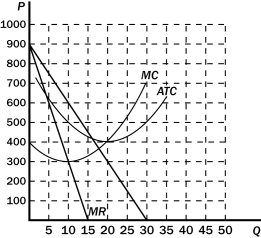 -Refer to Figure 17-6.The firm in this figure is monopolistically competitive.It illustrates
 (Multiple Choice)
4.9/5 (81)
(81) Scenario 17-2
Consider the problem facing two firms, Firm A and Firm B, in the fast-food restaurant market. Each firm has just come up with an idea for a new fast-food menu item which it would sell for $4. Assume that the marginal cost for each new menu item is a constant $2, and the only fixed cost is for advertising. Each company knows that if it spends $12 million on advertising it will get 2 million consumers to try its new product. Firm A has done market research which suggests that its product does not have any "staying" power in the market. Even though it could get 2 million consumers to buy the product once, it is unlikely that they will continue to buy the product in the future. Firm B's market research suggests that its product is very good, and consumers who try the product will continue to be consumers over the ensuing year. On the basis of its market research, Firm B estimates that its initial 2 million customers will buy one unit of the product each month in the coming year, for a total of 24 million units.
-Refer to Scenario 17-2.On the basis of a theory that people buy a product because it is advertised,the content of advertisements for Firm B's product
(Multiple Choice)
4.8/5 (79)
(79) Figure 17-3
The lines in the figures below illustrate the potential effect of entry and exit in a monopolistically competitive market on either the demand curve or the marginal cost curve of existing firms.
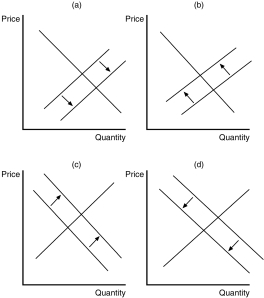 -Refer to Figure 17-3.Panel (d)illustrates the change that would occur if existing firms faced
 (Multiple Choice)
4.8/5 (81)
(81) In a small college town,four microbreweries have opened in the last two years.Demonstrate the effect of these new market entrants on demand for existing firms (microbreweries)that already served this market.Assume that the local community now places a moratorium on new liquor licenses for microbreweries.How will this moratorium affect the long-run profitability of incumbent firms?
(Essay)
4.8/5 (78)
(78) Economists who argue that advertising enhances market efficiency suggest that celebrity advertising signals inferior product quality.
(True/False)
4.7/5 (87)
(87) List five goods that are likely sold in a monopolistically competitive market.
(Essay)
4.8/5 (88)
(88) For a profit-maximizing firm in a monopolistically competitive market,when price is equal to average total cost,price must lie above marginal cost.
(True/False)
4.8/5 (77)
(77) According to the "signaling theory" of advertising,consumers
(Multiple Choice)
4.7/5 (73)
(73) The entry of new firms into a monopolistically competitive market is accompanied by
(Multiple Choice)
4.8/5 (68)
(68) Which of the following markets would most likely be represented by monopolistic competition?
(Multiple Choice)
5.0/5 (81)
(81) In markets where restrictions on advertising have been used to curtail competition,the U.S.courts have generally
(Multiple Choice)
4.9/5 (69)
(69) Brand names are rarely used to convey information about product quality.
(True/False)
4.9/5 (89)
(89) For a monopolistically competitive firm,at the profit-maximizing quantity of output,
(Multiple Choice)
4.8/5 (89)
(89) 
Filters
- Essay(0)
- Multiple Choice(0)
- Short Answer(0)
- True False(0)
- Matching(0)