



 Chat with AI
Exam 17: Monopolistic Competition

Exam 1: Ten Principles of Economics237 Questions
Exam 2: Thinking Like an Economist267 Questions
Exam 3: Interdependence and the Gains From Trade217 Questions
Exam 4: The Market Forces of Supply and Demand303 Questions
Exam 5: Elasticity and Its Applications282 Questions
Exam 6: Supply, demand, and Government Policies252 Questions
Exam 7: Consumers, producers, and the Efficiency of Markets248 Questions
Exam 8: Application: the Costs of Taxation245 Questions
Exam 9: Application: International Trade245 Questions
Exam 10: Externalities288 Questions
Exam 11: Public Goods and Common Resources258 Questions
Exam 12: The Design of the Tax System328 Questions
Exam 13: The Costs of Production303 Questions
Exam 14: Firms in Competitive Markets271 Questions
Exam 15: Monopoly306 Questions
Exam 16: Oligopoly291 Questions
Exam 17: Monopolistic Competition257 Questions
Exam 18: The Markets for the Factors of Production284 Questions
Exam 19: Earnings and Discrimination286 Questions
Exam 20: Income Inequality and Poverty247 Questions
Exam 21: The Theory of Consumer Choice238 Questions
Exam 22: Frontiers of Microeconomics199 Questions
Exam 23: Measuring a Nations Income215 Questions
Exam 24: Measuring the Cost of Living208 Questions
Exam 25: Production and Growth240 Questions
Exam 26: Saving, investment, and the Financial System282 Questions
Exam 27: The Basic Tools of Finance249 Questions
Exam 28: Unemployment242 Questions
Exam 29: The Monetary System277 Questions
Exam 30: Money Growth and Inflation224 Questions
Exam 31: Open-Economy Macroeconomics: Basic Concepts256 Questions
Exam 32: A Macroeconomic Theory of the Open Economy217 Questions
Exam 33: Aggregate Demand and Aggregate Supply302 Questions
Exam 34: The Influence of Monetary and Fiscal Policy on Aggregate Demand249 Questions
Exam 35: The Short Run Trade Off Between Inflation and Unemployment246 Questions
Exam 36: Five Debates Over Macroeconomic Policy140 Questions
Select questions type


Scenario 17-1
Vacation Inns of America (VIA) has recently announced intentions of building a new hotel/resort complex in Myrtle Beach, South Carolina. Assume that the hotel/resort market in Myrtle Beach is characterized by monopolistic competition.
-Refer to Scenario 17-1.As a result of the new VIA hotel/resort,tourists who stay in Myrtle Beach are likely to experience a
(Multiple Choice)
4.9/5  (78)
(78) In a long-run equilibrium,a firm in a monopolistically competitive market operates
(Multiple Choice)
4.9/5 (76)
(76) In monopolistically competitive markets,positive economic profits
(Multiple Choice)
4.8/5 (64)
(64) Table 17-2
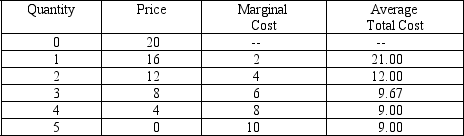 -Refer to Table 17-2.This table shows the demand schedule,marginal cost,and average cost for a monopolistically competitive firm.How much profit will this firm earn at the monopolistically competitive price?
 (Multiple Choice)
4.9/5 (71)
(71) A profit-maximizing firm in a monopolistically competitive market is characterized by which of the following?
(Multiple Choice)
5.0/5 (75)
(75) To maximize its profit,a monopolistically competitive firm chooses its level of output by looking for the
(Multiple Choice)
4.8/5 (73)
(73) The deadweight loss that is associated with a monopolistically competitive market is a result of
(Multiple Choice)
4.9/5 (77)
(77) Figure 17-1
 -Refer to Figure 17-1.If a firm in a monopolistically competitive market was producing the level of output depicted as Qd in panel (d),it would
 (Multiple Choice)
4.8/5 (70)
(70) Figure 17-4
 -Refer to Figure 17-4.Which of the panels shown could illustrate the short-run situation for a monopolistically competitive firm?
 (Multiple Choice)
4.7/5 (76)
(76) A profit-maximizing firm in a monopolistically competitive market always operates on the downward-sloping portion of its marginal cost curve.
(True/False)
4.9/5 (84)
(84) In markets where the government imposes an excise tax on unit sales,it also has a tendency to dabble with restrictions on advertising (for example,cigarettes and hard liquor).Do potential (or actual)restrictions on advertising in these markets serve the interest of a government that is interested in maximizing its tax revenue from the sale of these products? Explain your answer.
(Essay)
4.9/5 (77)
(77) Which of the following statements is correct? Among arguments for and against advertising,both sides agree that advertising leads to
(Multiple Choice)
4.8/5 (81)
(81) Product differentiation always leads to some measure of market power.
(True/False)
4.8/5 (69)
(69) Consider a monopolistically competitive firm in a market in long-run equilibrium.This firm is likely
(Multiple Choice)
4.8/5 (75)
(75) Which of the following markets is not likely characterized by a monopolistically competitive market?
(Multiple Choice)
4.9/5 (75)
(75) Evaluate the following statement in the context of business-stealing and product-variety externalities: "We have too many student apartments in this town already.Statistics show that vacancy rates average 15 percent during any given semester."
(Essay)
4.8/5 (75)
(75) In monopolistically competitive markets,free entry and exit suggests that
(Multiple Choice)
4.9/5 (81)
(81) As new firms enter a monopolistically competitive market,profits of existing firms
(Multiple Choice)
5.0/5 (79)
(79) Critics of advertising argue that advertising leads to less elastic demand for products and a larger markup of price over marginal cost.
(True/False)
4.9/5 (84)
(84) 
Filters
- Essay(0)
- Multiple Choice(0)
- Short Answer(0)
- True False(0)
- Matching(0)