



 Chat with AI
Exam 17: Monopolistic Competition

Exam 1: Ten Principles of Economics237 Questions
Exam 2: Thinking Like an Economist267 Questions
Exam 3: Interdependence and the Gains From Trade217 Questions
Exam 4: The Market Forces of Supply and Demand303 Questions
Exam 5: Elasticity and Its Applications282 Questions
Exam 6: Supply, demand, and Government Policies252 Questions
Exam 7: Consumers, producers, and the Efficiency of Markets248 Questions
Exam 8: Application: the Costs of Taxation245 Questions
Exam 9: Application: International Trade245 Questions
Exam 10: Externalities288 Questions
Exam 11: Public Goods and Common Resources258 Questions
Exam 12: The Design of the Tax System328 Questions
Exam 13: The Costs of Production303 Questions
Exam 14: Firms in Competitive Markets271 Questions
Exam 15: Monopoly306 Questions
Exam 16: Oligopoly291 Questions
Exam 17: Monopolistic Competition257 Questions
Exam 18: The Markets for the Factors of Production284 Questions
Exam 19: Earnings and Discrimination286 Questions
Exam 20: Income Inequality and Poverty247 Questions
Exam 21: The Theory of Consumer Choice238 Questions
Exam 22: Frontiers of Microeconomics199 Questions
Exam 23: Measuring a Nations Income215 Questions
Exam 24: Measuring the Cost of Living208 Questions
Exam 25: Production and Growth240 Questions
Exam 26: Saving, investment, and the Financial System282 Questions
Exam 27: The Basic Tools of Finance249 Questions
Exam 28: Unemployment242 Questions
Exam 29: The Monetary System277 Questions
Exam 30: Money Growth and Inflation224 Questions
Exam 31: Open-Economy Macroeconomics: Basic Concepts256 Questions
Exam 32: A Macroeconomic Theory of the Open Economy217 Questions
Exam 33: Aggregate Demand and Aggregate Supply302 Questions
Exam 34: The Influence of Monetary and Fiscal Policy on Aggregate Demand249 Questions
Exam 35: The Short Run Trade Off Between Inflation and Unemployment246 Questions
Exam 36: Five Debates Over Macroeconomic Policy140 Questions
Select questions type


Each firm in a monopolistically competitive firm faces a downward-sloping demand curve because
(Multiple Choice)
5.0/5  (67)
(67) When consumers are exposed to additional choices that result from the introduction of a new product,
(Multiple Choice)
4.7/5 (73)
(73) Both monopolistic competition and oligopoly are market structures
(Multiple Choice)
4.8/5 (73)
(73) Advertising during the Super Bowl is an example of information about quality contained primarily in the existence and expense of the advertising.
(True/False)
4.9/5 (70)
(70) Under which of the following market structures would consumers likely receive the most product variety?
(Multiple Choice)
4.9/5 (71)
(71) A monopolistically competitive firm faces the following demand curve for its product:  The firm has total fixed costs of $20 and a constant marginal cost of $5 per unit.The firm will maximize profit with the production of
 (Multiple Choice)
4.9/5 (78)
(78) Scenario 17-1
Vacation Inns of America (VIA) has recently announced intentions of building a new hotel/resort complex in Myrtle Beach, South Carolina. Assume that the hotel/resort market in Myrtle Beach is characterized by monopolistic competition.
-Refer to Scenario 17-1.Existing hotels,motels,and lodging facilities in Myrtle Beach are likely to experience what kind of externality as a result of the new VIA hotel/resort?
(Multiple Choice)
5.0/5 (70)
(70) Discuss how "brand names" may enhance the efficiency of markets in a less developed country.
(Essay)
4.8/5 (84)
(84) A firm has the following cost structure:  If this firm is in a typical monopolistically competitive market,it will likely produce
 (Multiple Choice)
4.9/5 (85)
(85) Perhaps it's not a problem at all,but if "too much choice" is a problem for consumers,it would occur in which market structure(s)?
(Multiple Choice)
4.9/5 (81)
(81) The claim that advertising reduces the elasticity of demand is likely to be made by a defender of advertising.
(True/False)
4.7/5 (81)
(81) Critics of markets that are characterized by firms that sell "brand" name products argue that brand names encourage consumers to pay more for branded products that
(Multiple Choice)
4.9/5 (68)
(68) Examples of monopolistically competitive markets include the markets for
(Multiple Choice)
4.8/5 (83)
(83) Figure 17-5
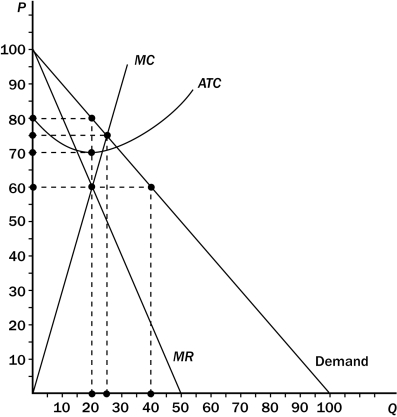 -Refer to Figure 17-5.This figure depicts a situation in a monopolistically competitive market.What price will the monopolistically competitive firm charge in this market?
 (Multiple Choice)
4.7/5 (95)
(95) Since a firm in a monopolistically competitive market faces a
(Multiple Choice)
4.7/5 (86)
(86) "In a long-run equilibrium,price is equal to average total cost." This statement applies to
(Multiple Choice)
4.9/5 (85)
(85) Figure 17-4
 -Refer to Figure 17-4.Panel (b)is consistent with a firm in a monopolistically competitive market that is
 (Multiple Choice)
4.8/5 (91)
(91) Most businesses advertise their products and services.Some business use SPAM emails to advertise because the cost of a mass e-mail is close to zero.Other business spend millions of dollars to advertise in a 30-second spot during the super bowl.Having observed this real world data,economists argue that the amount of money that a business spends on advertising is a proxy for a good or service's
(Multiple Choice)
4.7/5 (88)
(88) Firm A is a perfectly competitive firm.Firm B is a monopolistically competitive firm.Both firms are currently maximizing their respective profits.Which of the following statements is correct?
(Multiple Choice)
4.9/5 (84)
(84) 
Filters
- Essay(0)
- Multiple Choice(0)
- Short Answer(0)
- True False(0)
- Matching(0)