



 Chat with AI
Exam 2: Nucleic Acids

Exam 1: The Chemical Foundations of Biochemistry28 Questions
Exam 2: Nucleic Acids32 Questions
Exam 3: Proteins I31 Questions
Exam 4: Proteins Iienzymes41 Questions
Exam 5: Membranes and an Introduction to Signal Transduction33 Questions
Exam 6: Carbohydrates I46 Questions
Exam 7: The Common Catabolic Pathway41 Questions
Exam 8: Carbohydrates II19 Questions
Exam 9: Lipids I37 Questions
Exam 10: Lipids II21 Questions
Exam 11: Amine Metabolism16 Questions
Exam 12: Metabolism Integration19 Questions
Exam 13: Nucleotide Deoxynucleotide Metabolism40 Questions
Exam 14: Dna Replication, Damage and Repair38 Questions
Exam 15: Rna Synthesis40 Questions
Exam 16: Protein45 Questions
Exam 17: Control of Gene45 Questions
Exam 18: Determination of Macromolecular Structure60 Questions
Exam 19: Allosterism and Receptor-Ligand49 Questions
Exam 20: Designer Proteins and Protein Folding59 Questions
Exam 21: Biomolecule Purification57 Questions
Exam 22: Bioinformatics and Omics29 Questions
Exam 23: Signal51 Questions
Exam 24: Protein Trafficking57 Questions
Exam 25: Photosynthesis Nitrogen39 Questions
Select questions type


The most commonly used technique for making large numbers of copies of DNA is _____.
(Multiple Choice)
4.9/5  (72)
(72) This is the structure of adenine.
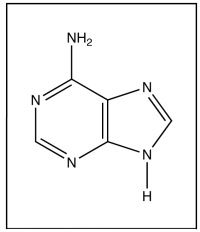 a. Is adenine a purine or a pyrimidine?
b. Which base does adenine base-pair (H-bond) with in DNA?
c. What is the name of the molecule that is composed of adenine linked to the C-1ꞌ of ribose?
d. Indicate on the drawing through which atom adenine is connected to ribose or deoxyribose.
e. Indicate on the drawing which groups on adenine are involved in base-pairing or H-bonding with its complementary base.
a. Is adenine a purine or a pyrimidine?
b. Which base does adenine base-pair (H-bond) with in DNA?
c. What is the name of the molecule that is composed of adenine linked to the C-1ꞌ of ribose?
d. Indicate on the drawing through which atom adenine is connected to ribose or deoxyribose.
e. Indicate on the drawing which groups on adenine are involved in base-pairing or H-bonding with its complementary base. (Short Answer)
4.9/5 (84)
(84) An E. coli has _____ replication fork(s) on its single chromosome; humans have _____ replication fork(s) on each chromosome.
(Multiple Choice)
4.9/5 (86)
(86) The pyrimidine found in both DNA and RNA is _____. The pyrimidine found only in DNA is _____, and the pyrimidine found only in RNA is _____.
(Short Answer)
4.8/5 (86)
(86) Which of the following best describes a new strand of DNA relative to the template strand used to synthesize it?
(Multiple Choice)
4.8/5 (64)
(64) Which of the following correctly describes the B-DNA double helix?
(Multiple Choice)
4.8/5 (80)
(80) The replication of DNA is made possible by the presence of _____ strands in the double helix of DNA.
(Multiple Choice)
4.8/5 (80)
(80) What term describes the production of multiple identical organisms from a single ancestor?
(Multiple Choice)
4.9/5 (91)
(91) Incorporation of which of the following would result in chain termination during sequencing of DNA?
(Multiple Choice)
4.8/5 (65)
(65) Nucleotides contain one or more phosphate groups that are usually attached to the ______.
(Multiple Choice)
4.9/5 (80)
(80) 
Filters
- Essay(0)
- Multiple Choice(0)
- Short Answer(0)
- True False(0)
- Matching(0)