



 Chat with AI
Exam 6: Carbohydrates I

Exam 1: The Chemical Foundations of Biochemistry28 Questions
Exam 2: Nucleic Acids32 Questions
Exam 3: Proteins I31 Questions
Exam 4: Proteins Iienzymes41 Questions
Exam 5: Membranes and an Introduction to Signal Transduction33 Questions
Exam 6: Carbohydrates I46 Questions
Exam 7: The Common Catabolic Pathway41 Questions
Exam 8: Carbohydrates II19 Questions
Exam 9: Lipids I37 Questions
Exam 10: Lipids II21 Questions
Exam 11: Amine Metabolism16 Questions
Exam 12: Metabolism Integration19 Questions
Exam 13: Nucleotide Deoxynucleotide Metabolism40 Questions
Exam 14: Dna Replication, Damage and Repair38 Questions
Exam 15: Rna Synthesis40 Questions
Exam 16: Protein45 Questions
Exam 17: Control of Gene45 Questions
Exam 18: Determination of Macromolecular Structure60 Questions
Exam 19: Allosterism and Receptor-Ligand49 Questions
Exam 20: Designer Proteins and Protein Folding59 Questions
Exam 21: Biomolecule Purification57 Questions
Exam 22: Bioinformatics and Omics29 Questions
Exam 23: Signal51 Questions
Exam 24: Protein Trafficking57 Questions
Exam 25: Photosynthesis Nitrogen39 Questions
Select questions type


Which of the following is an inhibitor of pyruvate dehydrogenase?
(Multiple Choice)
4.8/5  (69)
(69) What pathway is used to make glucose from other metabolites such as pyruvate or lactate?
(Multiple Choice)
4.8/5 (79)
(79) Unlike proteins and oligonucleotides, polysaccharides _____.
(Multiple Choice)
4.9/5 (67)
(67) What type of bond forms when the hydroxyethyl group is transferred to lipoamide?
(Multiple Choice)
4.7/5 (79)
(79) Describe the properties, structures, and functions of the major categories of monosaccharides. 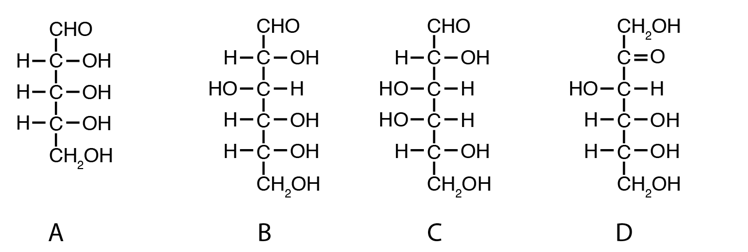 -Which structure(s) shown in the figure above represent reducing sugar(s)?
 (Multiple Choice)
4.8/5 (93)
(93) Which of the following is true concerning the reaction catalyzed by pyruvate dehydrogenase?
(Multiple Choice)
4.8/5 (86)
(86) Which of the following is the major difference between glycogen and amylopectin?
(Multiple Choice)
4.7/5 (82)
(82) Which of the following contains a bond that is used for a substrate-level phosphorylation in glycolysis?
(Multiple Choice)
4.9/5 (89)
(89) Which of the following compounds is used to produce ATP by substrate-level phosphorylation in glycolysis?
(Multiple Choice)
4.7/5 (68)
(68) Which enzyme is responsible for splitting a hexose into two trioses?
(Multiple Choice)
4.9/5 (71)
(71) Both (1 4) and (1 6) bonds can be found in the plant product______.
(Short Answer)
4.8/5 (84)
(84) Which enzyme catalyzes the major regulatory step of glycolysis?
(Multiple Choice)
4.9/5 (80)
(80) Under aerobic conditions, pyruvate is converted to _____ by pyruvate dehydrogenase.
(Multiple Choice)
4.8/5 (81)
(81) If a cell were given glucose labeled at C-3 with 14C, which carbon(s) of pyruvate would contain the label?
(Multiple Choice)
4.9/5 (74)
(74) In the catabolic pathway, major nutrients are _____ broken down mainly resulting in more _____ metabolites.
(Multiple Choice)
4.8/5 (86)
(86) _____ is a homopolymer composed of (1-4)-linked N-acetyl-D-Glucosamine residues that is the principle structural component of the exoskeleton of various groups of invertebrates.
(Short Answer)
4.8/5 (79)
(79) 
Filters
- Essay(0)
- Multiple Choice(0)
- Short Answer(0)
- True False(0)
- Matching(0)