



 Chat with AI
Exam 12: Monopoly

Exam 1: The Principles and Practice of Economics103 Questions
Exam 2: Economic Methods and Economic Questions94 Questions
Exam 3: Optimization: Doing the Best You Can94 Questions
Exam 4: Demand, supply, and Equilibrium185 Questions
Exam 5: Consumers and Incentives187 Questions
Exam 6: Sellers and Incentives261 Questions
Exam 7: Perfect Competition and the Invisible Hand251 Questions
Exam 8: Trade264 Questions
Exam 9: Externalities and Public Goods223 Questions
Exam 10: The Government in the Economy: Taxation and Regulation244 Questions
Exam 11: Markets for Factors of Production237 Questions
Exam 12: Monopoly295 Questions
Exam 13: Game Theory and Strategic Play199 Questions
Exam 14: Oligopoly and Monopolistic Competition264 Questions
Exam 15: Trade-Offs Involving Time and Risk147 Questions
Exam 16: The Economics of Information119 Questions
Exam 17: Auctions and Bargaining123 Questions
Exam 18: Social Economics111 Questions
Select questions type


Which of the following statements is true of price-makers?
(Multiple Choice)
4.9/5  (73)
(73) Scenario: When a monopolist charges $5 for its product, it sells 250 units of the product. When it decreases the price of the product to $4, it sells 325 units of the product.
-Refer to the scenario above.What is the change in total revenue due to the price reduction?
(Multiple Choice)
4.8/5 (73)
(73) You are good at creating Web sites.You make a social media Web site similar to Facebook,but after a while your Web site does not get enough attention and your business fails.This is because ________.
(Multiple Choice)
4.8/5 (73)
(73) The following figure shows the marginal revenue (MR), marginal cost (MC), and demand (D) curves for a firm operating as a monopoly.
 -Refer to the figure above.Compared to the competitive market outcome,when the monopolists sets its price to the optimal price,by how much is the price increased?
 (Multiple Choice)
4.9/5 (72)
(72) Which of the following is an example of legal market power?
(Multiple Choice)
4.8/5 (78)
(78) Scenario: Suppose the monopolist faces the following demand, total revenue, and marginal revenue curves:
Demand: Qᵈ = 100 - p,
Total Revenue: TR(Q) = 100 ∙ Q - Q²,
Marginal Revenue: MR(Q) = 100 - 2 ∙ Q.
This monopolist's total cost, average total cost, and marginal cost curves are given by
Total Cost: TC(Q) = 10 ∙ Q +  ∙ Q²,
Average Total Cost: ATC(Q) = 10 +
 ∙ Q,
Marginal Cost: MC(Q) = 10 + Q.
The monopolist's profit function is given by
Profits: π (P,Q) = Total Revenue - Total Cost
Profits: π (P,Q) = P ∙ Q - TC(Q),
Profits: π (P,Q) = Q ∙
 ,
Profits: π (P,Q) =
 ∙ Q,
Profits: π (P,Q) = [P - ATC(Q)] ∙ Q, so
Profits: π (P,Q) = Total Revenue - Total Cost
Profits: π (P,Q) = [100 ∙ Q - Q²] -
 , or
Profits: π (P,Q) =
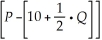 ∙ Q.
These revenue and cost curves are presented in table form below.
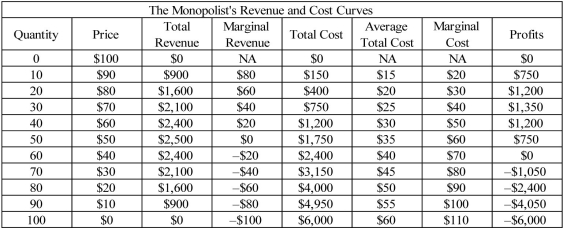 -Refer to the scenario above.Given the revenue and cost information,the monopolist will maximize profits by producing ________ units of output.
∙ Q²,
Average Total Cost: ATC(Q) = 10 + ∙ Q,
Marginal Cost: MC(Q) = 10 + Q.
The monopolist's profit function is given by
Profits: π (P,Q) = Total Revenue - Total Cost
Profits: π (P,Q) = P ∙ Q - TC(Q),
Profits: π (P,Q) = Q ∙ ,
Profits: π (P,Q) = ∙ Q,
Profits: π (P,Q) = [P - ATC(Q)] ∙ Q, so
Profits: π (P,Q) = Total Revenue - Total Cost
Profits: π (P,Q) = [100 ∙ Q - Q²] - , or
Profits: π (P,Q) = ∙ Q.
These revenue and cost curves are presented in table form below.
-Refer to the scenario above.Given the revenue and cost information,the monopolist will maximize profits by producing ________ units of output. (Multiple Choice)
4.9/5 (73)
(73) John uses WhatsApp Messenger to communicate with his friends.When he initially started using it,the messenger was not very popular among his friends,and John did not spend much time on it.As more and more of John's friends started using the messenger,the messenger's value to John increased substantially.What kind of externality is reflected in this example?
(Essay)
4.9/5 (65)
(65) The figure below shows the demand curve in a monopoly market.
 -Refer to the figure above.This monopolist initially produced 6 units,and now has a new plan to produce 8 units of this good.The quantity effect of this plan on the revenue of the monopolist is ________.
 (Multiple Choice)
4.9/5 (86)
(86) Economist Reuben Kessel wrote an influential article in 1958 analyzing price discrimination by medical care providers.Kessel interviewed several doctors and dentists in Los Angeles,and found that these providers often provided fee-for-service treatment to traveling business professionals but charged each patient a different amount.These health care providers told Kessel they had their receptionists see the make of car the individual was driving when determining the fee (along with other information the provider gleaned about the client).Assume this information revealed each client's willingness to pay.This is an example of ________.
(Multiple Choice)
4.9/5 (86)
(86) Which of the following is true of a decrease in product prices?
(Multiple Choice)
5.0/5 (69)
(69) Scenario: When a monopolist charges $10 for its product, it sells 500 units of the product. When it lowers the price to $6, it sells 1,400 units of the product.
-Refer to the scenario above.What is the price effect of the price change?
(Multiple Choice)
4.7/5 (91)
(91) At the profit-maximizing level of production of a monopolist,________.
(Multiple Choice)
4.8/5 (71)
(71) Suppose that a firm in a competitive market succeeds in producing a superior product and selling it at a price that generates a large demand.As a result,the firm's market share is almost 100 percent.Meanwhile,other firms are trying to regain their market shares through research and development.Is this firm a monopolist?
(Multiple Choice)
4.9/5 (66)
(66) The following figure shows the demand curve faced by a monopolist.
 -Refer to the figure above.What is the price effect of a price reduction from $6 to $4?
 (Multiple Choice)
4.9/5 (79)
(79) The following figure shows the marginal revenue (MR), marginal cost (MC), and demand (D) curves for a firm operating as a monopoly.
-Refer to the figure above.The level of output that corresponds to maximum revenue is ________.
-Refer to the figure above.The level of output that corresponds to maximum revenue is ________. (Multiple Choice)
4.9/5 (81)
(81) Suppose there are two market structures: Market A and Market B.Market A is characterized by the free entry and exit of firms,and the firms in the market face a horizontal demand curve.Market B has only one seller.
a)Identify the market structures.
b)Comment on the pricing mechanism,long-run profitability,and social surplus under both market structures.
(Essay)
5.0/5 (55)
(55) The socially optimal price is to set the price for a regulated monopolist ________.
(Multiple Choice)
4.9/5 (77)
(77) Buyers who buy in bulk are often offered discounts.This is an example of ________.
(Multiple Choice)
4.8/5 (75)
(75) 
Filters
- Essay(0)
- Multiple Choice(0)
- Short Answer(0)
- True False(0)
- Matching(0)