



 Chat with AI
Exam 12: Monopoly

Exam 1: The Principles and Practice of Economics103 Questions
Exam 2: Economic Methods and Economic Questions94 Questions
Exam 3: Optimization: Doing the Best You Can94 Questions
Exam 4: Demand, supply, and Equilibrium185 Questions
Exam 5: Consumers and Incentives187 Questions
Exam 6: Sellers and Incentives261 Questions
Exam 7: Perfect Competition and the Invisible Hand251 Questions
Exam 8: Trade264 Questions
Exam 9: Externalities and Public Goods223 Questions
Exam 10: The Government in the Economy: Taxation and Regulation244 Questions
Exam 11: Markets for Factors of Production237 Questions
Exam 12: Monopoly295 Questions
Exam 13: Game Theory and Strategic Play199 Questions
Exam 14: Oligopoly and Monopolistic Competition264 Questions
Exam 15: Trade-Offs Involving Time and Risk147 Questions
Exam 16: The Economics of Information119 Questions
Exam 17: Auctions and Bargaining123 Questions
Exam 18: Social Economics111 Questions
Select questions type


Which of the following statements is true of a perfectly competitive market?
(Multiple Choice)
4.8/5  (88)
(88) If a monopoly engages in first-degree price discrimination,________.
(Multiple Choice)
4.8/5 (72)
(72) Which of the following correctly identifies a problem with price regulation?
(Multiple Choice)
4.8/5 (87)
(87) The following figure shows the marginal revenue (MR) and demand curves faced by a monopolist.
 -Refer to the figure above.If the monopolist faces a constant marginal cost of $10,at what price should it sell its output?
 (Multiple Choice)
4.9/5 (76)
(76) The following figure shows the demand curve and the marginal revenue curve (MR)faced by a monopolist.The monopolist has a constant marginal cost of $3.
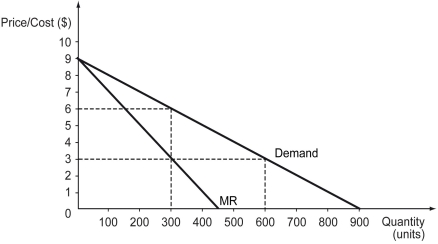 Calculate consumer surplus,monopoly's surplus,and deadweight loss.
 (Essay)
4.8/5 (86)
(86) Which of the following is true of an increase in product prices?
(Multiple Choice)
4.9/5 (76)
(76) The following figure shows the market demand curve for penicillin, an antibiotic medicine. Initially, the market was supplied by perfectly competitive firms. Later, the government granted the exclusive right to produce and sell penicillin to one firm. The figure also shows the marginal revenue curve (MR) of the firm once it begins to operate as a monopoly. The marginal cost is constant at $3, irrespective of the market structure.
 -Refer to the figure above.What is the price that the monopolistic firm would charge?
 (Multiple Choice)
4.8/5 (69)
(69) When firms charge different prices to different consumers for the same good or service,it is referred to as ________.
(Multiple Choice)
4.8/5 (95)
(95) Suppose that a fire-fighting service is offered by private firms and property owners can purchase the service for a fee (or not purchase the service).Does fire-fighting service have network externalities?
(Essay)
4.9/5 (83)
(83) The following figure shows the costs and revenue curves of a firm in a monopoly market.
 -Refer to the figure above.If the government decides to regulate this market at the socially optimal price level,the monopolist will ________.
 (Multiple Choice)
4.7/5 (96)
(96) Which of the following firms is most likely to have a constant marginal cost?
(Multiple Choice)
4.9/5 (92)
(92) Scenario: Tobac Co. is a monopolist in the cigarette market in Nicotiana Republic, where the U.S. dollar is used as the official currency. The firm faces the demand curve shown below. The firm has a constant marginal cost of $2.00 per pack. The fixed cost of the firm is $50 million. To answer the questions below, it is useful to know that the equation of the (inverse) demand curve is P = 8 - 0.04Q, where Q is the quantity demanded (in millions of packs) and P is the price per pack (in $). Also, you should draw in the marginal revenue curve.
 -Refer to the scenario above.If the quantity sold is 150 million packs,the firm's profit is ________.
 (Multiple Choice)
4.8/5 (76)
(76) How does a monopoly decide the optimal amount of a good that it produces? How does it set the price for its product?
(Essay)
5.0/5 (91)
(91) A monopolist faces an average total cost of $6 when it produces 200 units of its product.If it sells the 200 units at $8 per unit,the monopolist ________.
(Multiple Choice)
4.9/5 (68)
(68) A monopolist faces a linear,downward-sloping demand curve.If the slope of the demand curve is 2 (where price is on the y-axis and quantity on the x-axis)and the monopolist can sell four units of output at a price of $16.What is the marginal revenue from selling the fourth unit of output?
(Multiple Choice)
4.8/5 (82)
(82) In the United States,the ________ is a law that keeps markets open and competitive.
(Multiple Choice)
4.8/5 (80)
(80) Scenario: Tobac Co. is a monopolist in the cigarette market in Nicotiana Republic, where the U.S. dollar is used as the official currency. The firm faces the demand curve shown below. The firm has a constant marginal cost of $2.00 per pack. The fixed cost of the firm is $50 million. To answer the questions below, it is useful to know that the equation of the (inverse) demand curve is P = 8 - 0.04Q, where Q is the quantity demanded (in millions of packs) and P is the price per pack (in $). Also, you should draw in the marginal revenue curve.
 -Refer to the scenario above.What is Tobac Co.'s total revenue when it sells 50 million packs of cigarettes?
 (Multiple Choice)
4.8/5 (78)
(78) A monopolist faces an average total cost of $10 when it produces 400 units of its product.If it sells the 400 units at $6 per unit,the monopolist ________.
(Multiple Choice)
4.8/5 (80)
(80) 
Filters
- Essay(0)
- Multiple Choice(0)
- Short Answer(0)
- True False(0)
- Matching(0)