



 Chat with AI
Exam 12: Monopoly

Exam 1: The Principles and Practice of Economics103 Questions
Exam 2: Economic Methods and Economic Questions94 Questions
Exam 3: Optimization: Doing the Best You Can94 Questions
Exam 4: Demand, supply, and Equilibrium185 Questions
Exam 5: Consumers and Incentives187 Questions
Exam 6: Sellers and Incentives261 Questions
Exam 7: Perfect Competition and the Invisible Hand251 Questions
Exam 8: Trade264 Questions
Exam 9: Externalities and Public Goods223 Questions
Exam 10: The Government in the Economy: Taxation and Regulation244 Questions
Exam 11: Markets for Factors of Production237 Questions
Exam 12: Monopoly295 Questions
Exam 13: Game Theory and Strategic Play199 Questions
Exam 14: Oligopoly and Monopolistic Competition264 Questions
Exam 15: Trade-Offs Involving Time and Risk147 Questions
Exam 16: The Economics of Information119 Questions
Exam 17: Auctions and Bargaining123 Questions
Exam 18: Social Economics111 Questions
Select questions type


The following figure shows price versus quantity for a market.
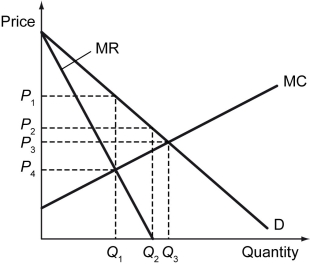 -Refer to the figure above.On what interval of quantity does total revenue increase when quantity increases?
 (Multiple Choice)
4.8/5  (77)
(77) The following figure shows the demand curve faced by a monopolist.
 -Refer to the figure above.What is the quantity effect of a price reduction from $6 to $4?
 (Multiple Choice)
4.9/5 (63)
(63) Why does the economy of scale lead to a monopoly situation in the market?
(Multiple Choice)
4.8/5 (78)
(78) A musician was guaranteed by the government that no one else could replicate or sell her music CDs.This is an example of a ________.
(Multiple Choice)
4.8/5 (81)
(81) The following figure shows the market demand curve for penicillin, an antibiotic medicine. Initially, the market was supplied by perfectly competitive firms. Later, the government granted the exclusive right to produce and sell penicillin to one firm. The figure also shows the marginal revenue curve (MR) of the firm once it begins to operate as a monopoly. The marginal cost is constant at $3, irrespective of the market structure.
 -Refer to the figure above.What is the deadweight loss when the market is converted into a monopoly?
 (Multiple Choice)
4.8/5 (76)
(76) The following figure shows the costs and revenue curves of a firm in a monopoly market.
 -Refer to the figure above.If this monopolist engages in the first-degree price discrimination,the consumer surplus in this market is equal to ________.
 (Multiple Choice)
4.9/5 (78)
(78) The following figure shows the demand curve faced by a monopolist.
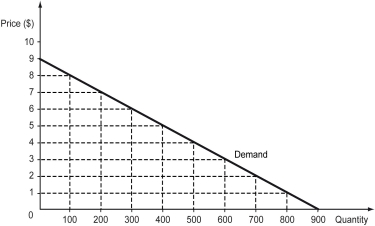 a)Calculate the quantity effect and price effect of a price cut from $6 to $5.Estimate the change in total revenue due to the price cut.
b)Comment on the elasticity of the demand curve between the price range $5 to $6.
a)Calculate the quantity effect and price effect of a price cut from $6 to $5.Estimate the change in total revenue due to the price cut.
b)Comment on the elasticity of the demand curve between the price range $5 to $6. (Essay)
4.8/5 (85)
(85) The following table shows the quantities sold of a monopolist's product at different prices.
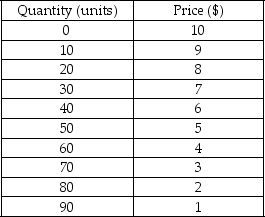 Comment on the relationship between total revenue and marginal revenue from the table.
 (Essay)
4.8/5 (74)
(74) The following figure shows the graph of a monopoly market. The marginal revenue curve has been omitted.
 -Refer to the figure above.How much would this monopolist charge for its product?
 (Multiple Choice)
4.8/5 (84)
(84) The following figure is a supply-demand diagram that characterizes the demand, marginal revenue, and cost curves for a profit-maximizing monopolist.
 -The following figure shows the demand curve for Good X in a perfectly competitive market.Later,the government grants one of the firms the exclusive right to manufacture and sell Good X.MR represents the marginal revenue curve of the firm when it operates as a monopoly.The marginal cost of producing Good X is constant at $5.
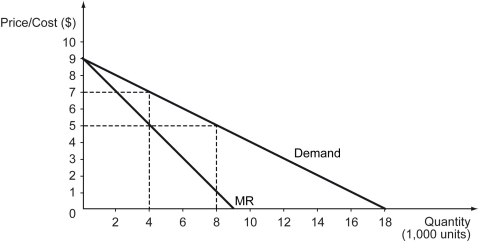 a)What is the quantity supplied when the market is perfectly competitive? What happens to the quantity supplied once the market changes to a monopoly?
b)What is the market price when the market is perfectly competitive? What is the market price when the market changes to a monopoly?
c)Compare the consumer surplus when the market is perfectly competitive and the consumer surplus when the market is a monopoly.Is there any producer surplus or deadweight loss in either case? If yes,then how much?
-The following figure shows the demand curve for Good X in a perfectly competitive market.Later,the government grants one of the firms the exclusive right to manufacture and sell Good X.MR represents the marginal revenue curve of the firm when it operates as a monopoly.The marginal cost of producing Good X is constant at $5.
a)What is the quantity supplied when the market is perfectly competitive? What happens to the quantity supplied once the market changes to a monopoly?
b)What is the market price when the market is perfectly competitive? What is the market price when the market changes to a monopoly?
c)Compare the consumer surplus when the market is perfectly competitive and the consumer surplus when the market is a monopoly.Is there any producer surplus or deadweight loss in either case? If yes,then how much? (Essay)
5.0/5 (81)
(81) The pricing rule for a monopolist who produces a divisible good is ________.
(Multiple Choice)
4.8/5 (76)
(76) Average total cost decreases with an increase in output because ________.
(Multiple Choice)
4.8/5 (76)
(76) The policy that aims to regulate and prevent anti-competitive pricing in the United States is referred to as ________ policy.
(Multiple Choice)
4.8/5 (69)
(69) Which of the following is a current example of a monopoly granted by legal market power? (You need to do some information gathering for this problem.)
(Multiple Choice)
4.9/5 (88)
(88) Which of the following statements is true of the demand curve and the marginal revenue curve of a monopolist?
(Multiple Choice)
4.8/5 (84)
(84) In Barylia,Greenaqua Corp.is the sole controller of a resource required for the production of bottled drinking water.Therefore,Greenaqua Corp.enjoys ________ market power.
(Multiple Choice)
4.9/5 (75)
(75) Everything else remaining unchanged,if a new seller enters a market to compete with an existing monopoly that is enjoying economies of scale,it will lead to ________.
(Multiple Choice)
5.0/5 (76)
(76) Scenario: Tobac Co. is a monopolist in the cigarette market in Nicotiana Republic, where the U.S. dollar is used as the official currency. The firm faces the demand curve shown below. The firm has a constant marginal cost of $2.00 per pack. The fixed cost of the firm is $50 million. To answer the questions below, it is useful to know that the equation of the (inverse) demand curve is P = 8 - 0.04Q, where Q is the quantity demanded (in millions of packs) and P is the price per pack (in $). Also, you should draw in the marginal revenue curve.
 -Refer to the scenario above.Tobac Co.'s total revenue is maximized when it sells ________ packs of cigarettes at ________ per pack.
 (Multiple Choice)
4.7/5 (73)
(73) When a monopolist sells positive levels of output,its demand curve ________.
(Multiple Choice)
4.8/5 (84)
(84) 
Filters
- Essay(0)
- Multiple Choice(0)
- Short Answer(0)
- True False(0)
- Matching(0)