



 Chat with AI
Exam 12: Monopoly

Exam 1: The Principles and Practice of Economics103 Questions
Exam 2: Economic Methods and Economic Questions94 Questions
Exam 3: Optimization: Doing the Best You Can94 Questions
Exam 4: Demand, supply, and Equilibrium185 Questions
Exam 5: Consumers and Incentives187 Questions
Exam 6: Sellers and Incentives261 Questions
Exam 7: Perfect Competition and the Invisible Hand251 Questions
Exam 8: Trade264 Questions
Exam 9: Externalities and Public Goods223 Questions
Exam 10: The Government in the Economy: Taxation and Regulation244 Questions
Exam 11: Markets for Factors of Production237 Questions
Exam 12: Monopoly295 Questions
Exam 13: Game Theory and Strategic Play199 Questions
Exam 14: Oligopoly and Monopolistic Competition264 Questions
Exam 15: Trade-Offs Involving Time and Risk147 Questions
Exam 16: The Economics of Information119 Questions
Exam 17: Auctions and Bargaining123 Questions
Exam 18: Social Economics111 Questions
Select questions type


Scenario: Mr. Olivander has a monopoly on supplying magic wands. The table below shows the demand schedule for magic wands per day.
 -Refer to the scenario above.If the marginal cost of a magic wand is $20,how many wands should Mr.Olivander sell to maximize his profit?
 (Multiple Choice)
4.7/5  (71)
(71) Scenario: Tobac Co. is a monopolist in cigarette market in Nicotiana Republic where the U.S. dollar is used as its official currency. The firm faces the demand curve shown below. The firm has a constant marginal cost of $2.00 per pack. The fixed cost of the firm is $50 million. To answer the questions below, it is useful to know that the equation of the (inverse) demand curve is P = 8 - 0.04Q, where Q is the quantity demanded (in millions of packs) and P is the price per pack (in $). Also, you should draw in the marginal revenue curve.
 -Refer to the scenario above.When Tobac Co.'s profit is maximized,the deadweight loss is ________.
 (Multiple Choice)
4.8/5 (72)
(72) The following figure represents the cost and revenue curves of a firm that is producing a service in a monopoly market.
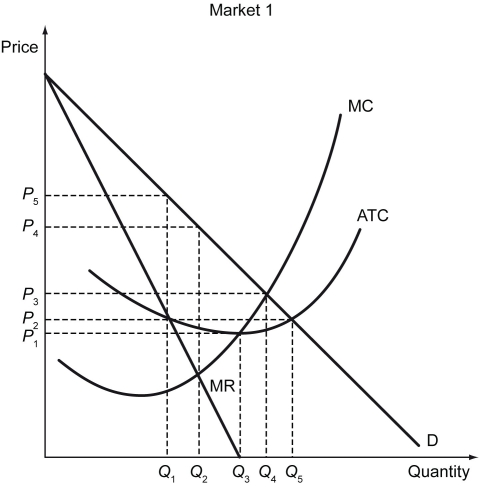 -Refer to the figure above.What is the price that this monopolist should charge in order to maximize its profit?
 (Multiple Choice)
4.8/5 (77)
(77) The following figure shows the demand curve, the marginal revenue (MR) curve, the marginal cost (MC) curve, and the average total cost (ATC) curve of a monopolist.
 -Refer to the figure above.What is the profit-maximizing quantity for the monopolist?
 (Multiple Choice)
4.7/5 (67)
(67) What makes World's Fair of 1876,in Philadelphia a natural experiment suitable to study the impact of patent protection on innovation? (The author of the study also used the data from the 1851 Fair in London.)
(Multiple Choice)
4.8/5 (80)
(80) Perfect price discrimination occurs when a firm charges ________.
(Multiple Choice)
4.8/5 (74)
(74) The following figure shows the demand and marginal revenue (MR) curves faced by a monopolist.
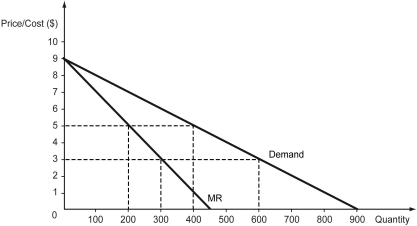 -Refer to the figure above.What is the profit-maximizing quantity that the monopolist should produce if it faces a constant marginal cost of $3?
 (Multiple Choice)
4.9/5 (85)
(85) Which of the following is NOT an example of a natural monopoly?
(Multiple Choice)
4.8/5 (82)
(82) The following figure shows the graph of a monopoly market. The marginal revenue curve has been omitted.
 -Refer to the figure above.What is the optimal output for this firm?
 (Multiple Choice)
4.9/5 (75)
(75) Scenario: Tobac Co. is a monopolist in the cigarette market in Nicotiana Republic, where the U.S. dollar is used as the official currency. The firm faces the demand curve shown below. The firm has a constant marginal cost of $2.00 per pack. The fixed cost of the firm is $50 million. To answer the questions below, it is useful to know that the equation of the (inverse) demand curve is P = 8 - 0.04Q, where Q is the quantity demanded (in millions of packs) and P is the price per pack (in $). Also, you should draw in the marginal revenue curve.
 -Refer to the scenario above.When the quantity sold goes up from 50 million to 100 million packs of cigarettes,the price effect on the firm's revenue is ________ and the quantity effect is ________.
 (Multiple Choice)
4.8/5 (76)
(76) The following figure shows the market demand curve for penicillin, an antibiotic medicine. Initially, the market was supplied by perfectly competitive firms. Later, the government granted the exclusive right to produce and sell penicillin to one firm. The figure also shows the marginal revenue curve (MR) of the firm once it begins to operate as a monopoly. The marginal cost is constant at $3, irrespective of the market structure.
 -Refer to the figure above.What is the consumer surplus when the market changes to a monopoly?
 (Multiple Choice)
4.9/5 (67)
(67) The following figure is a supply-demand diagram that characterizes the demand, marginal revenue, and cost curves for a profit-maximizing monopolist.
 -Refer to the figure above.Under monopoly,producer surplus is ________.
 (Multiple Choice)
4.9/5 (71)
(71) The investment by firms in the creation of products not yet available on the market is referred to as ________.
(Multiple Choice)
4.8/5 (83)
(83) If a firm can sell 15 units of output for $10 each or 14 units at $12 each,the additional revenue from selling the fifteenth unit is ________.
(Multiple Choice)
4.8/5 (81)
(81) The effect of the invisible hand is likely to be the strongest in ________.
(Multiple Choice)
4.9/5 (77)
(77) Which of the following characterizes the relation between total revenue and marginal revenue for a firm with market power?
(Multiple Choice)
4.8/5 (85)
(85) Which of the following does a social planner necessarily need to know to restore efficiency in a monopoly market?
(Multiple Choice)
4.9/5 (77)
(77) 
Filters
- Essay(0)
- Multiple Choice(0)
- Short Answer(0)
- True False(0)
- Matching(0)