



 Chat with AI
Exam 12: Monopoly

Exam 1: The Principles and Practice of Economics103 Questions
Exam 2: Economic Methods and Economic Questions94 Questions
Exam 3: Optimization: Doing the Best You Can94 Questions
Exam 4: Demand, supply, and Equilibrium185 Questions
Exam 5: Consumers and Incentives187 Questions
Exam 6: Sellers and Incentives261 Questions
Exam 7: Perfect Competition and the Invisible Hand251 Questions
Exam 8: Trade264 Questions
Exam 9: Externalities and Public Goods223 Questions
Exam 10: The Government in the Economy: Taxation and Regulation244 Questions
Exam 11: Markets for Factors of Production237 Questions
Exam 12: Monopoly295 Questions
Exam 13: Game Theory and Strategic Play199 Questions
Exam 14: Oligopoly and Monopolistic Competition264 Questions
Exam 15: Trade-Offs Involving Time and Risk147 Questions
Exam 16: The Economics of Information119 Questions
Exam 17: Auctions and Bargaining123 Questions
Exam 18: Social Economics111 Questions
Select questions type


The following figure shows the marginal revenue (MR) and demand curves faced by a monopolist.
 -Refer to the figure above.If the monopolist faces a constant marginal cost of $6,what is the optimal quantity that it should produce?
 (Multiple Choice)
4.8/5  (80)
(80) A monopolist faces a linear,downward-sloping demand curve.If the slope of the demand curve is 1 and the monopolist can sell one unit of output at a price of $10,what is the total revenue from selling the fourth unit of output?
(Multiple Choice)
4.9/5 (65)
(65) Tobac Co.is a monopolist in cigarette market in Nicotiana Republic,where the U.S.dollar is used as the official currency.The firm faces the demand curve shown below.The firm has a constant marginal cost of $2.00 per pack.If Tobac Co.could successfully carry out the first-degree (or perfect)price discrimination,the social surplus would ________ and the consumer surplus would be ________.
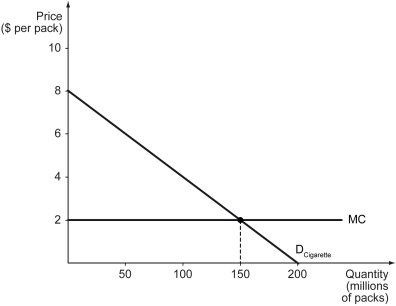
(Multiple Choice)
4.8/5 (83)
(83) Peak-load pricing is when a firm charges a different price during the peak (e.g.,highest demand)period than during off-peak times,because the marginal cost of providing the good or service during the peak is higher.For example,an electricity producer builds generating capacity to serve peak-period demand but only needs to call on this full capacity during a handful of days of the year.Building capacity to meet peak demand means that there is a discrete change in the marginal cost of providing the good or service across a binding capacity constraint.Is this an example of price discrimination? If so,to which degree? If not,explain why not.
(Multiple Choice)
4.9/5 (78)
(78) Scenario: Tobac Co. is a monopolist in cigarette market in Nicotiana Republic, where the U.S. dollar is used as the official currency. The firm has a constant marginal cost of $2.00 per pack and the fixed cost is $20 million. Through market research, the firm has found that there are two types of customer, Type 1 and Type 2. The demand curves of the two types of customers, and the total market demand curve, along with respective marginal revenue curves, are shown in the following figure.


 -Refer to the scenario above.If Tobac Co.could not carry out price discrimination,the firm would sell ________ as it would under the third-degree price discrimination.
 (Multiple Choice)
4.8/5 (80)
(80) Encouraging the formation of monopolies provides firms an incentive to ________.
(Multiple Choice)
4.9/5 (78)
(78) Which of the following is NOT true of price discrimination among units of output?
(Multiple Choice)
4.9/5 (82)
(82) The following figure shows the marginal revenue (MR) and demand curves faced by a monopolist.
-Refer to the figure above.If the monopolist faces a constant marginal cost of $2,at what price should it sell its output?
-Refer to the figure above.If the monopolist faces a constant marginal cost of $2,at what price should it sell its output? (Multiple Choice)
4.8/5 (70)
(70) Which of the following is an example of a good produced under monopoly?
(Multiple Choice)
4.9/5 (89)
(89) Among the following,which is the best example of price discrimination?
(Multiple Choice)
4.8/5 (74)
(74) The following figure shows the demand curve faced by a monopolist.
 -Refer to the figure above.What is the change in total revenue due to a price increase from $3 to $5?
 (Multiple Choice)
4.9/5 (86)
(86) Scenario: When a monopolist charges $5 for its product, it sells 250 units of the product. When it decreases the price of the product to $4, it sells 325 units of the product.
-Refer to the scenario above.What is the quantity effect of the price change?
(Multiple Choice)
4.9/5 (83)
(83) The following figure shows the marginal revenue (MR) curve and the demand curve faced by a monopolist. The monopolist faces a constant marginal cost of $3.
 -Refer to the figure above.What is the price at which the monopolist should sell its output?
 (Multiple Choice)
4.7/5 (80)
(80) Which of the following statements is true of a monopolist's supply curve?
(Multiple Choice)
4.7/5 (71)
(71) The following table shows the quantities of a good sold by a monopolist at different prices.
 -Refer to the table above.What is the marginal revenue of the monopolist when it sells 200 units of its product?
 (Multiple Choice)
4.9/5 (72)
(72) If a monopolist decides to charge a higher price for its product,it will yield a ________ revenue per unit sold and ________ number of units sold.
(Multiple Choice)
4.7/5 (76)
(76) The following figure shows the costs and revenue curves of a firm in a monopoly market.
 -Refer to the figure above.If the government decides to regulate this market,the best strategy would be to ________.
 (Multiple Choice)
4.9/5 (88)
(88) 
Filters
- Essay(0)
- Multiple Choice(0)
- Short Answer(0)
- True False(0)
- Matching(0)