



 Chat with AI
Exam 21: The Thigh, Hip, Groin, and Pelvis

Exam 1: The Athletic Trainer As a Health Care Provider20 Questions
Exam 2: Health Care Organization and Administration in Athletic Training21 Questions
Exam 3: Legal Concerns and Insurance Issues20 Questions
Exam 4: Fitness and Conditioning Techniques23 Questions
Exam 5: Nutrition and Supplements31 Questions
Exam 6: Environmental Considerations23 Questions
Exam 7: Protective Equipment22 Questions
Exam 8: Wrapping and Taping20 Questions
Exam 9: Mechanisms and Characteristics of Musculoskeletal and Nerve Trauma15 Questions
Exam 10: Tissue Response to Injury19 Questions
Exam 11: Psychosocial Intervention for Sports Injuries and Illnesses19 Questions
Exam 12: On-The-Field Acute Care and Emergency Procedures44 Questions
Exam 13: Off-The-Field Injury Evaluation29 Questions
Exam 14: Infectious Diseases, Bloodborne Pathogens, and Universal Precautions18 Questions
Exam 15: Using Therapeutic Modalities42 Questions
Exam 16: Using Therapeutic Exercise in Rehabilitation26 Questions
Exam 17: Pharmacology, Drugs, and Sports41 Questions
Exam 18: The Foot38 Questions
Exam 19: The Ankle and Lower Leg32 Questions
Exam 20: The Knee and Related Structures49 Questions
Exam 21: The Thigh, Hip, Groin, and Pelvis57 Questions
Exam 22: The Shoulder Complex40 Questions
Exam 23: The Elbow29 Questions
Exam 24: The Forearm, Wrist, Hand, and Fingers45 Questions
Exam 25: The Spine45 Questions
Exam 26: The Head, Face, Eyes, Ears, Nose, and Throat50 Questions
Exam 27: The Thorax and Abdomen27 Questions
Exam 28: Skin Disorders35 Questions
Exam 29: Additional General Medical Conditions30 Questions
Select questions type


Which of the following positions should a patient be in when undergoing Nobel's test?
(Multiple Choice)
4.9/5  (82)
(82) What muscles originate from the medial and lateral linea aspera of the femur?
(Multiple Choice)
4.8/5 (86)
(86) Which of the following information would an athletic trainer gather while preparing the history section of the assessment of a potential hip, groin, or pelvis injury?
(Multiple Choice)
4.9/5 (83)
(83) In the history section of a hip, groin, and pelvis assessment, what would be considered an inappropriate question to ask the patient?
(Multiple Choice)
4.9/5 (71)
(71) For the highlighted muscle in the image, what range of motion would be limited if the muscle were strained?
(Multiple Choice)
4.9/5 (85)
(85) Please check all of the special tests that are utilized to check for a tight iliotibial band.
(Multiple Choice)
4.9/5 (71)
(71) What injury to the thigh region is present in the x-ray image?
(Multiple Choice)
4.9/5 (86)
(86) Please check all of the muscles that laterally rotate the thigh.
(Multiple Choice)
4.7/5 (68)
(68) Which of the following muscles in the thigh is not biarticular?
(Multiple Choice)
4.9/5 (89)
(89) 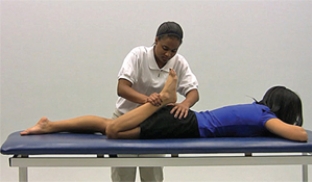
In the history section of a thigh assessment, what would be considered an inappropriate question to ask the patient?
(Multiple Choice)
4.8/5 (75)
(75) What suspected condition would be present that would discourage the patient performance of an isometric resistance to the thigh muscle groups?
(Multiple Choice)
4.7/5 (73)
(73) In managing a quadriceps grade 2 strain, what exercises should be avoided until later phases of the rehabilitation?
(Multiple Choice)
4.7/5 (86)
(86) Internal hip rotation in excess of what degree is characteristic of femoral anteversion?
(Multiple Choice)
4.9/5 (78)
(78) Which of the following hip problems occurs in male children ages 4 to 10?
(Multiple Choice)
4.9/5 (79)
(79) If a patient were suffering from a femoral stress fracture, how would the gait pattern be altered?
(Multiple Choice)
5.0/5 (78)
(78) In order to accurately measure anatomical leg-length discrepancy, the measurements should occur between which of the following anatomical structures?
(Multiple Choice)
4.9/5 (81)
(81) What condition occurs in boys who are characteristically tall and thin, or obese and between the ages of 10 and 17?
(Multiple Choice)
4.9/5 (63)
(63) 
Filters
- Essay(0)
- Multiple Choice(0)
- Short Answer(0)
- True False(0)
- Matching(0)