



 Chat with AI
Exam 23: Ecological Communities

Exam 1: The Nature of Science and the Characteristics of Life82 Questions
Exam 2: Biological Diversity, Bacteria, and Archaea101 Questions
Exam 3: Protista, Plantae, and Fungi83 Questions
Exam 4: Animalia81 Questions
Exam 5: The Chemistry of Life92 Questions
Exam 6: Cell Structure and Internal Compartments87 Questions
Exam 7: Cell Membranes, Transport, and Communication85 Questions
Exam 8: Energy, Metabolism, and Enzymes81 Questions
Exam 9: Photosynthesis and Cellular Respiration84 Questions
Exam 10: Cell Division89 Questions
Exam 11: Stem Cells, Cancer, and Human Health93 Questions
Exam 12: Patterns of Inheritance75 Questions
Exam 13: Chromosomes and Human Genetics75 Questions
Exam 14: Dna and Genes105 Questions
Exam 15: From Gene to Protein80 Questions
Exam 16: Dna Technology80 Questions
Exam 17: How Evolution Works80 Questions
Exam 18: Evolution of Populations80 Questions
Exam 19: Speciation and the Origins of Biological Diversity80 Questions
Exam 20: The Evolutionary History of Life100 Questions
Exam 21: The Biosphere89 Questions
Exam 22: Growth of Populations69 Questions
Exam 23: Ecological Communities133 Questions
Exam 24: Ecosystems75 Questions
Exam 25: Global Change70 Questions
Exam 26: Internal Organization and Homeostasis79 Questions
Exam 27: Nutrition and Digestion80 Questions
Exam 28: Circulation and Gas Exchange77 Questions
Exam 29: Animal Hormones78 Questions
Exam 30: Nervous and Sensory Systems78 Questions
Exam 31: Skeletons, Muscles, and Movement78 Questions
Exam 32: Defenses Against Disease78 Questions
Exam 33: Reproduction and Development76 Questions
Exam 34: Animal Behavior76 Questions
Exam 35: Plant Structure, Nutrition, and Transport80 Questions
Exam 36: Plant Growth and Reproduction80 Questions
Select questions type


The release of a parasitic wasp in California helped control the infestation of scale insects on citrus trees. However, it also caused the near-extinction of a different species of parasitic wasp. Should we consider this experiment an unqualified success?
(Multiple Choice)
4.7/5  (79)
(79) Relationships between different species often involve energy or lifestyle compromises. What best describes the compromises, if any, seen in mutualism?
(Multiple Choice)
4.8/5 (80)
(80) Which of the following symbols represents a competitive interaction?
(Multiple Choice)
4.8/5 (70)
(70) ____________________ competition occurs when one organism directly keeps another organism from using a resource; for example, when two species of birds attempt to use an abandoned woodpecker cavity.
(Short Answer)
4.9/5 (77)
(77) The consumer in a predator/prey interaction can be a selective force in the evolution of the prey species.
(True/False)
4.7/5 (87)
(87) The figure below illustrates how, although pines first established themselves as the dominant tree in the Lake Michigan sand dune community, black oaks ultimately become the dominant species. 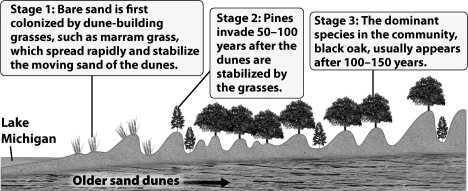 What best explains the gradual reduction of the pine?
 (Multiple Choice)
4.8/5 (80)
(80) Bees use pollen to feed ____________________, as a protein source. A variety of pollen provides a variety of protein sources.
(Short Answer)
4.8/5 (82)
(82) In the pollinator mutualism between the yucca plant and the yucca moth, the yucca plant is able to abort the seeds in any given flower if the moth lays too many eggs in that flower. What is the advantage the yucca plant gains by aborting these seeds?
(Multiple Choice)
5.0/5 (69)
(69) In a typical prairie food web, energy moves from grass to grasshopper to field mouse to fox. Which organism is the primary producer?
(Multiple Choice)
4.8/5 (68)
(68) Islands such as the Hawaiian Islands are particularly vulnerable to introduced species because
(Multiple Choice)
4.9/5 (76)
(76) An animal eats fruit from a plant and later deposits seed in its feces far from the plant. This is an example of a
(Multiple Choice)
4.9/5 (94)
(94) A deer and a caterpillar are peacefully munching on the leaves of the same apple tree. This is an example of
(Multiple Choice)
4.8/5 (72)
(72) The terms mutualistic and symbiotic can be used interchangeably; any mutualistic relationship is an example of symbiosis, whereas any symbiotic relationship is also mutualistic.
(True/False)
4.9/5 (83)
(83) ____________________ are organisms that make their own food from an external energy source, such as the sun.
(Short Answer)
4.8/5 (72)
(72) A(n)____________________ is an organism that transfers one plant's male reproductive cells to the female reproductive organs of another plant.
(Short Answer)
4.7/5 (80)
(80) Human cells contain mitochondria, which are responsible for processing the energy needed by our cells. Remember that the ancestors of mitochondria may once have been free-living prokaryotes. If mitochondria were still considered to be separate organisms within our cells, which of the following would best describe our relationship with them?
(Multiple Choice)
4.9/5 (99)
(99) Which of the following symbols represents a parasitic relationship?
(Multiple Choice)
4.8/5 (81)
(81) Communities always recover quickly from disturbances caused by humans.
(True/False)
4.9/5 (80)
(80) Secondary succession is more common following a disturbance than primary succession because ____________________ typically remain intact.
(Short Answer)
4.8/5 (65)
(65) In a typical prairie food web, energy moves from grass to grasshopper to field mouse to fox. Which organism is the secondary consumer?
(Multiple Choice)
5.0/5 (79)
(79) 
Filters
- Essay(0)
- Multiple Choice(0)
- Short Answer(0)
- True False(0)
- Matching(0)