



 Chat with AI
Exam 23: Ecological Communities

Exam 1: The Nature of Science and the Characteristics of Life82 Questions
Exam 2: Biological Diversity, Bacteria, and Archaea101 Questions
Exam 3: Protista, Plantae, and Fungi83 Questions
Exam 4: Animalia81 Questions
Exam 5: The Chemistry of Life92 Questions
Exam 6: Cell Structure and Internal Compartments87 Questions
Exam 7: Cell Membranes, Transport, and Communication85 Questions
Exam 8: Energy, Metabolism, and Enzymes81 Questions
Exam 9: Photosynthesis and Cellular Respiration84 Questions
Exam 10: Cell Division89 Questions
Exam 11: Stem Cells, Cancer, and Human Health93 Questions
Exam 12: Patterns of Inheritance75 Questions
Exam 13: Chromosomes and Human Genetics75 Questions
Exam 14: Dna and Genes105 Questions
Exam 15: From Gene to Protein80 Questions
Exam 16: Dna Technology80 Questions
Exam 17: How Evolution Works80 Questions
Exam 18: Evolution of Populations80 Questions
Exam 19: Speciation and the Origins of Biological Diversity80 Questions
Exam 20: The Evolutionary History of Life100 Questions
Exam 21: The Biosphere89 Questions
Exam 22: Growth of Populations69 Questions
Exam 23: Ecological Communities133 Questions
Exam 24: Ecosystems75 Questions
Exam 25: Global Change70 Questions
Exam 26: Internal Organization and Homeostasis79 Questions
Exam 27: Nutrition and Digestion80 Questions
Exam 28: Circulation and Gas Exchange77 Questions
Exam 29: Animal Hormones78 Questions
Exam 30: Nervous and Sensory Systems78 Questions
Exam 31: Skeletons, Muscles, and Movement78 Questions
Exam 32: Defenses Against Disease78 Questions
Exam 33: Reproduction and Development76 Questions
Exam 34: Animal Behavior76 Questions
Exam 35: Plant Structure, Nutrition, and Transport80 Questions
Exam 36: Plant Growth and Reproduction80 Questions
Select questions type


A community whose species are not replaced by other species is classified as a ____________________ community.
(Short Answer)
4.9/5  (83)
(83) Mutualistic relationships can have an effect on the distribution and abundance of the species involved.
(True/False)
4.8/5 (95)
(95) Succession has a major impact on the species makeup of a community at any given point in time.
(True/False)
4.7/5 (85)
(85) All of the following disturbances except _____ would be considered natural.
(Multiple Choice)
4.9/5 (83)
(83) Which of the following is not a producer in an aquatic biome?
(Multiple Choice)
4.9/5 (90)
(90) All natural communities consist of an equivalent number of species.
(True/False)
4.8/5 (81)
(81) In a typical prairie food web energy moves from grass to grasshopper to field mouse to fox. Which organism is the tertiary consumer?
(Multiple Choice)
4.8/5 (69)
(69) The general process by which species in a community are replaced over time is called ____________________.
(Short Answer)
4.9/5 (95)
(95) Why is the existence of food webs important even though food chains also exist?
(Multiple Choice)
4.8/5 (79)
(79) ____________________ are those organisms obtaining energy by eating all or portions of other organisms or their remains.
(Short Answer)
4.7/5 (77)
(77) Which of the following combinations of symbols represents an interaction in which one species benefits and the other is exploited?
(Multiple Choice)
4.8/5 (90)
(90) Examine the graph below. 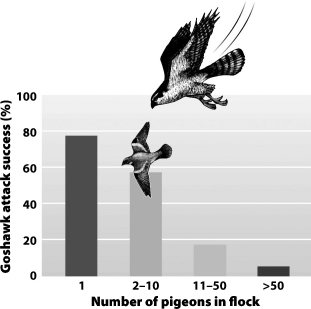 Research indicates that goshawk predation is much less effective when prey species, like wood pigeons, are in large flocks. This is true because
 (Multiple Choice)
4.9/5 (81)
(81) Which of the following could be an example of an induced response?
(Multiple Choice)
4.8/5 (85)
(85) Due to competition, forms of competing species may evolve to become more different from each other over time. This change is known as character ____________________.
(Short Answer)
5.0/5 (90)
(90) As the figure below illustrates, communities vary tremendously in size from as large as an entire forest to the digestive system of a single deer. 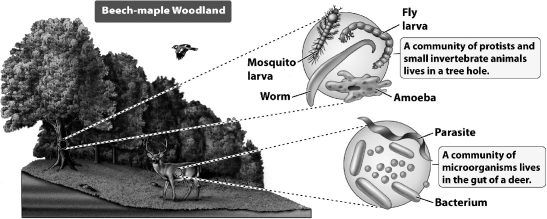 How do biologists recognize communities?
 (Multiple Choice)
4.8/5 (87)
(87) In _____ competition, species compete indirectly for a shared resource, each reducing the amount available to the other competitor.
(Multiple Choice)
4.8/5 (91)
(91) Why would a food web rather than a food chain be the preferred way to represent the movement of food through the community?
(Multiple Choice)
4.9/5 (89)
(89) 
Filters
- Essay(0)
- Multiple Choice(0)
- Short Answer(0)
- True False(0)
- Matching(0)