



 Chat with AI
Exam 23: Ecological Communities

Exam 1: The Nature of Science and the Characteristics of Life82 Questions
Exam 2: Biological Diversity, Bacteria, and Archaea101 Questions
Exam 3: Protista, Plantae, and Fungi83 Questions
Exam 4: Animalia81 Questions
Exam 5: The Chemistry of Life92 Questions
Exam 6: Cell Structure and Internal Compartments87 Questions
Exam 7: Cell Membranes, Transport, and Communication85 Questions
Exam 8: Energy, Metabolism, and Enzymes81 Questions
Exam 9: Photosynthesis and Cellular Respiration84 Questions
Exam 10: Cell Division89 Questions
Exam 11: Stem Cells, Cancer, and Human Health93 Questions
Exam 12: Patterns of Inheritance75 Questions
Exam 13: Chromosomes and Human Genetics75 Questions
Exam 14: Dna and Genes105 Questions
Exam 15: From Gene to Protein80 Questions
Exam 16: Dna Technology80 Questions
Exam 17: How Evolution Works80 Questions
Exam 18: Evolution of Populations80 Questions
Exam 19: Speciation and the Origins of Biological Diversity80 Questions
Exam 20: The Evolutionary History of Life100 Questions
Exam 21: The Biosphere89 Questions
Exam 22: Growth of Populations69 Questions
Exam 23: Ecological Communities133 Questions
Exam 24: Ecosystems75 Questions
Exam 25: Global Change70 Questions
Exam 26: Internal Organization and Homeostasis79 Questions
Exam 27: Nutrition and Digestion80 Questions
Exam 28: Circulation and Gas Exchange77 Questions
Exam 29: Animal Hormones78 Questions
Exam 30: Nervous and Sensory Systems78 Questions
Exam 31: Skeletons, Muscles, and Movement78 Questions
Exam 32: Defenses Against Disease78 Questions
Exam 33: Reproduction and Development76 Questions
Exam 34: Animal Behavior76 Questions
Exam 35: Plant Structure, Nutrition, and Transport80 Questions
Exam 36: Plant Growth and Reproduction80 Questions
Select questions type


Which of the following animals would be most likely to simultaneously participate in seed dispersal and a gut inhabitant mutualism?
(Multiple Choice)
4.9/5  (74)
(74) Food webs, like the one in the figure below, help biologists predict the impact to a community that changes in species abundance might produce. 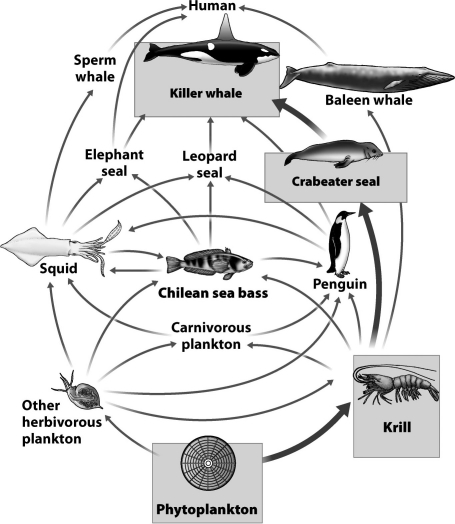 After studying the food web above, select a reasonable outcome following the complete disappearance of leopard seals.
 (Multiple Choice)
4.9/5 (82)
(82) The interactions among organisms that reside in the same community or ecosystem are unlikely to have much effect on the physical aspects of those systems.
(True/False)
4.7/5 (81)
(81) Human-caused changes in ecological communities can be considered unique because
(Multiple Choice)
4.8/5 (80)
(80) Which of the following experiments would help to identify a keystone species?
(Multiple Choice)
4.8/5 (82)
(82) The relationship among plants growing in a woodland and living in high density with limited resources can best be described as
(Multiple Choice)
4.9/5 (83)
(83) ____________________ consumers feed on primary consumers as part or all of their diet.
(Short Answer)
4.8/5 (83)
(83) Into which category would a human be assigned when eating chicken?
(Multiple Choice)
4.8/5 (75)
(75) Every healthy human digestive system is home to countless microorganisms. In a normal digestive system, what type of relationship would you say this is?
(Multiple Choice)
4.9/5 (73)
(73) The process by which communities recover from ____________________ is known as secondary succession.
(Short Answer)
4.8/5 (74)
(74) A(n)____________________ is an association of populations of different species that live in the same area.
(Short Answer)
4.8/5 (87)
(87) In seed-dispersal mutualism, plants produce _____ to entice consumers to disperse the plant's seeds.
(Multiple Choice)
4.8/5 (85)
(85) Which of the following statements about human-caused disturbances to communities is true?
(Multiple Choice)
4.7/5 (86)
(86) Black oak trees are one of the earliest colonists after bare sand dunes are created.
(True/False)
5.0/5 (76)
(76) The sea star Pisaster ochraceus was removed from selected intertidal communities along the Washington coast. After 10 years how did those communities compare to control communities?
(Multiple Choice)
4.8/5 (78)
(78) When two similar species inhabit the same area, they may evolve over time to become more different and
(Multiple Choice)
4.8/5 (76)
(76) Bees can actually be harmed by use as pollinators for single crops.
(True/False)
4.8/5 (85)
(85) 
Filters
- Essay(0)
- Multiple Choice(0)
- Short Answer(0)
- True False(0)
- Matching(0)