



 Chat with AI
Exam 26: Internal Organization and Homeostasis

Exam 1: The Nature of Science and the Characteristics of Life82 Questions
Exam 2: Biological Diversity, Bacteria, and Archaea101 Questions
Exam 3: Protista, Plantae, and Fungi83 Questions
Exam 4: Animalia81 Questions
Exam 5: The Chemistry of Life92 Questions
Exam 6: Cell Structure and Internal Compartments87 Questions
Exam 7: Cell Membranes, Transport, and Communication85 Questions
Exam 8: Energy, Metabolism, and Enzymes81 Questions
Exam 9: Photosynthesis and Cellular Respiration84 Questions
Exam 10: Cell Division89 Questions
Exam 11: Stem Cells, Cancer, and Human Health93 Questions
Exam 12: Patterns of Inheritance75 Questions
Exam 13: Chromosomes and Human Genetics75 Questions
Exam 14: Dna and Genes105 Questions
Exam 15: From Gene to Protein80 Questions
Exam 16: Dna Technology80 Questions
Exam 17: How Evolution Works80 Questions
Exam 18: Evolution of Populations80 Questions
Exam 19: Speciation and the Origins of Biological Diversity80 Questions
Exam 20: The Evolutionary History of Life100 Questions
Exam 21: The Biosphere89 Questions
Exam 22: Growth of Populations69 Questions
Exam 23: Ecological Communities133 Questions
Exam 24: Ecosystems75 Questions
Exam 25: Global Change70 Questions
Exam 26: Internal Organization and Homeostasis79 Questions
Exam 27: Nutrition and Digestion80 Questions
Exam 28: Circulation and Gas Exchange77 Questions
Exam 29: Animal Hormones78 Questions
Exam 30: Nervous and Sensory Systems78 Questions
Exam 31: Skeletons, Muscles, and Movement78 Questions
Exam 32: Defenses Against Disease78 Questions
Exam 33: Reproduction and Development76 Questions
Exam 34: Animal Behavior76 Questions
Exam 35: Plant Structure, Nutrition, and Transport80 Questions
Exam 36: Plant Growth and Reproduction80 Questions
Select questions type


Heatstroke results primarily from a loss of

Free
(Multiple Choice)
4.9/5  (67)
(67) Correct Answer: Verified
B
Blood pH is generally neutral in order to allow enzymes to function properly.
Free
(True/False)
4.8/5 (79)
(79) Correct Answer:Verified
VerifiedTrue
During the day, camels allow their body temperature to rise to up to 40.5°C. As they rest on the cool desert sand at night, their temperature drops back to normal as a result of ____________________ because the external temperature is below the camel's body temperature.
Free
(Short Answer)
5.0/5 (88)
(88) Correct Answer:Verified
Verifiedconduction
How might air conditioning reduce the number of deaths resulting from heat waves?
(Multiple Choice)
4.9/5 (67)
(67) A turtle lying on a warm rock on a sunny day is gaining heat from the sun by radiation and heat from the rock by ____________________.
(Short Answer)
4.9/5 (87)
(87) Secretion and ____________________ take place in the U-shaped kidney tubule.
(Short Answer)
4.8/5 (78)
(78) Which of the following would be the best way to avoid heatstroke on a very hot day?
(Multiple Choice)
4.9/5 (70)
(70) An organism that generates enough metabolic heat to contribute in an important way to its heat gain is known as a(n)
(Multiple Choice)
4.8/5 (79)
(79) The process of regulating internal conditions so that they remain steady even when the physical environment does not match them is called ____________________.
(Short Answer)
4.8/5 (76)
(76) The distances between capillaries and cell surfaces near capillaries are
(Multiple Choice)
4.9/5 (65)
(65) Analyze the tissue images below and select which statement is true. 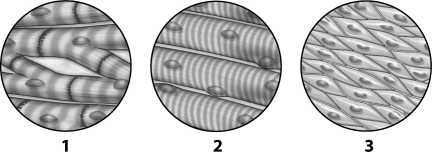
(Multiple Choice)
4.8/5 (67)
(67) In order for the epidermis to provide protection, it is made of only one type of tissue.
(True/False)
4.9/5 (86)
(86) If you have ever breathed air out of your lungs onto a cold glass surface, you have seen the glass "fog up" from water contained in your breath. Which of the descriptions below describes the journey of that water from a cell in your body to your breath?
(Multiple Choice)
4.9/5 (78)
(78) To help circulate heat gained from the environment while basking, marine iguanas
(Multiple Choice)
4.7/5 (80)
(80) Ectotherms depend more on heat from their environment than on ____________________ heat from internal chemical reactions.
(Short Answer)
5.0/5 (98)
(98) ____________________ feedback keeps the internal environment in a constant state within a range of external conditions.
(Short Answer)
5.0/5 (72)
(72) In kidneys, the glomerulus is composed of a bed of ____________________.
(Short Answer)
4.8/5 (91)
(91) 
Filters
- Essay(0)
- Multiple Choice(0)
- Short Answer(0)
- True False(0)
- Matching(0)