



 Chat with AI
Exam 26: Internal Organization and Homeostasis

Exam 1: The Nature of Science and the Characteristics of Life82 Questions
Exam 2: Biological Diversity, Bacteria, and Archaea101 Questions
Exam 3: Protista, Plantae, and Fungi83 Questions
Exam 4: Animalia81 Questions
Exam 5: The Chemistry of Life92 Questions
Exam 6: Cell Structure and Internal Compartments87 Questions
Exam 7: Cell Membranes, Transport, and Communication85 Questions
Exam 8: Energy, Metabolism, and Enzymes81 Questions
Exam 9: Photosynthesis and Cellular Respiration84 Questions
Exam 10: Cell Division89 Questions
Exam 11: Stem Cells, Cancer, and Human Health93 Questions
Exam 12: Patterns of Inheritance75 Questions
Exam 13: Chromosomes and Human Genetics75 Questions
Exam 14: Dna and Genes105 Questions
Exam 15: From Gene to Protein80 Questions
Exam 16: Dna Technology80 Questions
Exam 17: How Evolution Works80 Questions
Exam 18: Evolution of Populations80 Questions
Exam 19: Speciation and the Origins of Biological Diversity80 Questions
Exam 20: The Evolutionary History of Life100 Questions
Exam 21: The Biosphere89 Questions
Exam 22: Growth of Populations69 Questions
Exam 23: Ecological Communities133 Questions
Exam 24: Ecosystems75 Questions
Exam 25: Global Change70 Questions
Exam 26: Internal Organization and Homeostasis79 Questions
Exam 27: Nutrition and Digestion80 Questions
Exam 28: Circulation and Gas Exchange77 Questions
Exam 29: Animal Hormones78 Questions
Exam 30: Nervous and Sensory Systems78 Questions
Exam 31: Skeletons, Muscles, and Movement78 Questions
Exam 32: Defenses Against Disease78 Questions
Exam 33: Reproduction and Development76 Questions
Exam 34: Animal Behavior76 Questions
Exam 35: Plant Structure, Nutrition, and Transport80 Questions
Exam 36: Plant Growth and Reproduction80 Questions
Select questions type


The lack of water, otherwise known as ____________________, can lead to heatstroke.
(Short Answer)
4.7/5  (78)
(78) The circulation of blood through the body eventually increases the rate of heat transfers by
(Multiple Choice)
4.8/5 (79)
(79) Why do animals that live in cold climates have thick fur coats?
(Multiple Choice)
4.7/5 (79)
(79) An animal can lose heat by ____________________ even when the environmental temperature is greater than its internal temperature.
(Short Answer)
4.8/5 (82)
(82) The physical movement of heat that results from the movement of air or water is known as
(Multiple Choice)
4.9/5 (79)
(79) Which of the following statements about homeostasis is false?
(Multiple Choice)
4.8/5 (69)
(69) Having hundreds of different types of cells in the human body promotes efficiency of bodily processes.
(True/False)
4.7/5 (83)
(83) An animal that does not maintain a relatively constant core temperature is a(n)____________________.
(Short Answer)
4.7/5 (95)
(95) Despite its large size, an elephant can conserve heat energy longer than a hummingbird.
(True/False)
4.7/5 (67)
(67) After about an hour of basking in the sun, the body temperature of the marine iguana reaches 37°C and it dives into the water to feed. In the water, its body temperature rapidly drops and it must return to the rocks to warm up. This is an example of
(Multiple Choice)
5.0/5 (69)
(69) Animals can gain or lose heat by conduction and radiation, but the process of ____________________ only results in heat loss.
(Short Answer)
4.9/5 (81)
(81) ____________________ tissue, the interface between an organism and its environment, regulates the amount of water, heat, and other substances that are exchanged with the external environment.
(Short Answer)
4.8/5 (94)
(94) The figure below illustrates how the nephron in a human kidney aids in the removal of toxic by-products of protein metabolism and assists in the regulation of internal water and solute concentrations. 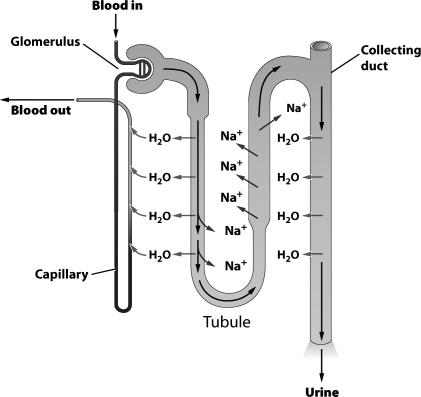 In the region of the nephron labeled "tubule," sodium is
 (Multiple Choice)
4.9/5 (80)
(80) 
Filters
- Essay(0)
- Multiple Choice(0)
- Short Answer(0)
- True False(0)
- Matching(0)