



 Chat with AI
Exam 26: Internal Organization and Homeostasis

Exam 1: The Nature of Science and the Characteristics of Life82 Questions
Exam 2: Biological Diversity, Bacteria, and Archaea101 Questions
Exam 3: Protista, Plantae, and Fungi83 Questions
Exam 4: Animalia81 Questions
Exam 5: The Chemistry of Life92 Questions
Exam 6: Cell Structure and Internal Compartments87 Questions
Exam 7: Cell Membranes, Transport, and Communication85 Questions
Exam 8: Energy, Metabolism, and Enzymes81 Questions
Exam 9: Photosynthesis and Cellular Respiration84 Questions
Exam 10: Cell Division89 Questions
Exam 11: Stem Cells, Cancer, and Human Health93 Questions
Exam 12: Patterns of Inheritance75 Questions
Exam 13: Chromosomes and Human Genetics75 Questions
Exam 14: Dna and Genes105 Questions
Exam 15: From Gene to Protein80 Questions
Exam 16: Dna Technology80 Questions
Exam 17: How Evolution Works80 Questions
Exam 18: Evolution of Populations80 Questions
Exam 19: Speciation and the Origins of Biological Diversity80 Questions
Exam 20: The Evolutionary History of Life100 Questions
Exam 21: The Biosphere89 Questions
Exam 22: Growth of Populations69 Questions
Exam 23: Ecological Communities133 Questions
Exam 24: Ecosystems75 Questions
Exam 25: Global Change70 Questions
Exam 26: Internal Organization and Homeostasis79 Questions
Exam 27: Nutrition and Digestion80 Questions
Exam 28: Circulation and Gas Exchange77 Questions
Exam 29: Animal Hormones78 Questions
Exam 30: Nervous and Sensory Systems78 Questions
Exam 31: Skeletons, Muscles, and Movement78 Questions
Exam 32: Defenses Against Disease78 Questions
Exam 33: Reproduction and Development76 Questions
Exam 34: Animal Behavior76 Questions
Exam 35: Plant Structure, Nutrition, and Transport80 Questions
Exam 36: Plant Growth and Reproduction80 Questions
Select questions type


Most marine animals and all land animals are ____________________ because they maintain internal salt and water levels that are not the same as those of their surroundings.
(Short Answer)
4.8/5  (83)
(83) A person whose hands are being warmed by holding a hot cup of tea is gaining heat by
(Multiple Choice)
4.8/5 (82)
(82) An iguana swimming in water colder than its body temperature
(Multiple Choice)
4.9/5 (71)
(71) Since the fur color of many mammals darkens in the winter months, the following conclusion is drawn:
(Multiple Choice)
4.7/5 (90)
(90) Insulin is a protein hormone that helps cells use glucose. In type I diabetes, insulin-making cells of the pancreas are attacked and destroyed. The preceding information is an example of the
(Multiple Choice)
4.8/5 (84)
(84) 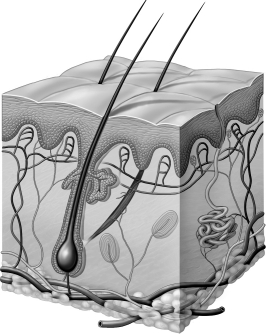
When a dog pants (breathes in and out rapidly through the mouth), evaporative cooling is enhanced by
(Multiple Choice)
4.9/5 (81)
(81) Some species of fish that live in the cold waters of the Arctic Ocean have evolved an "antifreeze" protein. Why might this protein be important to homeostasis?
(Multiple Choice)
4.7/5 (83)
(83) Examine the table below. 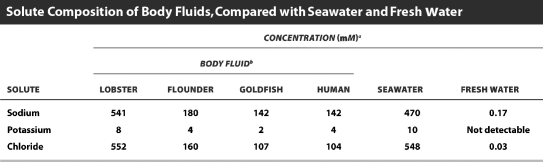 Based on the data in this table, which organism is most likely to be an osmoconformer? Note that lobsters and flounders live in seawater and goldfish live in freshwater.
 (Multiple Choice)
4.9/5 (88)
(88) Because the brain controls all body functions, the ____________________ system is the only system that communicates with all other body systems.
(Short Answer)
4.8/5 (69)
(69) Which of the following statements about temperature regulation is false?
(Multiple Choice)
4.7/5 (93)
(93) Aerobic exercise generates body heat primarily due to muscle contractions.
(True/False)
4.9/5 (90)
(90) To maintain homeostasis of its body fluids, a frog in freshwater would have to
(Multiple Choice)
4.9/5 (74)
(74) A large glass of ice water and a small glass of ice water are sitting on a table in the same room. The small glass of water would reach room temperature before the large glass of water.
(True/False)
4.7/5 (89)
(89) 
Filters
- Essay(0)
- Multiple Choice(0)
- Short Answer(0)
- True False(0)
- Matching(0)