



 Chat with AI
Exam 23: Ecological Communities

Exam 1: The Nature of Science and the Characteristics of Life82 Questions
Exam 2: Biological Diversity, Bacteria, and Archaea101 Questions
Exam 3: Protista, Plantae, and Fungi83 Questions
Exam 4: Animalia81 Questions
Exam 5: The Chemistry of Life92 Questions
Exam 6: Cell Structure and Internal Compartments87 Questions
Exam 7: Cell Membranes, Transport, and Communication85 Questions
Exam 8: Energy, Metabolism, and Enzymes81 Questions
Exam 9: Photosynthesis and Cellular Respiration84 Questions
Exam 10: Cell Division89 Questions
Exam 11: Stem Cells, Cancer, and Human Health93 Questions
Exam 12: Patterns of Inheritance75 Questions
Exam 13: Chromosomes and Human Genetics75 Questions
Exam 14: Dna and Genes105 Questions
Exam 15: From Gene to Protein80 Questions
Exam 16: Dna Technology80 Questions
Exam 17: How Evolution Works80 Questions
Exam 18: Evolution of Populations80 Questions
Exam 19: Speciation and the Origins of Biological Diversity80 Questions
Exam 20: The Evolutionary History of Life100 Questions
Exam 21: The Biosphere89 Questions
Exam 22: Growth of Populations69 Questions
Exam 23: Ecological Communities133 Questions
Exam 24: Ecosystems75 Questions
Exam 25: Global Change70 Questions
Exam 26: Internal Organization and Homeostasis79 Questions
Exam 27: Nutrition and Digestion80 Questions
Exam 28: Circulation and Gas Exchange77 Questions
Exam 29: Animal Hormones78 Questions
Exam 30: Nervous and Sensory Systems78 Questions
Exam 31: Skeletons, Muscles, and Movement78 Questions
Exam 32: Defenses Against Disease78 Questions
Exam 33: Reproduction and Development76 Questions
Exam 34: Animal Behavior76 Questions
Exam 35: Plant Structure, Nutrition, and Transport80 Questions
Exam 36: Plant Growth and Reproduction80 Questions
Select questions type


A(n)____________________ is a single sequence of who eats whom in a community.
(Short Answer)
4.9/5  (73)
(73) Which of the following best characterizes humans' method of obtaining energy?
(Multiple Choice)
4.9/5 (84)
(84) Coevolution often occurs when natural selection produces evolutionary change in predator and prey populations; a good example is
(Multiple Choice)
4.7/5 (73)
(73) Communities change with respect to several timescales; an example of long-term change would be the
(Multiple Choice)
4.9/5 (79)
(79) The fact that some organisms live in herds or flocks in order to protect themselves from predators is an example of ____________________ modification.
(Short Answer)
4.7/5 (71)
(71) The removal of a keystone species from a community usually results in
(Multiple Choice)
4.9/5 (88)
(88) Antibiotic therapy sometimes reduces the population of gut-inhabiting microorganisms. Bloating and diarrhea often follow until the populations reestablish themselves. This observation suggests that these microorganisms participate in a(n)_____ relationship with humans.
(Multiple Choice)
4.8/5 (74)
(74) Without pollinator mutualism, agricultural productivity could fall significantly.
(True/False)
4.8/5 (89)
(89) Pathogens are considered a special type of parasite because they
(Multiple Choice)
4.9/5 (65)
(65) As the figure below illustrates, the distribution of numerous intertidal organisms is restricted to bands or zones. The upper limit to the zone is determined by tolerance to physical factors like desiccation, whereas the lower boundary is determined by a biological interaction such as competition. 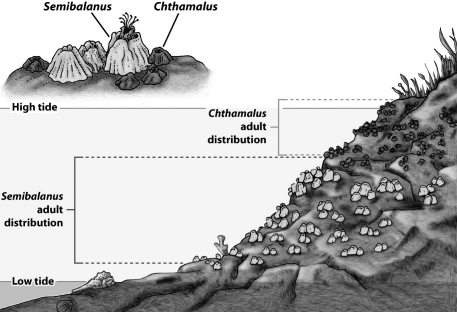 What could account for the lower limit for Semibalanus?
 (Multiple Choice)
4.9/5 (86)
(86) Certain species of squirrels and acorn woodpeckers both eat acorns. In forests without squirrels, the density of acorn woodpeckers averages 100 per square kilometer, whereas in forests with squirrels the density of acorn woodpeckers is roughly halved. This reduced density most probably results from
(Multiple Choice)
5.0/5 (84)
(84) A tapeworm is living in the intestine of a human and absorbing nutrients. This relationship is one of
(Multiple Choice)
4.9/5 (74)
(74) Into which category would a human be assigned when eating pepperoni pizza?
(Multiple Choice)
4.9/5 (81)
(81) A species can participate in several symbiotic relationships simultaneously; for example, the invasive fire tree competes with native vegetation for soil nutrients and maintains a mutualistic relationship with root bacteria.
(True/False)
4.7/5 (90)
(90) Which of the following symbols represents a mutualistic relationship?
(Multiple Choice)
4.8/5 (82)
(82) 
Filters
- Essay(0)
- Multiple Choice(0)
- Short Answer(0)
- True False(0)
- Matching(0)