



 Chat with AI
Exam 12: Franklin D. Roosevelt and the Shadow of War 1933–1941

Exam 1: The Ordeal of Reconstruction, 1865-1877105 Questions
Exam 2: Political Paralysis in the Gilded Age, 1869-1896147 Questions
Exam 3: Industry Comes of Age, 1865-1900157 Questions
Exam 4: America Moves to the City, 1865-1900154 Questions
Exam 5: The Great West and the Agricultural Revolution, 1865-1896161 Questions
Exam 6: Empire and Expansion, 1890-1909161 Questions
Exam 7: Progressivism and the Republican Roosevelt, 1901-1912142 Questions
Exam 8: Wilsonian Progressivism in Peace and War, 1913-1920144 Questions
Exam 9: American Life in the “Roaring Twenties” 1920–1929145 Questions
Exam 10: The Politics of Boom and Bust 1920–1932105 Questions
Exam 11: The Great Depression and the New Deal 1933–1939118 Questions
Exam 12: Franklin D. Roosevelt and the Shadow of War 1933–1941104 Questions
Exam 13: America in World War II 1941–1945106 Questions
Exam 14: The Cold War Begins 1945-1952154 Questions
Exam 15: American Zenith 1952-1963181 Questions
Exam 16: The Stormy Sixties 1963-1973168 Questions
Exam 17: Challenges to the Postwar Order 1973-198083 Questions
Exam 18: The Resurgence of Conservatism 1980-1992120 Questions
Exam 19: America Confronts the Post-Cold War Era, 1992-200087 Questions
Exam 20: The American People Face a New Century, 2001-201488 Questions
Select questions type


The era of informal polling techniques came to an end and was replaced by more scientifically based systems
(Multiple Choice)
4.9/5  (87)
(87) Locate the following places by reference number on the map:
Europe at the Onset of World War II, c. 1939
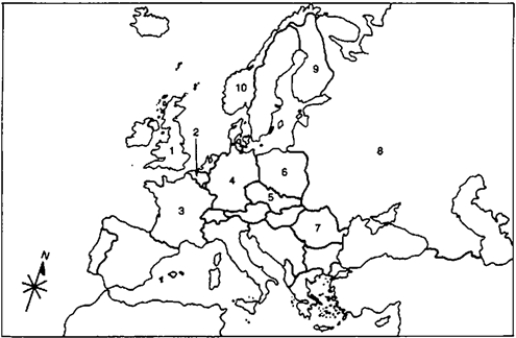 -____ The nation that was sacrificed at the Munich Conference by the Allied nations to achieve "peace in our time."
 (Short Answer)
4.9/5 (73)
(73) By mid-1941, Japan believed that it had no alternative to war with the United States because President Franklin Roosevelt
(Multiple Choice)
4.8/5 (85)
(85) Among the principles of the Atlantic Charter signed by President Roosevelt and British Prime Minister Churchill were
(Multiple Choice)
4.8/5 (79)
(79) Those opposed to the Lend-Lease program, such as members of America First Committee,were primarily motivated by a fear that
(Multiple Choice)
5.0/5 (79)
(79) Arrange these events in chronological order: (A) Munich Conference, (B) German invasion of Poland, and (C) Hitler-Stalin nonaggression treaty.
(Multiple Choice)
4.8/5 (89)
(89) America's neutrality policy during the Spanish Civil War of 1936-1939 contributed to
(Multiple Choice)
4.7/5 (73)
(73) Identify and state the historical significance of the following:
-Josef Goebbels
(Short Answer)
4.8/5 (85)
(85) In response to Senator Joseph McCarthy's anticommunist attacks, President Eisenhower
(Multiple Choice)
4.9/5 (74)
(74) Identify and state the historical significance of the following:
-Wendell Willkie
(Short Answer)
4.7/5 (83)
(83) Identify and state the historical significance of the following:
-the St. Louis
(Short Answer)
4.9/5 (75)
(75) Identify and state the historical significance of the following:
-Atlantic Charter
(Short Answer)
4.8/5 (74)
(74) Do you think the argument that "one should not change horses in the middle of a stream" is sufficient to justify Franklin Roosevelt's breaking the two-term tradition in 1940? Do you think anyone should be allowed to serve more than two terms in the presidency? Why or why not? Why do you believe Congress passed and the states ratified the 22nd Amendment to the Constitution in 1951 limiting a president to being elected to two terms in office?
(Essay)
4.8/5 (82)
(82) Americans' fervent isolationism in the 1930s can best be attributed to
(Multiple Choice)
4.8/5 (93)
(93) Compare and contrast the views of the Committee to Defend America by Aiding the Allies with those of the America First Committee. Had you lived in America just after the fall of France in June 1940, which view would you have supported? Why? Support your choice with specific historical examples that bolster the contemporaneous view of either advocacy organization.
(Essay)
4.8/5 (73)
(73) In 1940, in exchange for American destroyers, the British gave the United States
(Multiple Choice)
4.8/5 (85)
(85) Explain how, in the 1930s, "the American people were overwhelmingly anti-Nazi and anti-Hitler, ... but they were desperately determined to stay out [of war]."
(Not Answered)
This question doesn't have any answer yet
In the 1940 presidential election campaign, both President Roosevelt and the Republican candidate, Wendell Willkie, agreed that the
(Multiple Choice)
5.0/5 (84)
(84) Identify and state the historical significance of the following:
-"cash-and-carry basis"
(Short Answer)
4.9/5 (79)
(79) 
Filters
- Essay(0)
- Multiple Choice(0)
- Short Answer(0)
- True False(0)
- Matching(0)