



 Chat with AI
Exam 12: Franklin D. Roosevelt and the Shadow of War 1933–1941


Identify and state the historical significance of the following:
-Johnson Debt Default Act

 (78)
 Answered by Examlex AI Copilot
The Johnson Debt Default Act, officially known as the Johnson Act, was a piece of legislation passed by the United States Congress in 1934 during the Great Depression. It was named after its sponsor, Senator Hiram Warren Johnson of California. The act was designed to prevent countries that had defaulted on their World War I debts to the United States from borrowing further funds from American citizens and financial institutions.
Historical Significance:
1. Response to Debt Default: The act was a response to the failure of several European countries to repay their debts to the United States incurred during and after World War I. These debts were in the form of both government loans and private loans, and as the Great Depression deepened, many debtor nations found it increasingly difficult to meet their obligations.
2. Protection of American Investors: By prohibiting defaulting countries from soliciting new loans in the U.S. financial markets, the Johnson Act aimed to protect American investors from potential losses and discourage irresponsible borrowing practices by foreign governments.
3. Impact on International Relations: The Johnson Debt Default Act had significant implications for international relations, as it strained the U.S.'s diplomatic ties with debtor nations. It also contributed to the growing isolationist sentiment in the United States during the interwar period, as it effectively cut off a financial avenue that could have facilitated closer economic cooperation.
4. Influence on Subsequent Debt Negotiations: The act influenced the way international debt was managed and negotiated in subsequent years. It highlighted the need for international cooperation in addressing sovereign debt issues, which became particularly relevant in the post-World War II era with the establishment of international financial institutions such as the International Monetary Fund (IMF) and the World Bank.
5. Long-term Effects: The Johnson Act remained in effect for many years, and its legacy can be seen in modern legislation that governs international lending and debt repayment. It set a precedent for the U.S. government to use legislative means to manage and influence international financial transactions, especially in cases where there is a perceived risk to national interests or financial stability.
In summary, the Johnson Debt Default Act of 1934 was historically significant as it reflected the United States' approach to international debt during a period of economic turmoil, influenced the country's foreign policy, and set a precedent for future financial legislation.
From 1925 to 1940, the transition of American policy on arms sales to warring nations followed this sequence
(60)  Verified
D
Identify and state the historical significance of the following:
-invasion of Ethiopia
(70) Answered by Examlex AI CopilotThe invasion of Ethiopia, also known as the Second Italo-Ethiopian War, refers to the military campaign initiated by Fascist Italy against the Ethiopian Empire in October 1935. This conflict is historically significant for several reasons:
1. **Manifestation of Fascist Aggression**: The invasion was a clear demonstration of Fascist Italy's imperial ambitions under the leadership of Benito Mussolini. It was part of Mussolini's broader aim to build a "New Roman Empire" and to avenge the previous defeat Italy had suffered at the Battle of Adwa in 1896 during the First Italo-Ethiopian War.
2. **Use of Chemical Weapons**: The Italian forces used chemical weapons, such as mustard gas, against Ethiopian troops and civilians, in clear violation of the 1925 Geneva Protocol. This use of chemical warfare was widely condemned and remains a dark chapter in the history of warfare.
3. **Failure of the League of Nations**: The League of Nations, the precursor to the United Nations, was unable to prevent the invasion or effectively sanction Italy for its aggression. This failure undermined the credibility of the League and highlighted the limitations of international organizations in maintaining peace in the face of aggressive expansionist policies by powerful nations.
4. **Precedent for World War II**: The invasion is often seen as a prelude to World War II, as it demonstrated the ineffectiveness of the international community to check the ambitions of totalitarian regimes. It emboldened other aggressive powers, such as Nazi Germany and Imperial Japan, to pursue their expansionist goals, which eventually led to the outbreak of the Second World War.
5. **African Resistance and Decolonization**: Ethiopia, under the leadership of Emperor Haile Selassie, became a symbol of resistance against colonialism for many African nations. The invasion and subsequent resistance efforts were an important chapter in the narrative of African decolonization and the struggle for independence throughout the continent.
6. **Ethiopian Independence**: Despite being occupied by Italy from 1936 to 1941, Ethiopia maintained its independence, and with the help of Allied forces during World War II, it was able to expel the Italian occupiers. Ethiopia's resistance and eventual liberation were significant in that it was one of the few African countries to maintain its independence during the era of European colonialism.
7. **International Solidarity**: The invasion prompted international solidarity with Ethiopia, with many volunteers from around the world, including African Americans and other Africans in the diaspora, coming to the aid of the Ethiopian cause. This global response was an early example of transnational activism against colonial aggression.
In summary, the invasion of Ethiopia by Italy in 1935 is historically significant as it exposed the weaknesses of the international system at the time, highlighted the brutal nature of colonial warfare, and served as a precursor to the global conflict of World War II. It also played a role in the narrative of African resistance and the eventual wave of decolonization that swept across the continent in the mid-20th century.
At what point, during the turbulent and cataclysmic European events of the 1930s and 1940-1941, do you believe American entry into the war in Europe became inevitable? Explain and justify your answer with specific historical examples that support your analysis.
(71) Throughout most of the 1930s, majorities of the American people responded to the aggressive actions of Germany, Italy, and Japan by
(84) Explain in what way the Neutrality Acts of the 1930s "marked in effect an abandonment of the [United States'] traditional policy of freedom of the seas." How did the Neutrality Acts of the 1930s expressly contradict President Woodrow Wilson's insistence on maintaining America's neutral shipping rights two years before American entry into World War I? What do you believe accounts for this fundamental abandonment of the American government's traditional policy of upholding "freedom of the seas" as Fascism was on the rise worldwide less than twenty years after the conclusion of World War I?
(74) Locate the following places by reference number on the map:
Europe at the Onset of World War II, c. 1939
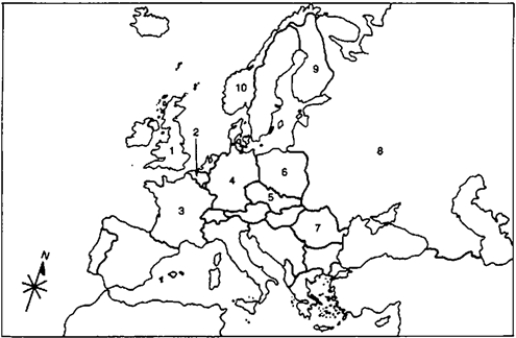 -____ The only European nation to pay off its World War I debts to the United States, invaded by the Soviet Union in 1939-1940.
 (73) Franklin Roosevelt's sensational Quarantine Speech in 1937 resulted in
(85) One of the few successful wartime American efforts to save Jews from perishing in the Holocaust came when
(88) Identify and state the historical significance of the following:
-fascism
(74) Identify and state the historical significance of the following:
-Good Neighbor policy
(75) Identify and state the historical significance of the following:
-Abraham Lincoln Brigade
(87) Locate the following places by reference number on the map:
Europe at the Onset of World War II, c. 1939
-____ The nation that, when invaded in 1939, touched off the formal onset of World War II.
-____ The nation that, when invaded in 1939, touched off the formal onset of World War II. (82) Identify and state the historical significance of the following:
-"merchants of death"
(84) Identify and state the historical significance of the following:
-Nazi party
(78) By the mid-1930s, there was strong nationwide agitation for a constitutional amendment to
(88) Identify and state the historical significance of the following:
-Neutrality Acts of 1935, 1936, and 1937
(85) Identify and state the historical significance of the following:
-Japanese militarism and the "China incident" of 1937
(79) As part of his Good Neighbor policy toward Latin America, President Roosevelt developed more generous policies of
(64) Identify and state the historical significance of the following:
-"phony war"
(91) 
Filters
- Essay(0)
- Multiple Choice(0)
- Short Answer(0)
- True False(0)
- Matching(0)