



 Chat with AI
Exam 12: Franklin D. Roosevelt and the Shadow of War 1933–1941

Exam 1: The Ordeal of Reconstruction, 1865-1877105 Questions
Exam 2: Political Paralysis in the Gilded Age, 1869-1896147 Questions
Exam 3: Industry Comes of Age, 1865-1900157 Questions
Exam 4: America Moves to the City, 1865-1900154 Questions
Exam 5: The Great West and the Agricultural Revolution, 1865-1896161 Questions
Exam 6: Empire and Expansion, 1890-1909161 Questions
Exam 7: Progressivism and the Republican Roosevelt, 1901-1912142 Questions
Exam 8: Wilsonian Progressivism in Peace and War, 1913-1920144 Questions
Exam 9: American Life in the “Roaring Twenties” 1920–1929145 Questions
Exam 10: The Politics of Boom and Bust 1920–1932105 Questions
Exam 11: The Great Depression and the New Deal 1933–1939118 Questions
Exam 12: Franklin D. Roosevelt and the Shadow of War 1933–1941104 Questions
Exam 13: America in World War II 1941–1945106 Questions
Exam 14: The Cold War Begins 1945-1952154 Questions
Exam 15: American Zenith 1952-1963181 Questions
Exam 16: The Stormy Sixties 1963-1973168 Questions
Exam 17: Challenges to the Postwar Order 1973-198083 Questions
Exam 18: The Resurgence of Conservatism 1980-1992120 Questions
Exam 19: America Confronts the Post-Cold War Era, 1992-200087 Questions
Exam 20: The American People Face a New Century, 2001-201488 Questions
Select questions type


Identify and state the historical significance of the following:
-Battle of Britain
(Short Answer)
4.9/5  (68)
(68) To what extent did American diplomacy and economic policy during the 1930s and up to the surprise bombing of Pearl Harbor on December 7, 1941provoke war with Japan? What might the United States have done to delay or even prevent war with Japan? Why wasn't that done?
(Essay)
4.9/5 (83)
(83) Identify and state the historical significance of the following:
-the Holocaust
(Essay)
4.8/5 (79)
(79) Identify and state the historical significance of the following:
-totalitarianism
(Short Answer)
4.9/5 (86)
(86) Identify and state the historical significance of the following:
-Munich conference
(Short Answer)
4.7/5 (80)
(80) Identify and state the historical significance of the following:
-War Refugee Board
(Short Answer)
4.9/5 (72)
(72) Identify and state the historical significance of the following:
-Joseph Stalin
(Short Answer)
4.7/5 (84)
(84) Identify and state the historical significance of the following:
-Francisco Franco
(Short Answer)
4.9/5 (92)
(92) Locate the following places by reference number on the map:
Europe at the Onset of World War II, c. 1939
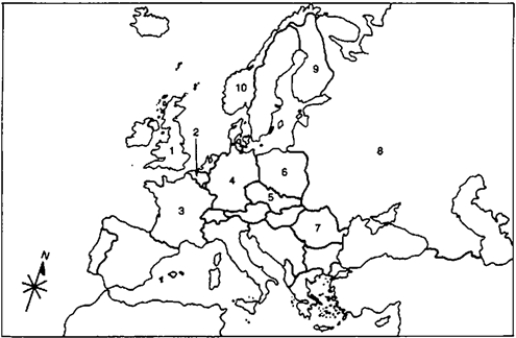 -____ The nation invaded by Hitler in 1941 despite a formal nonaggression pact signed two years earlier.
 (Short Answer)
4.9/5 (84)
(84) Locate the following places by reference number on the map:
Europe at the Onset of World War II, c. 1939
-____ The nation through which German armies twice invaded France in the twentieth century.
-____ The nation through which German armies twice invaded France in the twentieth century. (Short Answer)
4.9/5 (85)
(85) Identify and state the historical significance of the following:
-George Gallup
(Short Answer)
4.8/5 (98)
(98) Explain in what way a) the Neutrality Acts of 1935, 1936, and 1937, b) the fall of France, c) Hitler's invasion of the Soviet Union, and d) the attack on Pearl Harbor mark the most important turning points in American foreign policy from "storm-cellar isolationism" to full-fledged interventionism between 1935 and 1941.
(Essay)
4.9/5 (77)
(77) Identify and state the historical significance of the following:
-Spanish Civil War
(Short Answer)
4.9/5 (73)
(73) The text states that the ultimate cause of America's entry into World War II was the fact that it pursued policies in both Europe and Asia that invited retaliation. Do you agree with the authors' assessment of why America ultimately entered World War II? If not, why not? If so, what were those policies, and why were Americans willing to risk war to uphold them?
(Essay)
4.8/5 (84)
(84) Liberal and left-wing Americans reacted to General Franco's efforts to stage a Fascist coup and overthrow the Republic in Spain by
(Multiple Choice)
4.9/5 (69)
(69) During the 1930s, the United States admitted ____ Jewish refugees from Nazism.
(Multiple Choice)
4.9/5 (85)
(85) The net effect of most of Franklin Roosevelt's foreign policy moves in his first term in office suggested that
(Multiple Choice)
4.8/5 (79)
(79) Which of the following nations was not conquered by Hitler's Germany between September 1939 and June 1940?
(Multiple Choice)
4.7/5 (76)
(76) America's attempt to remain neutral in the war between the Axis powers and the Allies came to an end when
(Multiple Choice)
4.8/5 (82)
(82) Franklin Roosevelt was motivated to run for a third term as president in 1940 mainly by his
(Multiple Choice)
4.9/5 (87)
(87) 
Filters
- Essay(0)
- Multiple Choice(0)
- Short Answer(0)
- True False(0)
- Matching(0)