



 Chat with AI
Exam 18: International Trade and Comparative Advantage

Exam 1: What Is Economics?227 Questions
Exam 2: The Economy: Myth and Reality150 Questions
Exam 3: The Fundamental Economic Problem: Scarcity and Choice250 Questions
Exam 4: Supply and Demand: An Initial Look308 Questions
Exam 5: An Introduction to Macroeconomics211 Questions
Exam 6: The Goals of Macroeconomic Policy207 Questions
Exam 7: Economic Growth: Theory and Policy223 Questions
Exam 8: Aggregate Demand and the Powerful Consumer214 Questions
Exam 9: Demand-Side Equilibrium: Unemployment or Inflation?211 Questions
Exam 10: Bringing in the Supply Side: Unemployment and Inflation?223 Questions
Exam 11: Managing Aggregate Demand: Fiscal Policy205 Questions
Exam 12: Money and the Banking System219 Questions
Exam 13: Monetary Policy: Conventional and Unconventional205 Questions
Exam 14: The Financial Crisis and the Great Recession61 Questions
Exam 15: The Debate over Monetary and Fiscal Policy214 Questions
Exam 16: Budget Deficits in the Short and Long Run210 Questions
Exam 17: The Trade Off between Inflation and Unemployment214 Questions
Exam 18: International Trade and Comparative Advantage226 Questions
Exam 19: The International Monetary System: Order or Disorder?213 Questions
Exam 20: Exchange Rates and the Macroeconomy214 Questions
Select questions type


If one country has an absolute advantage in every commodity,there is no reason for it to trade.
(True/False)
4.8/5  (83)
(83) If a nation does not have an absolute advantage in producing anything,it
(Multiple Choice)
4.7/5 (71)
(71) If England uses one week's time to produce ten yards of cloth or two barrels of wine and Portugal uses one week's time to produce twelve yards of cloth or six barrels of wine,England has the comparative advantage in both goods.
(True/False)
5.0/5 (85)
(85) Figure 18-9
 -In Figure 18-9,Pestoland exports pasta to Pastaland.The equilibrium price of pasta will be
 (Multiple Choice)
4.8/5 (79)
(79) Baumol and Blinder offer some reasons why countries trade with each other.List three of the reasons,and give an example of each to illustrate the reason.
(Essay)
4.9/5 (76)
(76) What would be the output combination for two products A and B on the production possibility frontier,if a country uses its entire resources for producing A?
(Multiple Choice)
4.9/5 (88)
(88) Specialization permits larger outputs and offers economies of large-scale production.
(True/False)
4.8/5 (74)
(74) A tariff has one distinct advantage over a quota.It increases tax revenues to the government.
(True/False)
4.8/5 (90)
(90) Among the impediments to the international mobility of capital are
(Multiple Choice)
4.8/5 (82)
(82) The "infant industry argument" recommends protectionism for industries that produce children's clothing.
(True/False)
4.8/5 (78)
(78) In the past,when the United States enjoyed a continuing trade surplus,wages in the United States
(Multiple Choice)
5.0/5 (79)
(79) Strategic trade policy relies on threats of protectionism to protect free trade.
(True/False)
4.9/5 (75)
(75) A country can gain by importing a good that it can make itself if
(Multiple Choice)
4.8/5 (71)
(71) Comparative advantage is the rule that ordinarily prevents a nation from independently producing all of the goods it requires.
(True/False)
4.8/5 (86)
(86) Figure 18-7
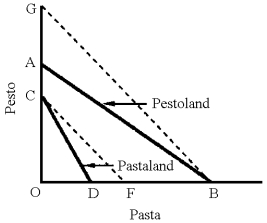 -In Figure 18-7,AB represents the production possibilities of Pestoland and CD that of Pastaland.In this graph,Pestoland has a comparative advantage in
 (Multiple Choice)
4.8/5 (65)
(65) Equilibrium price in international trade is the common price between exporting and importing countries.
(True/False)
4.9/5 (72)
(72) 
Filters
- Essay(0)
- Multiple Choice(0)
- Short Answer(0)
- True False(0)
- Matching(0)