



 Chat with AI
Exam 18: International Trade and Comparative Advantage

Exam 1: What Is Economics?227 Questions
Exam 2: The Economy: Myth and Reality150 Questions
Exam 3: The Fundamental Economic Problem: Scarcity and Choice250 Questions
Exam 4: Supply and Demand: An Initial Look308 Questions
Exam 5: An Introduction to Macroeconomics211 Questions
Exam 6: The Goals of Macroeconomic Policy207 Questions
Exam 7: Economic Growth: Theory and Policy223 Questions
Exam 8: Aggregate Demand and the Powerful Consumer214 Questions
Exam 9: Demand-Side Equilibrium: Unemployment or Inflation?211 Questions
Exam 10: Bringing in the Supply Side: Unemployment and Inflation?223 Questions
Exam 11: Managing Aggregate Demand: Fiscal Policy205 Questions
Exam 12: Money and the Banking System219 Questions
Exam 13: Monetary Policy: Conventional and Unconventional205 Questions
Exam 14: The Financial Crisis and the Great Recession61 Questions
Exam 15: The Debate over Monetary and Fiscal Policy214 Questions
Exam 16: Budget Deficits in the Short and Long Run210 Questions
Exam 17: The Trade Off between Inflation and Unemployment214 Questions
Exam 18: International Trade and Comparative Advantage226 Questions
Exam 19: The International Monetary System: Order or Disorder?213 Questions
Exam 20: Exchange Rates and the Macroeconomy214 Questions
Select questions type


How does the imposition of a tariff reduce the price of imports?
(Multiple Choice)
4.8/5  (87)
(87) Figure 18-7
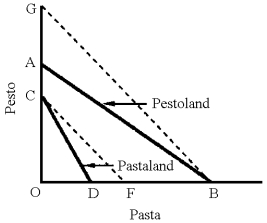 -In Figure 18-7,where AB represents the production possibilities of Pestoland and CD the production possibilities of Pastaland,Pastaland is
 (Multiple Choice)
4.8/5 (84)
(84) The quantity supplied by domestic producers in an importing country must be less than the quantity demanded by its population.
(True/False)
4.8/5 (75)
(75) Quebec is capable of producing 10 pallets of wood shingles or 8 barrels of maple syrup with a unit of labor.Vermont is capable of producing 12 pallets of wood shingles or 12 barrels of maple syrup with a unit of labor.Assume that this is typical of the labor force as a whole.Which location has the absolute advantage and which has the comparative advantage,in the production of each good? Can these locations reap gains from trade?
(Essay)
4.8/5 (89)
(89) Specialization is the concept of devoting resources to the production of only a small number of goods and services.
(True/False)
4.8/5 (84)
(84) "I oppose a free trade agreement with Mexico because American workers will lose jobs to low-paid Mexican workers." Explain whether you agree or disagree with this statement.
(Essay)
4.8/5 (85)
(85) The danger of using the national defense argument to protect domestic industries necessary to wage war is that
(Multiple Choice)
4.8/5 (89)
(89) One nation can gain from an exchange only at the expense of another.
(True/False)
4.8/5 (83)
(83) A program of protection that results in preserving jobs in certain industries
(Multiple Choice)
4.9/5 (70)
(70) The United States is known worldwide as being a low tariff nation.
(True/False)
4.9/5 (79)
(79) Table 18-2
 -Suppose that with 1 unit of labor,Canada can produce 40 TVs or 20 computers.With 1 unit of labor,Taiwan can produce 30 TVs or 10 computers.Which of the following is correct?
 (Multiple Choice)
4.9/5 (70)
(70) The United States can produce 1,000 shoes if it specializes in shoe production.Alternatively,it can produce 500 shirts.Taiwan can produce 500 shoes or 200 shirts.Explain which country will specialize in shoe production and which in shirt production.What are the possible terms of trade?
(Essay)
4.7/5 (75)
(75) Figure 18-7
-In Figure 18-7,CF has the same slope as BG.AB and CD are the production possibilities of Pestoland and Pastaland,respectively.If both countries are given the opportunity to trade at prices indicated by CF,
-In Figure 18-7,CF has the same slope as BG.AB and CD are the production possibilities of Pestoland and Pastaland,respectively.If both countries are given the opportunity to trade at prices indicated by CF, (Multiple Choice)
4.8/5 (73)
(73) If England uses one week's time to produce ten yards of cloth or two barrels of wine and Portugal uses one week's time to produce twelve yards of cloth or six barrels of wine,then England has a comparative advantage in the production of cloth.
(True/False)
4.8/5 (85)
(85) Figure 18-7
-In Figure 18-7,it is probably t that wages are
-In Figure 18-7,it is probably t that wages are (Multiple Choice)
4.7/5 (80)
(80) International trade usually benefits one trading partner while making the other trading partner worse off.
(True/False)
4.9/5 (86)
(86) 
Filters
- Essay(0)
- Multiple Choice(0)
- Short Answer(0)
- True False(0)
- Matching(0)