



 Chat with AI
Exam 18: International Trade and Comparative Advantage

Exam 1: What Is Economics?227 Questions
Exam 2: The Economy: Myth and Reality150 Questions
Exam 3: The Fundamental Economic Problem: Scarcity and Choice250 Questions
Exam 4: Supply and Demand: An Initial Look308 Questions
Exam 5: An Introduction to Macroeconomics211 Questions
Exam 6: The Goals of Macroeconomic Policy207 Questions
Exam 7: Economic Growth: Theory and Policy223 Questions
Exam 8: Aggregate Demand and the Powerful Consumer214 Questions
Exam 9: Demand-Side Equilibrium: Unemployment or Inflation?211 Questions
Exam 10: Bringing in the Supply Side: Unemployment and Inflation?223 Questions
Exam 11: Managing Aggregate Demand: Fiscal Policy205 Questions
Exam 12: Money and the Banking System219 Questions
Exam 13: Monetary Policy: Conventional and Unconventional205 Questions
Exam 14: The Financial Crisis and the Great Recession61 Questions
Exam 15: The Debate over Monetary and Fiscal Policy214 Questions
Exam 16: Budget Deficits in the Short and Long Run210 Questions
Exam 17: The Trade Off between Inflation and Unemployment214 Questions
Exam 18: International Trade and Comparative Advantage226 Questions
Exam 19: The International Monetary System: Order or Disorder?213 Questions
Exam 20: Exchange Rates and the Macroeconomy214 Questions
Select questions type


 -From Table 18-1,the United States

From 1975 to 2008,which of the following countries experienced greater wage increases than the U.S.?
(Multiple Choice)
4.8/5  (69)
(69) If nations begin to specialize in production for the purpose of trade,
(Multiple Choice)
4.8/5 (84)
(84) One of the main reasons that people want to limit imports is the
(Multiple Choice)
4.8/5 (83)
(83) According to William Safire,"helpfulism" is basically protectionism.
(True/False)
4.7/5 (78)
(78) Figure 18-2
 -In Figure 18-2,if the United States and Mexico are negotiating to trade wheat for petroleum,
 (Multiple Choice)
4.8/5 (89)
(89) Foreign competition will always put a domestic industry at a disadvantage.This leads to massive trade adjustment assistance on the part of each country.
(True/False)
4.8/5 (72)
(72) Figure 18-5
 -From the graph in Figure 18-5 (curves show output per unit of labor input),one can infer that
 (Multiple Choice)
5.0/5 (67)
(67) A country has a comparative advantage over another in the production of gadgets if it can produce
(Multiple Choice)
4.7/5 (78)
(78) Japan and China produce guns and rice.The country with the lowest opportunity cost of guns (in terms of rice)will
(Multiple Choice)
4.9/5 (88)
(88) Discuss national defense,infant industry,and strategic trade as arguments for protection.
(Essay)
4.7/5 (89)
(89) If a nation can produce greater quantities of a good than another nation,it has a(n)
(Multiple Choice)
4.7/5 (71)
(71) Table 18-2
 -Suppose that the United States can make 15 cars or 20 bottles of wine with one year's worth of labor.France can make 10 cars or 18 bottles of wine with one year's worth of labor.From these numbers,we can conclude that
 (Multiple Choice)
4.8/5 (68)
(68) If two countries have production possibilities curves with different slopes,there is no possibility for gains from trade.
(True/False)
4.7/5 (71)
(71) Which of the following statements regarding the cheap foreign labor argument is correct?
(Multiple Choice)
4.9/5 (85)
(85) If the United States imposes a tariff on the import of Japanese cars instead of a quota,the price
(Multiple Choice)
4.9/5 (82)
(82) 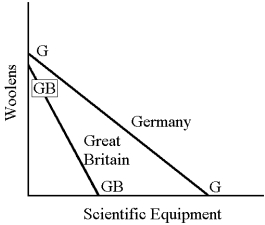 -In Figure 18-1,

Filters
- Essay(0)
- Multiple Choice(0)
- Short Answer(0)
- True False(0)
- Matching(0)