



 Chat with AI
Exam 18: International Trade and Comparative Advantage

Exam 1: What Is Economics?227 Questions
Exam 2: The Economy: Myth and Reality150 Questions
Exam 3: The Fundamental Economic Problem: Scarcity and Choice250 Questions
Exam 4: Supply and Demand: An Initial Look308 Questions
Exam 5: An Introduction to Macroeconomics211 Questions
Exam 6: The Goals of Macroeconomic Policy207 Questions
Exam 7: Economic Growth: Theory and Policy223 Questions
Exam 8: Aggregate Demand and the Powerful Consumer214 Questions
Exam 9: Demand-Side Equilibrium: Unemployment or Inflation?211 Questions
Exam 10: Bringing in the Supply Side: Unemployment and Inflation?223 Questions
Exam 11: Managing Aggregate Demand: Fiscal Policy205 Questions
Exam 12: Money and the Banking System219 Questions
Exam 13: Monetary Policy: Conventional and Unconventional205 Questions
Exam 14: The Financial Crisis and the Great Recession61 Questions
Exam 15: The Debate over Monetary and Fiscal Policy214 Questions
Exam 16: Budget Deficits in the Short and Long Run210 Questions
Exam 17: The Trade Off between Inflation and Unemployment214 Questions
Exam 18: International Trade and Comparative Advantage226 Questions
Exam 19: The International Monetary System: Order or Disorder?213 Questions
Exam 20: Exchange Rates and the Macroeconomy214 Questions
Select questions type


The way in which a country benefits from trade is that it can
(Multiple Choice)
4.8/5  (73)
(73) Figure 18-4
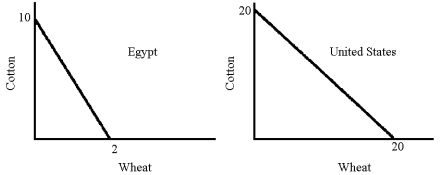 -In Figure 18-4,the opportunity cost of a unit of wheat in terms of cotton is
 (Multiple Choice)
4.7/5 (86)
(86) In discussing trade,it is ____ that matters rather than ____.
(Multiple Choice)
4.8/5 (83)
(83) The basic concept behind strategic trade policy is that free trade is the best policy to pursue,but some countries don't play by those rules.Therefore,
(Multiple Choice)
4.8/5 (80)
(80) A country has a comparative advantage over another in the production of gadgets if it can produce
(Multiple Choice)
5.0/5 (77)
(77) Mercantilist policy is to do everything it can to promote exports and to discourage imports.
(True/False)
4.8/5 (82)
(82) Table 18-2
 -Suppose that Captain Canada can produce 100 hockey sticks or 10 gallons of maple syrup in a typical work week,while Captain Germany can produce 90 hockey sticks or 10 gallons of maple syrup in a typical work week.From these numbers,we can conclude
 (Multiple Choice)
4.8/5 (77)
(77)  -From Figure 18-6,one can infer that
"The United States has more oil in Alaska than there is oil in Kuwait.Therefore,the United States should stop importing oil." Evaluate this statement using economic analysis.
(Essay)
4.7/5 (84)
(84) Is it possible for a country to have an absolute disadvantage and a comparative advantage in the production of a good?
(Multiple Choice)
4.7/5 (88)
(88) What is strategic trade policy? What are the pros and cons of such a policy by a nation in its dealings with other nations?
(Essay)
4.8/5 (73)
(73) Figure 18-8
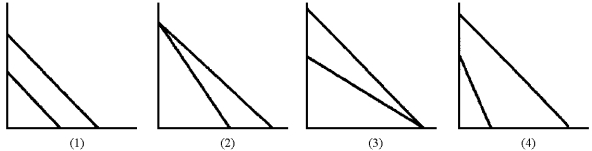 -Figure 18-8 has four sets of production possibility curves for two hypothetical countries.In which case will there be no advantage to trade between the two countries?
 (Multiple Choice)
5.0/5 (85)
(85) Trade occurs only when a country has an absolute advantage and not just a comparative advantage over another country.
(True/False)
4.9/5 (72)
(72) An upward spiral of protectionism is a possible outcome of strategic trade policy.
(True/False)
4.9/5 (78)
(78) The world price of a commodity will settle at the level where
(Multiple Choice)
4.9/5 (81)
(81) A country that must inhibit imports should give preference to
(Multiple Choice)
4.7/5 (78)
(78) Compare and contrast the effects of a quota and a tariff on imports.Be sure to include both short-run and long-run effects in your answer.
(Essay)
4.9/5 (63)
(63) 
Filters
- Essay(0)
- Multiple Choice(0)
- Short Answer(0)
- True False(0)
- Matching(0)