



 Chat with AI
Exam 18: International Trade and Comparative Advantage

Exam 1: What Is Economics?227 Questions
Exam 2: The Economy: Myth and Reality150 Questions
Exam 3: The Fundamental Economic Problem: Scarcity and Choice250 Questions
Exam 4: Supply and Demand: An Initial Look308 Questions
Exam 5: An Introduction to Macroeconomics211 Questions
Exam 6: The Goals of Macroeconomic Policy207 Questions
Exam 7: Economic Growth: Theory and Policy223 Questions
Exam 8: Aggregate Demand and the Powerful Consumer214 Questions
Exam 9: Demand-Side Equilibrium: Unemployment or Inflation?211 Questions
Exam 10: Bringing in the Supply Side: Unemployment and Inflation?223 Questions
Exam 11: Managing Aggregate Demand: Fiscal Policy205 Questions
Exam 12: Money and the Banking System219 Questions
Exam 13: Monetary Policy: Conventional and Unconventional205 Questions
Exam 14: The Financial Crisis and the Great Recession61 Questions
Exam 15: The Debate over Monetary and Fiscal Policy214 Questions
Exam 16: Budget Deficits in the Short and Long Run210 Questions
Exam 17: The Trade Off between Inflation and Unemployment214 Questions
Exam 18: International Trade and Comparative Advantage226 Questions
Exam 19: The International Monetary System: Order or Disorder?213 Questions
Exam 20: Exchange Rates and the Macroeconomy214 Questions
Select questions type


Figure 18-9
 -In Figure 18-9,Pestoland exports pasta to Pastaland.Equilibrium will occur when
 (Multiple Choice)
4.8/5  (94)
(94) Workers in high-wage countries cannot improve their real income when they trade with low-wage countries.
(True/False)
4.9/5 (74)
(74) Colombia produces coffee with less labor and land than any other country; it therefore surely has
(Multiple Choice)
4.8/5 (81)
(81) A quota sets the maximum amount of a good that is permitted into a country.
(True/False)
5.0/5 (86)
(86) Table 18-4
 -Table 18-4 presents the demand and supply schedules for television sets in Japan and the United States.If Japan and the United States trade with each other,what will be the equilibrium price in the world market for television sets?
 (Multiple Choice)
4.9/5 (70)
(70) The U.S.Constitution prevents tariffs on trade between the individual states.
(True/False)
4.8/5 (87)
(87) An example of a quota that protects an American industry is the quota on
(Multiple Choice)
4.7/5 (77)
(77) Figure 18-3
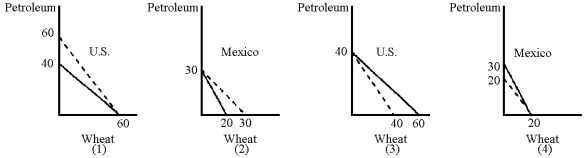 -In Figure 18-3,the solid lines represent the respective production possibilities curves for the United States and Mexico.Which graphs show the correct consumption possibilities curves (dashed lines)after an agreement is reached to trade 1 unit of wheat for 1 unit of petroleum?
 (Multiple Choice)
4.8/5 (80)
(80) For many years the U.S.government imposed quotas on cheap,Middle Eastern oil imports.The U.S.consumer consequently paid $3 billion more per year for oil products.A likely rationale for such a policy is
(Multiple Choice)
4.8/5 (80)
(80) Figure 18-5
 -From the graph in Figure 18-5 (curves show output per unit of labor input),one can infer that
 (Multiple Choice)
4.9/5 (77)
(77) The economic effects of a quota are identical to those of a tariff.
(True/False)
4.8/5 (74)
(74) One country has an absolute advantage over another country if it can produce a good using smaller quantities of resources.
(True/False)
4.9/5 (80)
(80) Suppose the South had won the Civil War,and trade no longer took place between Northern and Southern states.Explain whether the sum of the North and South GDPs would have been higher or lower than with the current United States.
(Essay)
5.0/5 (64)
(64) A tariff is a limitation on the amount of a good that can be imported.
(True/False)
4.8/5 (83)
(83) David Ricardo discovered that two countries can still gain by trading even if one country is more efficient in the production of every commodity.Ricardo's discovery is called the law of
(Multiple Choice)
4.9/5 (90)
(90) A tariff is a tax on imports imposed by the country that is importing the goods.
(True/False)
4.8/5 (77)
(77) The essential logic behind international trade is not different from that underlying trade among different states.Why,then,do we study international trade as a special subject?
(Essay)
5.0/5 (71)
(71) Table 18-4
-Table 18-4 presents the demand and supply schedules for television sets in Japan and the United States.If there is no trade between these countries,what are the equilibrium price and quantity in the United States?
-Table 18-4 presents the demand and supply schedules for television sets in Japan and the United States.If there is no trade between these countries,what are the equilibrium price and quantity in the United States? (Multiple Choice)
4.9/5 (81)
(81) 
Filters
- Essay(0)
- Multiple Choice(0)
- Short Answer(0)
- True False(0)
- Matching(0)