



 Chat with AI
Exam 15: Origin of the Solar System and Extrasolar Planets

Exam 1: Here and Now97 Questions
Exam 2: A Users Guide to the Sky116 Questions
Exam 3: Cycles of the Sun and Moon154 Questions
Exam 4: The Origin of Modern Astronomy144 Questions
Exam 5: Light and Telescopes156 Questions
Exam 6: Atoms and Spectra125 Questions
Exam 7: The Sun146 Questions
Exam 8: The Family of Stars190 Questions
Exam 9: The Formation and Structure of Stars136 Questions
Exam 10: The Deaths of Stars128 Questions
Exam 11: Neutron Stars and Black Holes99 Questions
Exam 12: The Milky Way Galaxy117 Questions
Exam 13: Galaxies: Normal and Active151 Questions
Exam 14: Modern Cosmology112 Questions
Exam 15: Origin of the Solar System and Extrasolar Planets104 Questions
Exam 16: Earth and Moon: Bases for Comparative Planetology98 Questions
Exam 17: Mercury, Venus, and Mars83 Questions
Exam 18: The Outer Solar System137 Questions
Exam 19: Meteorites, Asteroids, and Comets91 Questions
Exam 20: Astrobiology: Life on Other Worlds97 Questions
Select questions type


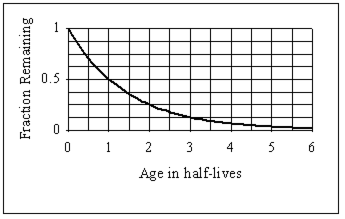
The diagram below illustrates the radioactive decay of potassium (40K), which has a half-life of 1.3 billion years. If a lunar rock is found that currently contains 5 grams of 40K, and it is determined that the sample contained 20 grams when it was formed, how old is the lunar rock?
(Multiple Choice)
4.9/5  (74)
(74) Violent impacts of infalling particles release energy called ____________.
(Short Answer)
4.7/5 (65)
(65) ____________ is the separation of material in a newly formed planet or asteroid according to density. This happens when the object becomes molten.
(Multiple Choice)
4.9/5 (68)
(68) Jovian worlds that orbit close to their host stars are called ____________.
(Short Answer)
4.8/5 (83)
(83) The most important effect in clearing the solar nebula of gas and dust was
(Multiple Choice)
4.9/5 (83)
(83)  In the above cartoon, the interior of a planet has separated into the layers shown by a process known as ___________.
 (Multiple Choice)
4.9/5 (79)
(79) Describe some characteristics that the terrestrial planets have in common. Use the solar nebula theory to explain the commonality.
(Essay)
4.8/5 (82)
(82) How is radioactive dating used to determine the age of an object?
(Multiple Choice)
4.8/5 (80)
(80) The large planetesimals would have grown faster than the smaller planetesimals because
(Multiple Choice)
4.8/5 (82)
(82) A planet found orbiting a star other than the Sun is called a(n) ____________.
(Short Answer)
5.0/5 (91)
(91) If the terrestrial planets were formed by homogeneous accretion, then
(Multiple Choice)
4.9/5 (82)
(82) 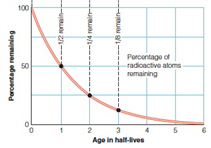 Using the graph shown above, find out how many half-lives does it take for 3/4 of the daughter products to form.
 (Multiple Choice)
4.8/5 (73)
(73) Debris disks are cold dust disks around main-sequence stars that are produced by collisions among planetesimals.
(True/False)
4.8/5 (93)
(93) The hydrogen and helium in our solar system were created from subatomic particles about ____________ years ago.
(Multiple Choice)
4.7/5 (81)
(81) Outgassing refers to the formation of an atmosphere by the attraction of gases from the surrounding nebula.
(True/False)
4.8/5 (91)
(91) 
Filters
- Essay(0)
- Multiple Choice(0)
- Short Answer(0)
- True False(0)
- Matching(0)