



 Chat with AI
Exam 5: Light and Telescopes

Exam 1: Here and Now97 Questions
Exam 2: A Users Guide to the Sky116 Questions
Exam 3: Cycles of the Sun and Moon154 Questions
Exam 4: The Origin of Modern Astronomy144 Questions
Exam 5: Light and Telescopes156 Questions
Exam 6: Atoms and Spectra125 Questions
Exam 7: The Sun146 Questions
Exam 8: The Family of Stars190 Questions
Exam 9: The Formation and Structure of Stars136 Questions
Exam 10: The Deaths of Stars128 Questions
Exam 11: Neutron Stars and Black Holes99 Questions
Exam 12: The Milky Way Galaxy117 Questions
Exam 13: Galaxies: Normal and Active151 Questions
Exam 14: Modern Cosmology112 Questions
Exam 15: Origin of the Solar System and Extrasolar Planets104 Questions
Exam 16: Earth and Moon: Bases for Comparative Planetology98 Questions
Exam 17: Mercury, Venus, and Mars83 Questions
Exam 18: The Outer Solar System137 Questions
Exam 19: Meteorites, Asteroids, and Comets91 Questions
Exam 20: Astrobiology: Life on Other Worlds97 Questions
Select questions type


_______ penetrate(s) the Earth's atmosphere to reach its surface.
(Multiple Choice)
4.9/5  (78)
(78) The process of combining signals from separate telescopes to improve resolution is called ____________________.
(Short Answer)
4.9/5 (74)
(74)  Fill in the blanks to produce a correct statement: The above computer model shows concentric circles, otherwise known as ________________, from ________ star(s).
 (Multiple Choice)
4.8/5 (86)
(86) _________________ refers to the ability of a telescope to produce bright images.
(Short Answer)
4.7/5 (98)
(98) 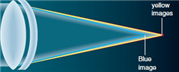 As shown, a(n) ______________ is added to help focus the red and yellow images.
 (Multiple Choice)
4.9/5 (75)
(75) Light travels at speed c . Complete the following equation using only words:
wave speed = _____________ × ________________
(Short Answer)
4.9/5 (85)
(85) Which of the following types of electromagnetic radiation has the highest frequency?
(Multiple Choice)
4.9/5 (72)
(72) A(n) ____________________ is used to measure the brightness and color of stars.
(Short Answer)
4.7/5 (72)
(72) ____ has (have) wavelengths that are shorter than visible light.
I. Gamma rays
II. Ultraviolet light
III. Infrared radiation
IV. X-rays
(Multiple Choice)
4.8/5 (70)
(70) If you focused a store-bought telescope at a tree down the street on a clear day, the tree would be viewed as ______________ and _____________.
(Multiple Choice)
4.9/5 (81)
(81) X-rays easily penetrate Earth's atmosphere and reach the ground from space.
(True/False)
4.9/5 (86)
(86) The colors of the rainbow from shortest to longest wavelength are ______________________.
(Short Answer)
4.8/5 (74)
(74) Reflecting telescopes are no longer popular with astronomers because they are expensive and suffer from chromatic aberration.
(True/False)
4.8/5 (80)
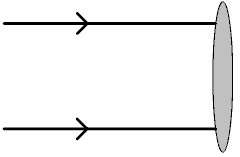
(80) The figure below shows a single lens with two rays of white light incident on it from the left. Sketch the paths of the blue, yellow, and red components of each of these rays to the point where the light from the upper and lower rays would meet.
(Essay)
4.8/5 (71)
(71) An ordinary glass lens forms an image by ____________ of light.
(Multiple Choice)
4.9/5 (83)
(83) 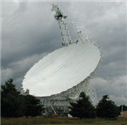 Which kind of telescope is shown?
In which way does a photon of blue light NOT differ from a photon of red light?
(Multiple Choice)
4.7/5 (77)
(77) 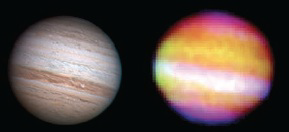 In the above images, which is the representational-color image and for which band of the electromagnetic spectrum?
 (Multiple Choice)
4.9/5 (72)
(72) 
Filters
- Essay(0)
- Multiple Choice(0)
- Short Answer(0)
- True False(0)
- Matching(0)