



 Chat with AI
Exam 15: Income Inequality and Poverty

Exam 1: The Economic Approach210 Questions
Exam 2: Some Tools of the Economist257 Questions
Exam 3: Demand, Supply, and the Market Process585 Questions
Exam 4: Supply and Demand: Applications and Extensions331 Questions
Exam 5: Difficult Cases for the Market, and the Role of Government168 Questions
Exam 6: The Economics of Political Action360 Questions
Exam 7: Consumer Choice and Elasticity223 Questions
Exam 8: Costs and the Supply of Goods231 Questions
Exam 9: Price Takers and the Competitive Process497 Questions
Exam 10: Price-Searcher Markets With Low Entry Barriers216 Questions
Exam 11: Price-Searcher Markets With High Entry Barriers254 Questions
Exam 12: The Supply of and Demand for Productive Resources200 Questions
Exam 13: Earnings, Productivity, and the Job Market109 Questions
Exam 14: Investment, the Capital Market, and the Wealth of Nations129 Questions
Exam 15: Income Inequality and Poverty136 Questions
Exam 16: Applying the Basics: Special Topics in Economics709 Questions
Select questions type


Which of the following benefits is counted as income when the official poverty rate is calculated?
(Multiple Choice)
4.8/5  (92)
(92) (I) High implicit marginal tax rates reduce the incentive of the poor to earn. (II) The Samaritan's dilemma is that transfer programs lower the opportunity cost of activities that lead to poverty.
(Multiple Choice)
4.8/5 (88)
(88) Government programs that take money from high-income people and give it to low-income people typically
(Multiple Choice)
4.9/5 (75)
(75) Which of the following is not counted as income when the official poverty rate is calculated?
(Multiple Choice)
4.8/5 (87)
(87) Figure 15-1 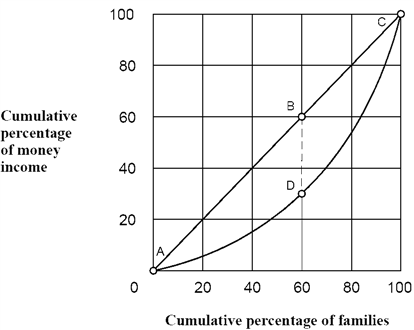 As shown in Figure 15-1, the distance between points B and D means that 60 percent of families earn less of total income than required for perfect equality.
 (Multiple Choice)
4.9/5 (71)
(71) Figure 15-4 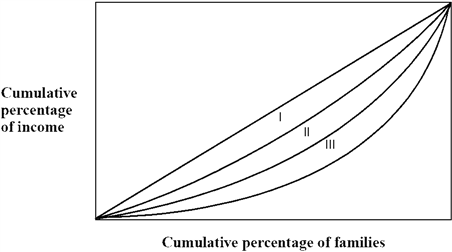 Figure 15-4 shows the Lorenz Curve for three countries, I, II, and III. Which of the following statements is true?
 (Multiple Choice)
4.8/5 (87)
(87) It would be more reasonable to use annual income data as an index of economic inequality if all of the households
(Multiple Choice)
4.8/5 (74)
(74) The idea that transfer benefits to the poor encourage behavior that increases the risk of poverty is known as the
(Multiple Choice)
4.8/5 (72)
(72) Andy observes that the income distribution between the richest and poorest people in the population has remained fixed for decades. He concludes that the rich stay rich and the poor stay poor. Is this a valid conclusion, or has Andy missed something?
(Essay)
4.8/5 (70)
(70) What percent of the families classified as poor in 2009 were headed by an elderly (age 65 and over) person?
(Multiple Choice)
4.8/5 (67)
(67) Which of the following contributed to the increase in income inequality among families in the United States during the 1980s and 1990s?
(Multiple Choice)
4.7/5 (69)
(69) In 2009, the percentage of all U.S. families officially considered to be in poverty was approximately
(Multiple Choice)
5.0/5 (92)
(92) The sharp reduction in marginal tax rates during the 1980s
(Multiple Choice)
4.9/5 (85)
(85) 
Filters
- Essay(0)
- Multiple Choice(0)
- Short Answer(0)
- True False(0)
- Matching(0)