



 Chat with AI
Exam 11: Price-Searcher Markets With High Entry Barriers

Exam 1: The Economic Approach210 Questions
Exam 2: Some Tools of the Economist257 Questions
Exam 3: Demand, Supply, and the Market Process585 Questions
Exam 4: Supply and Demand: Applications and Extensions331 Questions
Exam 5: Difficult Cases for the Market, and the Role of Government168 Questions
Exam 6: The Economics of Political Action360 Questions
Exam 7: Consumer Choice and Elasticity223 Questions
Exam 8: Costs and the Supply of Goods231 Questions
Exam 9: Price Takers and the Competitive Process497 Questions
Exam 10: Price-Searcher Markets With Low Entry Barriers216 Questions
Exam 11: Price-Searcher Markets With High Entry Barriers254 Questions
Exam 12: The Supply of and Demand for Productive Resources200 Questions
Exam 13: Earnings, Productivity, and the Job Market109 Questions
Exam 14: Investment, the Capital Market, and the Wealth of Nations129 Questions
Exam 15: Income Inequality and Poverty136 Questions
Exam 16: Applying the Basics: Special Topics in Economics709 Questions
Select questions type


Economists generally criticize high barriers to market entry because

Free
(Multiple Choice)
4.7/5  (87)
(87) Correct Answer: Verified
A
Use the figure to answer the following question(s).
Figure 11-10
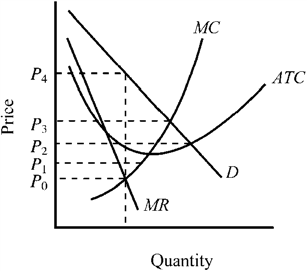 Given the cost and revenue curves illustrated in Figure 11-10, what price will a profit-maximizing monopolist charge?
Free
(Multiple Choice)
4.9/5 (88)
(88) Correct Answer:Verified
VerifiedD
Use the figure to answer the following question(s).
Figure 11-14
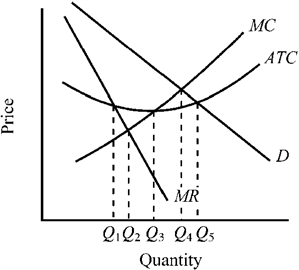 What quantity would the industry depicted in Figure 11-14 produce if member firms were successfully colluding?
Free
(Multiple Choice)
4.8/5 (88)
(88) Correct Answer:Verified
VerifiedB
Assuming that firms maximize profits, how will the price and output policy of an unregulated monopolist compare with ideal market efficiency?
(Multiple Choice)
4.9/5 (82)
(82) Which one of the following factors increases the likelihood that a cartel agreement will lead to higher profit for cartel members?
(Multiple Choice)
4.8/5 (97)
(97) Which one of the following factors reduces the likelihood that a cartel agreement will lead to higher producer profit?
(Multiple Choice)
4.9/5 (78)
(78) A market situation in which the average total costs of production continually decline with increased output until the entire market is supplied is called
(Multiple Choice)
4.8/5 (80)
(80) A market situation where a small number of sellers compose the entire industry is called
(Multiple Choice)
4.9/5 (77)
(77) An oligopolistic firm that is deciding the price to charge, the output to produce, or the quality of product to offer, must consider
(Multiple Choice)
4.9/5 (76)
(76) Which of the following is an obstacle that would reduce the likelihood of effective collusion among oligopolists?
(Multiple Choice)
4.8/5 (73)
(73) Figure 11-18 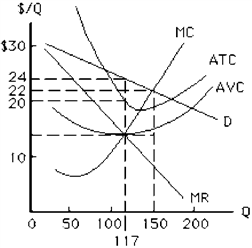 The total revenue for the firm in Figure 11-18, a monopolist that maximizes profit while charging all customers the same price, is
 (Multiple Choice)
4.9/5 (77)
(77) If mutual interdependence among firms is present, each profit-maximizing firm in the market
(Multiple Choice)
4.8/5 (92)
(92) Use the table to answer the following question.
Table 11-6
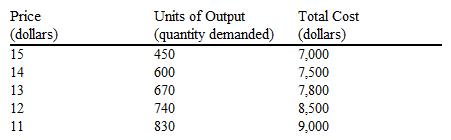 The demand and cost schedules of a monopolist are presented in Table 11-6. What price should a profit-maximizing monopolist charge?
 (Multiple Choice)
4.8/5 (80)
(80) Which of the following is a major shortcoming of government regulation of business monopoly?
(Multiple Choice)
4.8/5 (80)
(80) Which of the following reflects the incentive structure confronted by a typical firm in a cartel?
(Multiple Choice)
4.8/5 (84)
(84) How will the price and output of an unregulated monopolist compare with the ideal levels that might be reached if the market was competitive?
(Multiple Choice)
4.8/5 (81)
(81) The two conflicting tendencies that a firm has in an oligopolistic industry are the incentive to
(Multiple Choice)
4.9/5 (72)
(72) Use the figure to answer the following question(s).
Figure 11-6
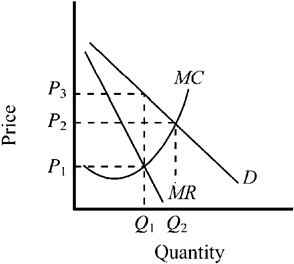 The demand and cost conditions in an industry are as depicted in Figure 11-6. In the viewpoint of economic efficiency, what would the ideal price and output be?
 (Multiple Choice)
4.9/5 (88)
(88) Figure 11-21 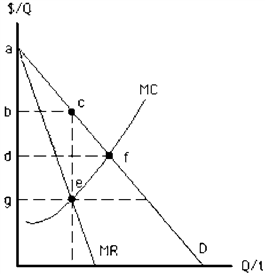 In Figure 11-21, the increase in consumer surplus that occurs when price is set equal to marginal cost rather than at the profit-maximizing level, as it would be in an unregulated monopoly, is shown by area
 (Multiple Choice)
4.7/5 (91)
(91) 
Filters
- Essay(0)
- Multiple Choice(0)
- Short Answer(0)
- True False(0)
- Matching(0)