



 Chat with AI
Exam 11: Price-Searcher Markets With High Entry Barriers

Exam 1: The Economic Approach210 Questions
Exam 2: Some Tools of the Economist257 Questions
Exam 3: Demand, Supply, and the Market Process585 Questions
Exam 4: Supply and Demand: Applications and Extensions331 Questions
Exam 5: Difficult Cases for the Market, and the Role of Government168 Questions
Exam 6: The Economics of Political Action360 Questions
Exam 7: Consumer Choice and Elasticity223 Questions
Exam 8: Costs and the Supply of Goods231 Questions
Exam 9: Price Takers and the Competitive Process497 Questions
Exam 10: Price-Searcher Markets With Low Entry Barriers216 Questions
Exam 11: Price-Searcher Markets With High Entry Barriers254 Questions
Exam 12: The Supply of and Demand for Productive Resources200 Questions
Exam 13: Earnings, Productivity, and the Job Market109 Questions
Exam 14: Investment, the Capital Market, and the Wealth of Nations129 Questions
Exam 15: Income Inequality and Poverty136 Questions
Exam 16: Applying the Basics: Special Topics in Economics709 Questions
Select questions type


Antitrust action restructures a previously monopolized industry into a competitive industry. If economies of scale are unimportant in the industry, the expected result of this movement from monopoly to competition is
(Multiple Choice)
5.0/5  (67)
(67) Oligopolistic agreements on price tend to be unstable because
(Multiple Choice)
5.0/5 (74)
(74) Under which one of the following market structures are firms most likely to enter into a price-fixing agreement designed to maximize their joint profit?
(Multiple Choice)
4.9/5 (77)
(77) (I) Oligopolistic firms have an incentive to collude to increase profits. (II) Oligopolistic firms have an incentive to cheat on collusive agreements to increase profits.
(Multiple Choice)
4.8/5 (84)
(84) Consider the following demand and cost information for a monopoly.
Table 11-1
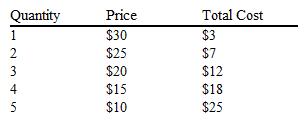 Refer to Table 11-1. To maximize profit, the monopolist sets price at
 (Multiple Choice)
4.8/5 (91)
(91) The figure below illustrates the cost and revenue structure for a monopoly firm.
Figure 11-17
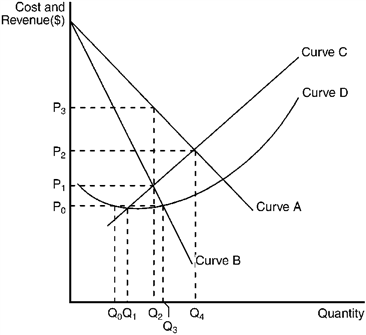 Refer to Figure 11-17. If the monopoly firm wants to maximize its profit, it should operate at a level of output equal to
 (Multiple Choice)
4.9/5 (75)
(75) Regulating natural monopolies according to the "rate of return" criterion is likely to
(Multiple Choice)
4.8/5 (74)
(74) Monopolists are criticized because they are inefficient. What is meant by this statement?
(Multiple Choice)
4.8/5 (83)
(83) Because each oligopolist cares about its own profit rather than the collective profit of all the oligopolists together,
(Multiple Choice)
4.9/5 (83)
(83) In the case where a natural monopoly exists in an industry,
(Multiple Choice)
4.8/5 (85)
(85) In which of the following industries would we expect collusion to be most effective?
(Multiple Choice)
4.8/5 (78)
(78) Use the table to answer the following question.
Table 11-4
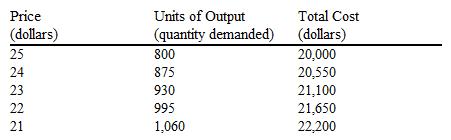 The demand and total cost schedules of a monopolist are presented in Table 11-4. What price should a profit-maximizing monopolist charge?
 (Multiple Choice)
4.7/5 (68)
(68) When a monopolist is maximizing profit, which of the following conditions will always be satisfied?
(Multiple Choice)
4.9/5 (83)
(83) Use the figure to answer the following question(s).
Figure 11-13
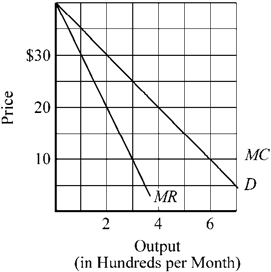 Using Figure 11-13, determine the maximum joint monthly profit of the firms if they operate as a cartel.
 (Multiple Choice)
4.9/5 (91)
(91) Which of the following accurately describes a major difference between a monopolist and firms in competitive price-searcher markets?
(Multiple Choice)
4.9/5 (73)
(73) A monopolist earning short-run economic profit determines that at its present level of output, marginal revenue is $23 and marginal cost is $30. Which of the following should the firm do to increase profit?
(Multiple Choice)
4.9/5 (83)
(83) Figure 11-16 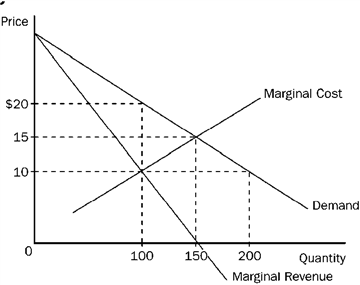 Refer to Figure 11-16. The allocative inefficiency caused by a profit-maximizing monopoly amounts to
 (Multiple Choice)
4.9/5 (79)
(79) 
Filters
- Essay(0)
- Multiple Choice(0)
- Short Answer(0)
- True False(0)
- Matching(0)