



 Chat with AI
Exam 11: Price-Searcher Markets With High Entry Barriers

Exam 1: The Economic Approach210 Questions
Exam 2: Some Tools of the Economist257 Questions
Exam 3: Demand, Supply, and the Market Process585 Questions
Exam 4: Supply and Demand: Applications and Extensions331 Questions
Exam 5: Difficult Cases for the Market, and the Role of Government168 Questions
Exam 6: The Economics of Political Action360 Questions
Exam 7: Consumer Choice and Elasticity223 Questions
Exam 8: Costs and the Supply of Goods231 Questions
Exam 9: Price Takers and the Competitive Process497 Questions
Exam 10: Price-Searcher Markets With Low Entry Barriers216 Questions
Exam 11: Price-Searcher Markets With High Entry Barriers254 Questions
Exam 12: The Supply of and Demand for Productive Resources200 Questions
Exam 13: Earnings, Productivity, and the Job Market109 Questions
Exam 14: Investment, the Capital Market, and the Wealth of Nations129 Questions
Exam 15: Income Inequality and Poverty136 Questions
Exam 16: Applying the Basics: Special Topics in Economics709 Questions
Select questions type


Use the figure to answer the following question(s).
Figure 11-8
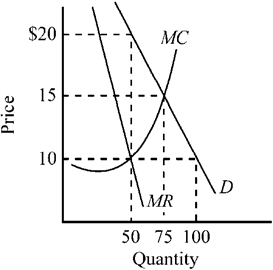 The demand and cost conditions in an industry are as depicted in Figure 11-8. In the viewpoint of economic efficiency, what would the ideal price and output be?
 (Multiple Choice)
4.8/5  (76)
(76) Which of the following best fits the definition of a monopoly?
(Multiple Choice)
4.9/5 (94)
(94) Use the figure to answer the following question(s).
Figure 11-12
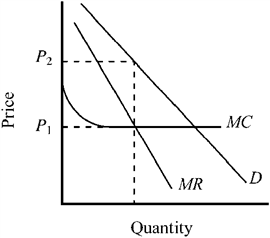 Figure 11-12 indicates the industry cost and demand conditions for a product produced in an oligopolistic industry. The price of this product is most likely to be
 (Multiple Choice)
5.0/5 (79)
(79) The figure below illustrates the cost and revenue structure for a monopoly firm.
Figure 11-17
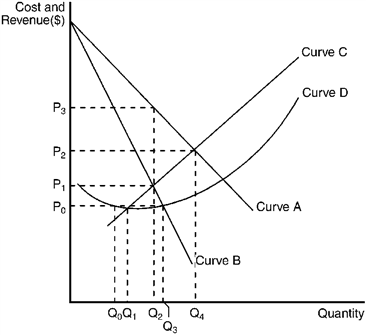 Refer to Figure 11-17. The demand curve for a monopoly firm is depicted by curve
 (Multiple Choice)
4.9/5 (73)
(73) Use the figure to answer the following question(s).
Figure 11-2
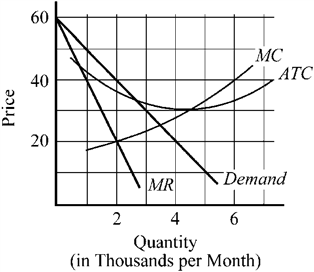 What is the maximum profit per month that the monopolist will be able to earn in Figure 11-2?
 (Multiple Choice)
4.9/5 (84)
(84) Figure 11-20 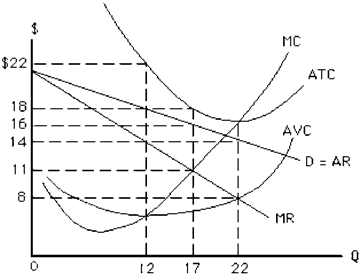 At the profit-maximizing level of production, the monopoly in Figure 11-20 will have total revenue of
 (Multiple Choice)
4.9/5 (78)
(78) As a group, oligopolists would always earn the highest profit if they would
(Multiple Choice)
4.8/5 (88)
(88) Empirical studies show that the after-tax accounting profits of manufacturing corporations are approximately what percent of sales?
(Multiple Choice)
5.0/5 (77)
(77) Which of the following will reduce the likelihood of effective collusion among oligopolistic producers?
(Multiple Choice)
4.8/5 (72)
(72) Which of the following constitutes a barrier limiting the entry of potential competitors into a market?
(Multiple Choice)
4.8/5 (87)
(87) Which of the following will be an obstacle to oligopolistic collusion in a market?
(Multiple Choice)
4.9/5 (63)
(63) The prisoners' dilemma is used to illustrate the basic idea that
(Multiple Choice)
4.9/5 (82)
(82) Use the table to answer the following question.
Table 11-2
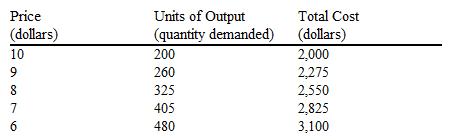 The demand and total cost schedules of a monopolist are presented in Table 11-2. What price should a profit-maximizing monopolist charge?
 (Multiple Choice)
4.8/5 (69)
(69) Use the table to answer the following question.
Table 11-3
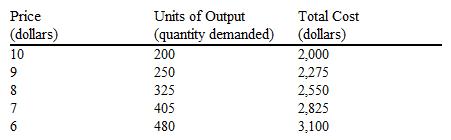 The demand and total cost schedules of a monopolist are presented in Table 11-3. What price should a profit-maximizing monopolist charge?
 (Multiple Choice)
4.8/5 (71)
(71) Figure 11-5 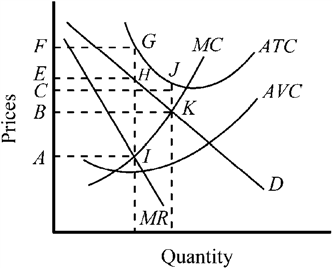 Indicate the maximum profit (or minimum loss) a pure monopolist with the cost and demand conditions depicted in Figure 11-5 would be able to achieve.
 (Multiple Choice)
4.8/5 (81)
(81) New York City limits the number of taxi cabs that can legally operate in the city. The most likely result of this practice is that
(Multiple Choice)
4.7/5 (80)
(80) 
Filters
- Essay(0)
- Multiple Choice(0)
- Short Answer(0)
- True False(0)
- Matching(0)