



 Chat with AI
Exam 11: Price-Searcher Markets With High Entry Barriers

Exam 1: The Economic Approach210 Questions
Exam 2: Some Tools of the Economist257 Questions
Exam 3: Demand, Supply, and the Market Process585 Questions
Exam 4: Supply and Demand: Applications and Extensions331 Questions
Exam 5: Difficult Cases for the Market, and the Role of Government168 Questions
Exam 6: The Economics of Political Action360 Questions
Exam 7: Consumer Choice and Elasticity223 Questions
Exam 8: Costs and the Supply of Goods231 Questions
Exam 9: Price Takers and the Competitive Process497 Questions
Exam 10: Price-Searcher Markets With Low Entry Barriers216 Questions
Exam 11: Price-Searcher Markets With High Entry Barriers254 Questions
Exam 12: The Supply of and Demand for Productive Resources200 Questions
Exam 13: Earnings, Productivity, and the Job Market109 Questions
Exam 14: Investment, the Capital Market, and the Wealth of Nations129 Questions
Exam 15: Income Inequality and Poverty136 Questions
Exam 16: Applying the Basics: Special Topics in Economics709 Questions
Select questions type


Which of the following would increase the likelihood that firms in an industry could successfully collude?
(Multiple Choice)
4.8/5  (86)
(86) Figure 11-19 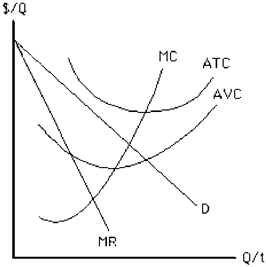 In the short run, the monopolist depicted in Figure 11-19 should
 (Multiple Choice)
4.9/5 (84)
(84) From the viewpoint of allocative efficiency, which of the following is a defect of pure monopoly?
(Multiple Choice)
4.7/5 (84)
(84) A monopolist finds out that if he lowers his price from $10 to $8, sales rise from 100 units to 115 units. Therefore, in this price range,
(Multiple Choice)
4.9/5 (77)
(77) If marginal revenue exceeds marginal cost, a profit-maximizing monopolist will
(Multiple Choice)
4.8/5 (95)
(95) Cartel agreements are difficult to maintain because individual members
(Multiple Choice)
4.9/5 (86)
(86) Which of the following is most likely to contribute to the presence of monopoly in an industry?
(Multiple Choice)
4.9/5 (77)
(77) At the long-run equilibrium level of output, the monopolist's marginal cost will
(Multiple Choice)
4.9/5 (77)
(77) At a given output level, a monopolist earns a profit only if the
(Multiple Choice)
4.9/5 (68)
(68) Assume a monopolist's marginal cost and marginal revenue curves intersect and the demand curve passes above its average total cost curve. The firm will
(Multiple Choice)
4.9/5 (78)
(78) Use the figure to answer the following question(s).
Figure 11-1
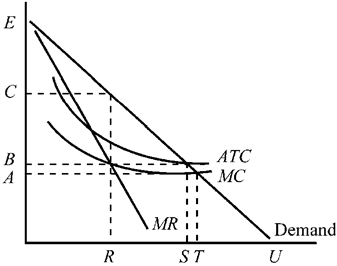 What price and output in Figure 11-1 would an unregulated profit-maximizing monopolist choose?
 (Multiple Choice)
4.7/5 (70)
(70) Use the figure to answer the following question(s).
Figure 11-1
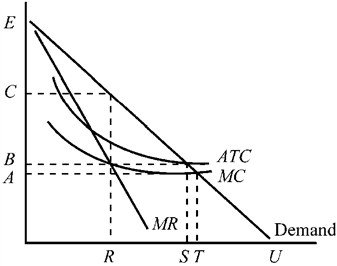 If a regulatory agency were using the "normal return" (zero economic profit) criteria to impose a price on a monopolist with the cost and demand conditions depicted in Figure 11-1, what price would the regulators set, and what output would the monopolist produce?
 (Multiple Choice)
4.9/5 (92)
(92) Use the figure to answer the following question(s).
Figure 11-6
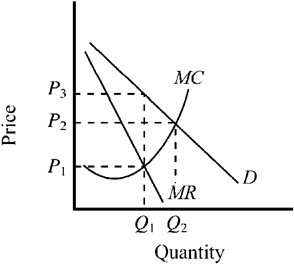 If the output in the industry is produced by a monopolist, at what price will the good sell and what quantity will be produced in Figure 11-6?
 (Multiple Choice)
4.8/5 (79)
(79) Figure 11-16 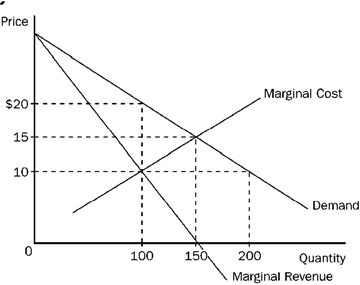 Refer to Figure 11-16. To maximize its profit, a monopolist would choose which of the following outcomes?
 (Multiple Choice)
4.9/5 (95)
(95) Which of the following is a characteristic of an oligopolistic industry?
(Multiple Choice)
4.9/5 (79)
(79) Use the figure to answer the following question(s).
Figure 11-3
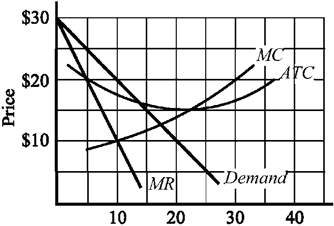 The cost and demand conditions for a monopolist are depicted in Figure 11-3. If the monopolist is maximizing profit, it will charge a price of
 (Multiple Choice)
4.8/5 (68)
(68) Assuming that firms maximize profits, how will the price and output policy of an unregulated monopolist compare with ideal market efficiency?
(Multiple Choice)
4.9/5 (62)
(62) 
Filters
- Essay(0)
- Multiple Choice(0)
- Short Answer(0)
- True False(0)
- Matching(0)