



 Chat with AI
Exam 11: Price-Searcher Markets With High Entry Barriers

Exam 1: The Economic Approach210 Questions
Exam 2: Some Tools of the Economist257 Questions
Exam 3: Demand, Supply, and the Market Process585 Questions
Exam 4: Supply and Demand: Applications and Extensions331 Questions
Exam 5: Difficult Cases for the Market, and the Role of Government168 Questions
Exam 6: The Economics of Political Action360 Questions
Exam 7: Consumer Choice and Elasticity223 Questions
Exam 8: Costs and the Supply of Goods231 Questions
Exam 9: Price Takers and the Competitive Process497 Questions
Exam 10: Price-Searcher Markets With Low Entry Barriers216 Questions
Exam 11: Price-Searcher Markets With High Entry Barriers254 Questions
Exam 12: The Supply of and Demand for Productive Resources200 Questions
Exam 13: Earnings, Productivity, and the Job Market109 Questions
Exam 14: Investment, the Capital Market, and the Wealth of Nations129 Questions
Exam 15: Income Inequality and Poverty136 Questions
Exam 16: Applying the Basics: Special Topics in Economics709 Questions
Select questions type


Which of the following is true for a firm that is a monopolist?
(Multiple Choice)
4.9/5  (85)
(85) A profit-maximizing monopolist will continue expanding output as long as
(Multiple Choice)
4.8/5 (67)
(67) Which of the following firms best fits the definition of a monopoly?
(Multiple Choice)
4.9/5 (89)
(89) A profit-maximizing monopolist that produces in the short run will
(Multiple Choice)
4.9/5 (79)
(79) When significant economies of scale are present in the production process, an industry will tend naturally toward monopoly because
(Multiple Choice)
4.7/5 (72)
(72) The difficulty in analyzing oligopolistic behavior arises from the
(Multiple Choice)
4.9/5 (77)
(77) When natural monopoly is present in an industry, the per-unit costs of production will be
(Multiple Choice)
4.8/5 (71)
(71) The figure below illustrates the cost and revenue structure for a monopoly firm.
Figure 11-17
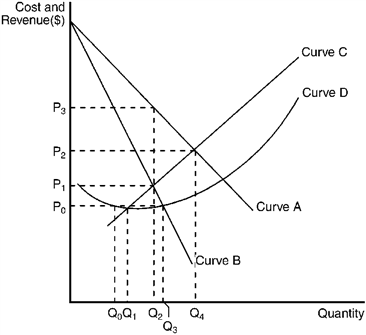 Refer to Figure 11-17. The average total cost curve for a monopoly firm is depicted by curve
 (Multiple Choice)
4.8/5 (88)
(88) Suppose all automobile manufacturers have collusively agreed to sell their cars at a uniform price. If a firm wanted to break this agreement and not be detected, what would be one way to do this?
(Essay)
4.9/5 (78)
(78) The oil industry is dominated by a cartel known as OPEC, and the cocaine industry is dominated by the Columbian cocaine cartel. If these cartels are being successful,
(Multiple Choice)
4.7/5 (67)
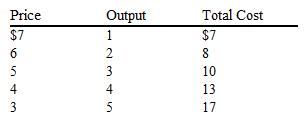
(67) To maximize profit, the monopolist, whose cost and demand conditions are shown below, should charge a price of
(Multiple Choice)
4.9/5 (80)
(80) Which of the following increases the likelihood that a group of sellers can increase profits as the result of collusion?
(Multiple Choice)
4.9/5 (69)
(69) Use the figure to answer the following question(s).
Figure 11-13
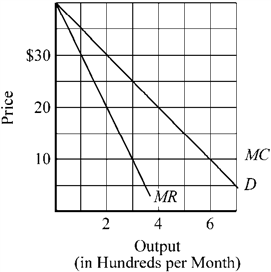 If the firms in the industry depicted in Figure 11-13 compete with each other, what would the industry's price and output be?
 (Multiple Choice)
4.9/5 (77)
(77) Which of the following statements is true for a monopolist?
(Multiple Choice)
4.9/5 (107)
(107) In an oligopolistic market, if rival sellers act independently, each will have a strong incentive to
(Multiple Choice)
4.8/5 (70)
(70) What problem does the government have that makes price regulation less than an ideal solution?
(Multiple Choice)
4.9/5 (58)
(58) 
Filters
- Essay(0)
- Multiple Choice(0)
- Short Answer(0)
- True False(0)
- Matching(0)