



 Chat with AI
Exam 15: Income Inequality and Poverty

Exam 1: The Economic Approach210 Questions
Exam 2: Some Tools of the Economist257 Questions
Exam 3: Demand, Supply, and the Market Process585 Questions
Exam 4: Supply and Demand: Applications and Extensions331 Questions
Exam 5: Difficult Cases for the Market, and the Role of Government168 Questions
Exam 6: The Economics of Political Action360 Questions
Exam 7: Consumer Choice and Elasticity223 Questions
Exam 8: Costs and the Supply of Goods231 Questions
Exam 9: Price Takers and the Competitive Process497 Questions
Exam 10: Price-Searcher Markets With Low Entry Barriers216 Questions
Exam 11: Price-Searcher Markets With High Entry Barriers254 Questions
Exam 12: The Supply of and Demand for Productive Resources200 Questions
Exam 13: Earnings, Productivity, and the Job Market109 Questions
Exam 14: Investment, the Capital Market, and the Wealth of Nations129 Questions
Exam 15: Income Inequality and Poverty136 Questions
Exam 16: Applying the Basics: Special Topics in Economics709 Questions
Select questions type


In 2007, the poorest 20 percent of families in the United States population earned approximately ____ percent of the before-tax total income. (Fill in the blank.)
(Multiple Choice)
4.7/5  (84)
(84) Annual income data would be a better index of economic inequality if
(Multiple Choice)
4.9/5 (85)
(85) If complete equality of income were legislated, which of the following would economics predict?
(Multiple Choice)
4.8/5 (83)
(83) Assume that Peter is a single parent who is in poverty. He receives food stamps and Medicaid. For every $100 that he earns, Peter loses $35 in food stamps and $20 in Medicaid benefits. Also, Peter's income is taxed at a rate of 10%. Then, Peter's total tax rate is
(Multiple Choice)
4.9/5 (84)
(84) If complete equality of income were legislated, which of the following would economics predict?
(Multiple Choice)
4.9/5 (80)
(80) Figure 15-1 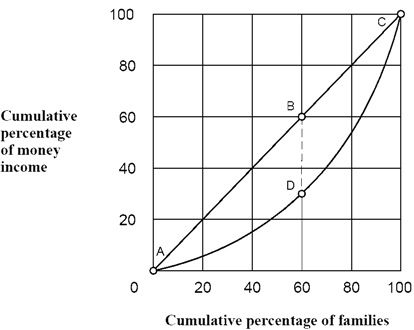 As shown in Figure 15-1, the degree of unequal income distribution is measured by the area between the
 (Multiple Choice)
4.9/5 (87)
(87) The amount of additional earnings that must be paid explicitly in taxes or implicitly in the form of a reduction in income supplements is known as the
(Multiple Choice)
4.8/5 (71)
(71) Evaluate this sentence, "The best way to get rid of poverty is to increase government expenditures on welfare programs."
(Multiple Choice)
4.9/5 (94)
(94) Compared to those with higher incomes, low-income families are more likely to
(Multiple Choice)
4.9/5 (80)
(80) Which of the following best explains why so many persons with incomes below the poverty threshold income level work very little or not at all?
(Multiple Choice)
4.8/5 (74)
(74) Which of the following statements regarding poverty in the United States is correct?
(Multiple Choice)
4.8/5 (82)
(82) Compared to those with lower incomes, families with higher incomes are more likely to be headed by a
(Multiple Choice)
4.9/5 (84)
(84) Which of the following programs is most clearly advantageous to those with lower levels of income?
(Multiple Choice)
4.8/5 (70)
(70) Suppose you had the choice of attending two universities. University A pays all of its professors the same wage and awards the same raises. University B pays each professor according to market wages and productivity. Which university would you rather attend and why?
(Essay)
4.8/5 (74)
(74) This year, Bob earned a total of $9,000. As a result, he received $9,000 less in government transfers. Therefore, his implicit marginal tax rate is
(Multiple Choice)
4.8/5 (84)
(84) Imagine two countries, Lebos and Egap, that have identical average annual incomes. In Lebos, the poorest families one year almost always end up as the richest families the next year and become middle-income families the year after that. In Egap, however, the poor remain poor and rich remain rich. Which of the following is true about the two countries?
(Multiple Choice)
4.9/5 (77)
(77) 
Filters
- Essay(0)
- Multiple Choice(0)
- Short Answer(0)
- True False(0)
- Matching(0)