



 Chat with AI
Exam 15: Income Inequality and Poverty

Exam 1: The Economic Approach210 Questions
Exam 2: Some Tools of the Economist257 Questions
Exam 3: Demand, Supply, and the Market Process585 Questions
Exam 4: Supply and Demand: Applications and Extensions331 Questions
Exam 5: Difficult Cases for the Market, and the Role of Government168 Questions
Exam 6: The Economics of Political Action360 Questions
Exam 7: Consumer Choice and Elasticity223 Questions
Exam 8: Costs and the Supply of Goods231 Questions
Exam 9: Price Takers and the Competitive Process497 Questions
Exam 10: Price-Searcher Markets With Low Entry Barriers216 Questions
Exam 11: Price-Searcher Markets With High Entry Barriers254 Questions
Exam 12: The Supply of and Demand for Productive Resources200 Questions
Exam 13: Earnings, Productivity, and the Job Market109 Questions
Exam 14: Investment, the Capital Market, and the Wealth of Nations129 Questions
Exam 15: Income Inequality and Poverty136 Questions
Exam 16: Applying the Basics: Special Topics in Economics709 Questions
Select questions type


Measuring poverty using an absolute income scale like the poverty line can be misleading because
(Multiple Choice)
4.9/5  (76)
(76) This year, Sue earned $2,000 more than last year. As a result, she received $500 less in government transfers. Therefore, Sue's implicit marginal tax rate is
(Multiple Choice)
4.8/5 (86)
(86) Data suggest that the large increase in government spending on income transfers over the past three decades has been accompanied by
(Multiple Choice)
4.9/5 (84)
(84) Since 1980, income inequality (as measured by the income share of the highest 20 percent of income earners relative to the lowest 20 percent) has
(Multiple Choice)
5.0/5 (84)
(84) Even if lifetime incomes were equal, there still might be substantial inequality in annual income data because
(Multiple Choice)
4.8/5 (73)
(73) The level of money income below which a family is considered poor is called the
(Multiple Choice)
4.9/5 (74)
(74) Data on income inequality in the United States indicate that
(Multiple Choice)
4.9/5 (88)
(88) If a family earned an additional $6,000 and, as a consequence, sustained a reduction of $3,600 in government benefits, the implicit marginal tax rate for this family would be
(Multiple Choice)
4.8/5 (94)
(94) Figure 15-1 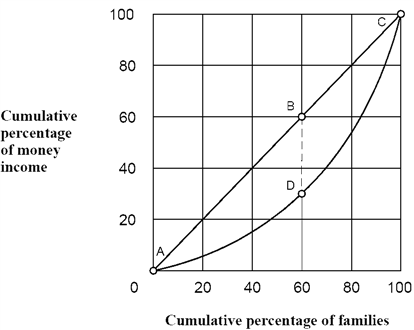 As shown in Figure 15-1, 80 percent of families earned a cumulative share of about ____ of income.
 (Multiple Choice)
4.9/5 (73)
(73) If a family earned an additional $6,000 of income from work and as a result their welfare benefits were reduced by $3,000, the implicit marginal tax rate for this family would be
(Multiple Choice)
4.8/5 (92)
(92) Compared to low-income families, upper-income families are likely to
(Multiple Choice)
4.8/5 (75)
(75) How do the high implicit marginal tax rates that often occur when transfer payments are inversely linked to earnings affect the incentive of poor people to work and earn?
(Multiple Choice)
4.9/5 (68)
(68) Income supplements large enough to significantly increase the economic status of poor people will
(Multiple Choice)
4.8/5 (86)
(86) Data on the distribution of income among individuals and families in the United States indicate that
(Multiple Choice)
4.9/5 (76)
(76) Compared to high-income families, low-income families tend to have
(Multiple Choice)
4.8/5 (78)
(78) The phenomenon that describes how transfer programs, which significantly reduce the adversities of poverty, also reduce the opportunity cost of choices that often lead to poverty is known as
(Multiple Choice)
4.8/5 (82)
(82) 
Filters
- Essay(0)
- Multiple Choice(0)
- Short Answer(0)
- True False(0)
- Matching(0)