



 Chat with AI
Exam 15: Income Inequality and Poverty

Exam 1: The Economic Approach210 Questions
Exam 2: Some Tools of the Economist257 Questions
Exam 3: Demand, Supply, and the Market Process585 Questions
Exam 4: Supply and Demand: Applications and Extensions331 Questions
Exam 5: Difficult Cases for the Market, and the Role of Government168 Questions
Exam 6: The Economics of Political Action360 Questions
Exam 7: Consumer Choice and Elasticity223 Questions
Exam 8: Costs and the Supply of Goods231 Questions
Exam 9: Price Takers and the Competitive Process497 Questions
Exam 10: Price-Searcher Markets With Low Entry Barriers216 Questions
Exam 11: Price-Searcher Markets With High Entry Barriers254 Questions
Exam 12: The Supply of and Demand for Productive Resources200 Questions
Exam 13: Earnings, Productivity, and the Job Market109 Questions
Exam 14: Investment, the Capital Market, and the Wealth of Nations129 Questions
Exam 15: Income Inequality and Poverty136 Questions
Exam 16: Applying the Basics: Special Topics in Economics709 Questions
Select questions type


Some people inherit money and wealth that they did nothing to earn. Why don't we tax inheritance at 100 percent?
(Essay)
4.8/5  (104)
(104) According to the official measure of poverty, in 2009 the poverty rate of families in the United States was
(Multiple Choice)
5.0/5 (83)
(83) If a family earned $10,000 and, as a consequence, sustained a reduction of $4,000 in government benefits, the family's implicit marginal tax rate would be
(Multiple Choice)
4.8/5 (87)
(87) Which of the following groups are overrepresented among those with low incomes?
(Multiple Choice)
4.7/5 (77)
(77) In the United States the degree of individual income mobility (that is, the degree to which people move from higher to lower or lower to higher income groupings) is
(Multiple Choice)
4.7/5 (87)
(87) Which of the following would cause the poverty threshold income level for a given family to increase by 20 percent from one year to another?
(Multiple Choice)
4.9/5 (74)
(74) Figure 15-2 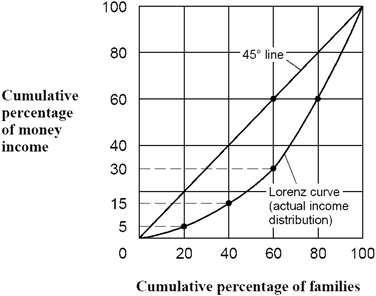 According to the Lorenz curve shown in Figure 15-2, what percentage of total income is earned by the richest 20 percent of families?
 (Multiple Choice)
4.8/5 (92)
(92) Figure 15-3 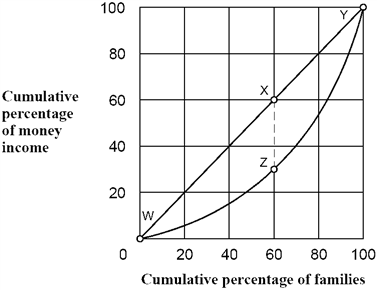 As shown in Figure 15-3, 40 percent of families earned a cumulative share of about ____ percent of income.
 (Multiple Choice)
4.9/5 (83)
(83) When there is only a weak link between work effort and reward
(Multiple Choice)
4.8/5 (89)
(89) Which of the following is true of the tax and transfer programs of the United States?
(Multiple Choice)
4.8/5 (74)
(74) Poor people, who receive income assistance from the government, often do not work because
(Multiple Choice)
4.8/5 (83)
(83) Imagine two cities, Engelgrad and Legreeville, where the rich, middle, and poor income recipients in one city have annual incomes identical to their counterparts' incomes in the other city. In Engelgrad, the poorest families one year almost always end up as the richest families the next year and become middle-income families the year after that. In Legreeville, however, the poor remain poor and the rich remain rich. Which of the following is true about the two cities?
(Multiple Choice)
4.9/5 (77)
(77) Income inequality exists in the United States. Is this necessarily a bad thing? Explain how our assessment of income inequality depends crucially on the source of that inequality.
(Essay)
4.8/5 (76)
(76) Which of the following is false about data on the inequality of annual family (or household) incomes?
(Multiple Choice)
4.9/5 (95)
(95) As the War on Poverty programs were instituted and transfer payments expanded in the last half of the 1960s, what happened to the poverty rate?
(Multiple Choice)
4.7/5 (82)
(82) Why have the earnings of persons with less education (and skill) fallen relative to those with more education (and skill)?
(Multiple Choice)
4.8/5 (86)
(86) Figure 15-3 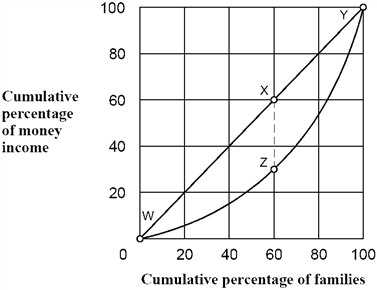 As shown in Figure 15-3, the perfect equality line is drawn between points
 (Multiple Choice)
4.9/5 (81)
(81) 
Filters
- Essay(0)
- Multiple Choice(0)
- Short Answer(0)
- True False(0)
- Matching(0)