



 Chat with AI
Exam 15: Income Inequality and Poverty

Exam 1: The Economic Approach210 Questions
Exam 2: Some Tools of the Economist257 Questions
Exam 3: Demand, Supply, and the Market Process585 Questions
Exam 4: Supply and Demand: Applications and Extensions331 Questions
Exam 5: Difficult Cases for the Market, and the Role of Government168 Questions
Exam 6: The Economics of Political Action360 Questions
Exam 7: Consumer Choice and Elasticity223 Questions
Exam 8: Costs and the Supply of Goods231 Questions
Exam 9: Price Takers and the Competitive Process497 Questions
Exam 10: Price-Searcher Markets With Low Entry Barriers216 Questions
Exam 11: Price-Searcher Markets With High Entry Barriers254 Questions
Exam 12: The Supply of and Demand for Productive Resources200 Questions
Exam 13: Earnings, Productivity, and the Job Market109 Questions
Exam 14: Investment, the Capital Market, and the Wealth of Nations129 Questions
Exam 15: Income Inequality and Poverty136 Questions
Exam 16: Applying the Basics: Special Topics in Economics709 Questions
Select questions type


Which of the following is true concerning the distribution of income?
(Multiple Choice)
4.9/5  (85)
(85) "There is considerable movement up and down the economic ladder. Relative income positions often change over time." This statement is
(Multiple Choice)
5.0/5 (81)
(81) Use the following two statements to answer this question. (I) In a market system, resource prices both provide incentives for the efficient allocation of resources and determine income distribution.
(II) Income and wealth are neither created nor destroyed, they are just fixed-sized pies to be allocated among individuals.
(Multiple Choice)
4.8/5 (67)
(67) When a person who receives welfare benefits earns income, those benefits are reduced as earned income rises. This is referred to as
(Multiple Choice)
4.8/5 (64)
(64) In 2009, the proportion of all poverty-level families headed by a female was
(Multiple Choice)
4.9/5 (80)
(80) Figure 15-3 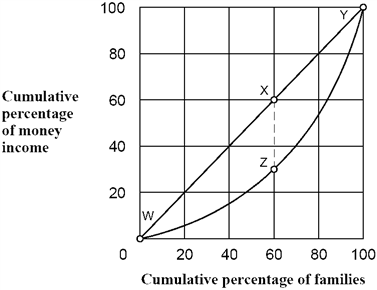 As shown in Figure 15-3, 20 percent of families earned a cumulative share of about ____ percent of income.
 (Multiple Choice)
4.8/5 (75)
(75) Figure 15-4 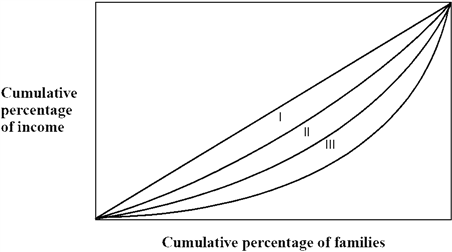 Figure 15-4 shows the Lorenz Curve for three countries, I, II, and III. Of the three countries shown,
 (Multiple Choice)
4.9/5 (102)
(102) Compared to low-income families, a larger proportion of high-income families
(Multiple Choice)
4.8/5 (60)
(60) Which one of the following groups has a below-average incidence of poverty?
(Multiple Choice)
4.9/5 (90)
(90) (I) Positive economics cannot determine how much income inequality should be present in a country. (II) Critics of government action to reduce income inequality argue that modifying the market process of income determination may create perverse incentives and hurt wealth creation.
(Multiple Choice)
4.7/5 (78)
(78) Why don't we divide the economic pie evenly so that each person receives the same income?
(Essay)
4.8/5 (64)
(64) When determining whether an income places a family or individual in poverty, the official poverty rate excludes
(Multiple Choice)
4.8/5 (99)
(99) This year, Tammy earned $15,000 and she paid 15 percent in income and payroll taxes. She qualified for Medicaid and food stamps. For every $100 that she earns, Tammy loses $35 in Medicaid benefits and $15 in food stamps. Tammy faces an effective marginal tax rate of
(Multiple Choice)
4.7/5 (63)
(63) A valid argument against redistributing income to achieve complete equality is that
(Multiple Choice)
4.8/5 (73)
(73) Why not designate the poorest 10 percent of the population as the official measure of poverty?
(Essay)
4.9/5 (83)
(83) Redistribution through the public sector tends to lower economic prosperity because
(Multiple Choice)
4.8/5 (64)
(64) Which of the following is accurate regarding income statistics?
(Multiple Choice)
4.9/5 (73)
(73) Assume that Jill is a single parent who is in poverty. She receives food stamps and Medicaid. For every $100 that she earns, Jill loses $20 of her food stamp benefits and $15 in her Medicaid benefits. Jill's implicit marginal tax rate from these two programs is
(Multiple Choice)
4.7/5 (79)
(79) 
Filters
- Essay(0)
- Multiple Choice(0)
- Short Answer(0)
- True False(0)
- Matching(0)